Mental math skills Extra Challenge Multiplication Worksheets for Ages 4-9
3 filtered results
Difficulty Level
Grade
Age
-
From - To
Subject
Activity
Standards
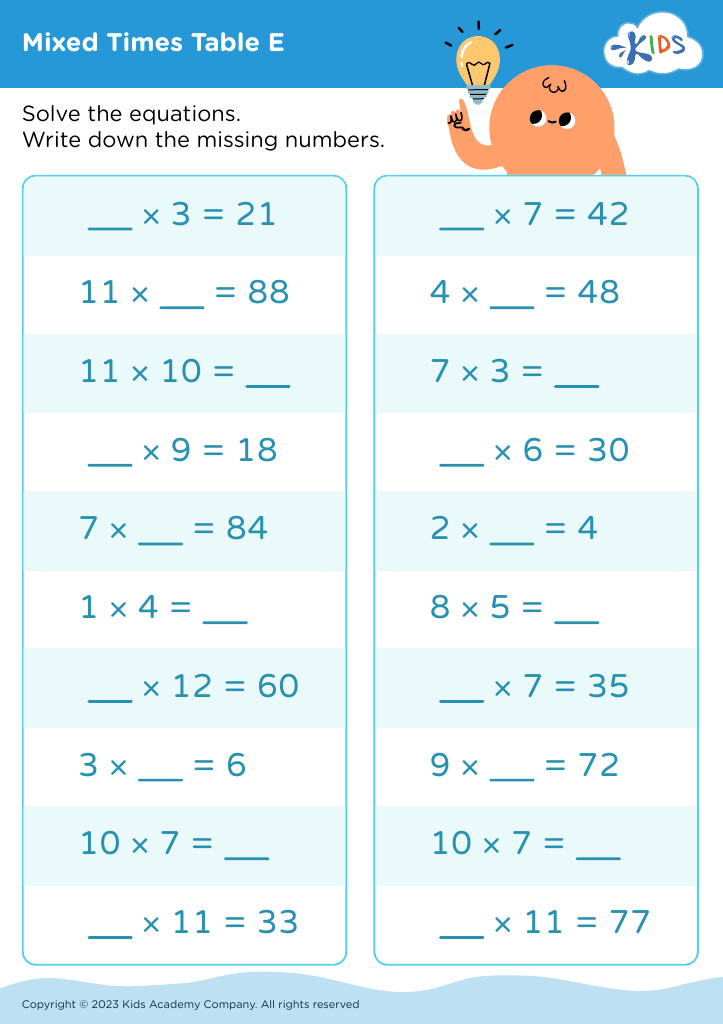
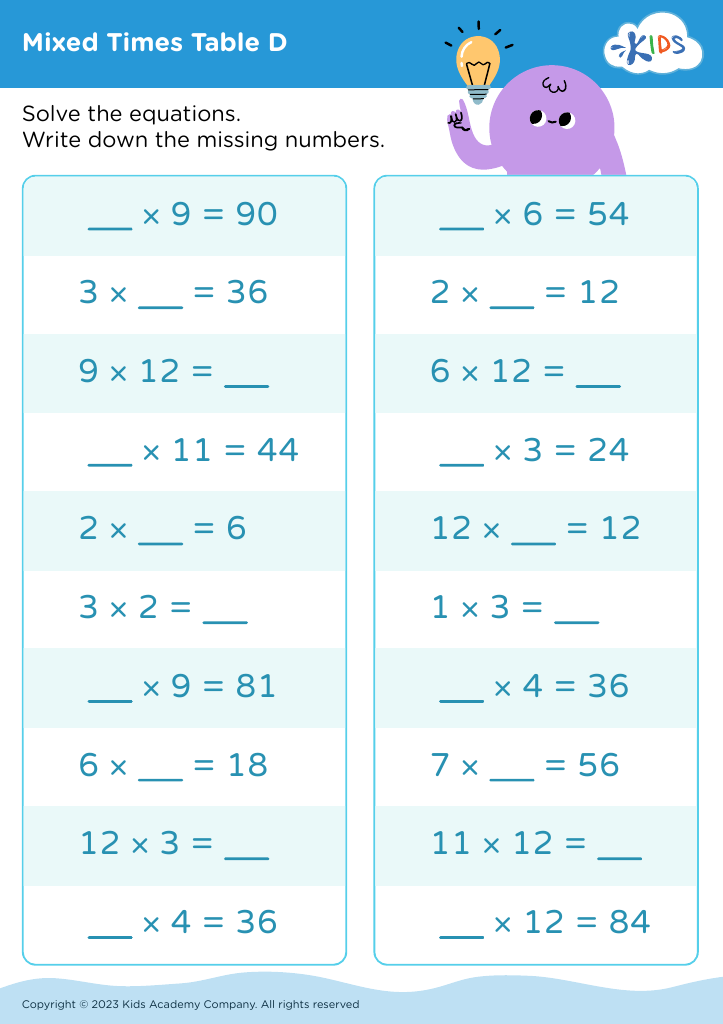
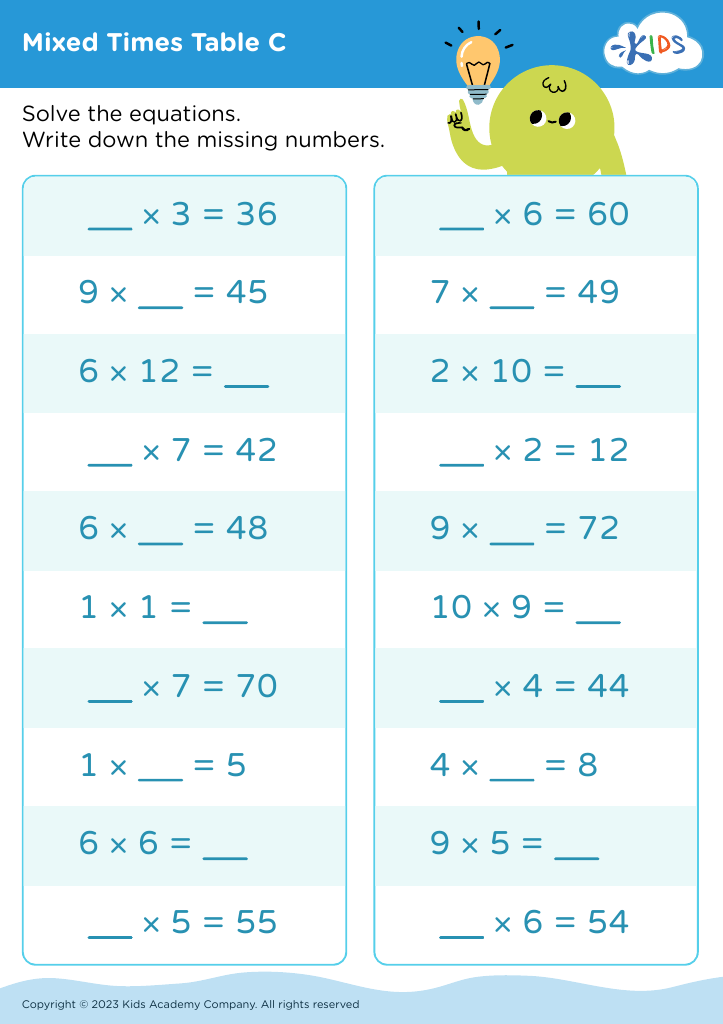
Boost your child’s brainpower with our Mental Math Skills Extra Challenge Multiplication Worksheets for Ages 4-9, available at Kids Academy. Specifically designed to enhance multiplication ability, these worksheets offer fun and engaging challenges that help young learners build critical mental math skills. Each sheet is thoughtfully curated to suit various skill levels, making learning enjoyable and effective. Targeted at early-grade students, this resource ensures a strong foundation in multiplication that will benefit your child across all areas of math. Turn practice into play and watch your little mathematician thrive with Kids Academy's expertly crafted materials.
Favorites
With answer key
Interactive
Join Kids Academy for Free
Who is primarily going to use this learning content?








Mental math skills, especially in multiplication, play a crucial role in a child's overall cognitive development and academic success. For parents and teachers of children aged 4-9, prioritizing these skills is crucial for several reasons:
Firstly, mental math enhances a child's problem-solving abilities and boosts their capacity to handle complex tasks. It encourages them to think critically and develop strategies for arriving at solutions quickly and efficiently.
Secondly, early mastery of multiplication lays the foundation for all subsequent math learning. If children are comfortable with multiplication, they will find it easier to tackle division, fractions, algebra, and other advanced math concepts later on. Strong mental math skills can significantly impact their performance in standardized tests and ongoing school assessments.
Thirdly, mental math improves memory and reinforces cognitive functions. Regular practice of multiplication tables strengthens neural pathways, enhancing overall brain function and paving the way for improvement in non-mathematical areas like reading comprehension and logical reasoning.
Moreover, confidence in mental math cultivates a positive attitude towards mathematics. Children who find math accessible and rewarding are more likely to pursue STEM-related subjects with enthusiasm, opening up a wide array of future career opportunities.
Thus, encouraging mental math skills through multiplication beyond the basics serves as both an immediate academic booster and a long-term cognitive investment.