
Noun identification Extra Challenge Worksheets for Ages 5-6
3 filtered results
Difficulty Level
Grade
Age
-
From - To
Subject
Activity
Standards
Enhance your child's grammar skills with our "Noun Identification Extra Challenge Worksheets" designed especially for kids aged 5-6. These worksheets provide a fun and engaging way to help your young learner identify and understand nouns in everyday language. Each activity is crafted to challenge their developing minds, boosting their confidence and mastery in grammar. With colorful illustrations and kid-friendly exercises, your child will enjoy recognizing people, places, things, and ideas. Prepare them for academic success by making learning enjoyable and effective. Download now and turn noun identification into an exciting adventure!
Favorites
With answer key
Interactive
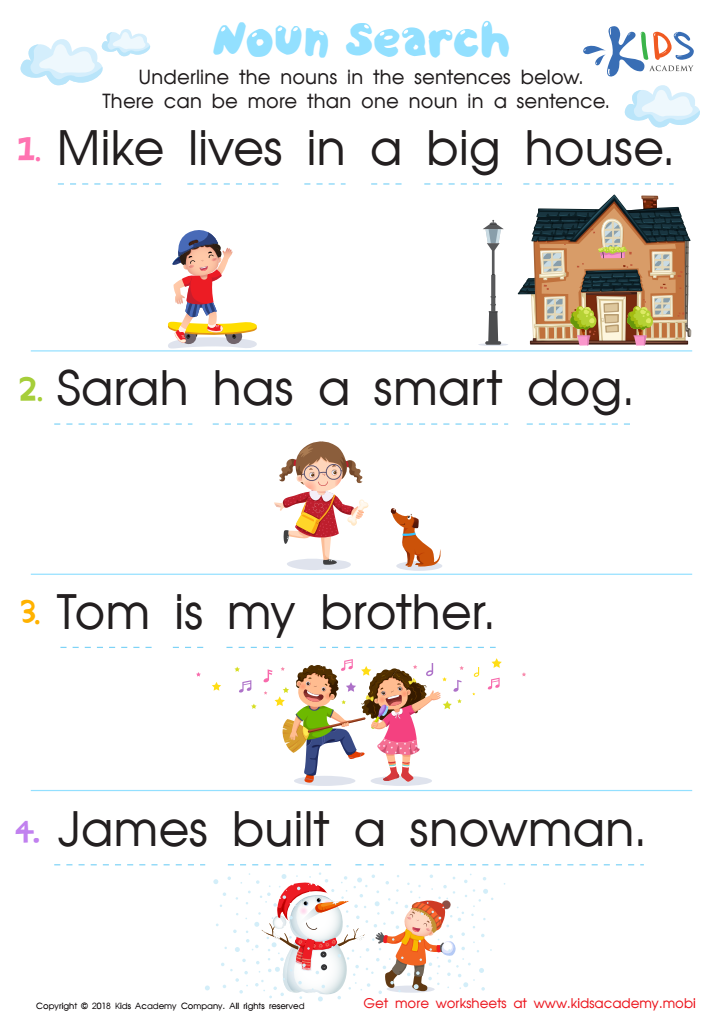
Noun Search Worksheet
To help your children learn the basics of grammar, start with nouns, verbs, adverbs and adjectives. This noun search worksheet will help your child understand the most common part of speech - the noun. Ask them to underline the nouns in each sentence. This is a great way to start learning proper grammar.
 Assign to My Students
Noun Search Worksheet
Worksheet
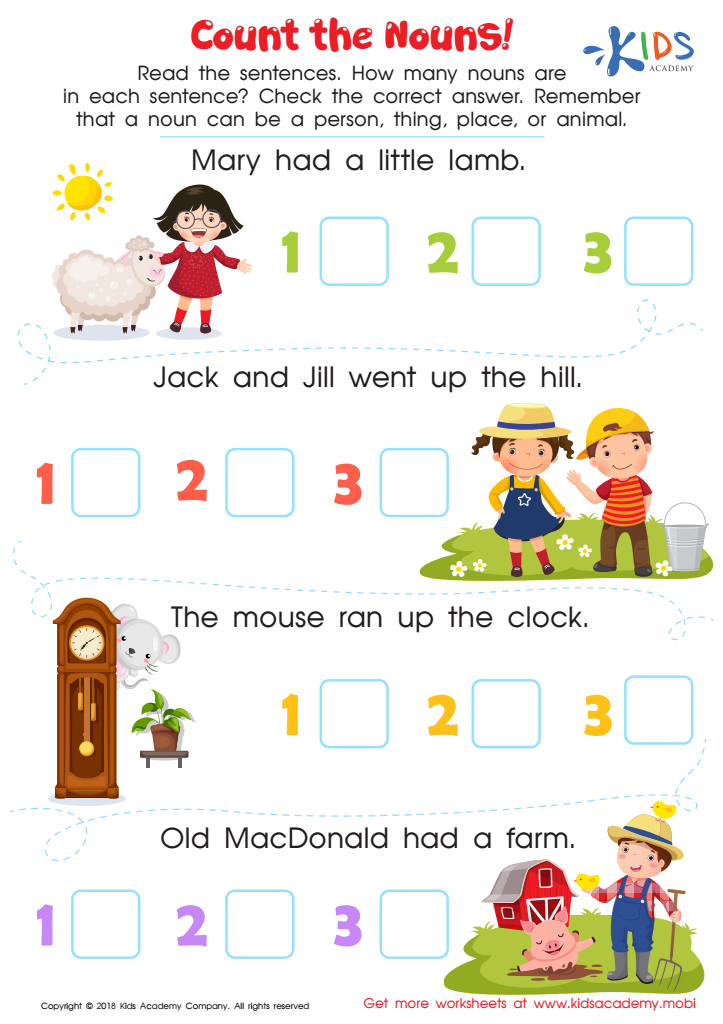
Count the Nouns Worksheet
Read the sentences with your children and ask them to find the nouns. Explain that nouns are names of people, animals, places or things. Point out the boxes with the answers to check.
Count the Nouns Worksheet
Worksheet
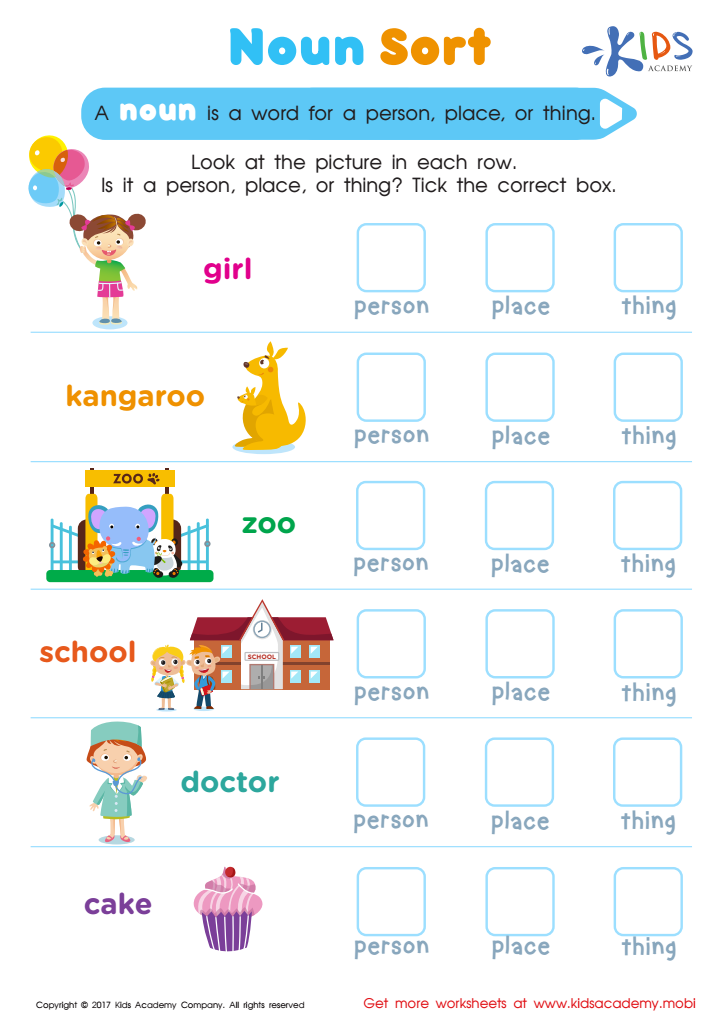
Noun Sort Printable
This printable worksheet helps kids sort nouns into person, place, or thing categories. Perfect for learning the basics of grammar!
This printable worksheet helps kids learn parts of speech by sorting nouns into person, place, or thing categories using familiar images. Perfect for mastering basic grammar!
Noun Sort Printable
Worksheet
Join Kids Academy for Free
Who is primarily going to use this learning content?






Understanding nouns forms an essential part of early language development for children ages 5-6. Engaging them in noun identification exercises serves multiple educational benefits. Firstly, it lays a solid foundation in grammar, enabling children to construct simple sentences and communicate more effectively. This early mastery aids in the development of both oral and written language skills, fostering future academic success.
Furthermore, such challenges stimulate cognitive development by encouraging children to categorize objects, people, and places, enhancing their ability to process and organize information. This cognitive exercise aids in better comprehension and improves their capacity to absorb new vocabulary.
Including parents or teachers in this exercise promotes a more interactive and engaging learning environment. Parents and teachers can provide immediate feedback, making the learning process more dynamic and personalized. They can also integrate noun identification into daily activities, making learning more practical and less abstract for young minds.
Ultimately, nurturing these early grammatical skills not only prepares children for more advanced linguistic challenges but also bolsters their confidence and enthusiasm for learning. The cumulative effect is a more well-rounded educational experience, equipping children with essential tools for both academic success and effective communication in everyday life.








