
Comparing lengths Extra Challenge Measurement Worksheets for Ages 6-8
5 filtered results
Difficulty Level
Grade
Age
-
From - To
Subject
Activity
Standards
Introduce your child to the world of measurement with our "Comparing Lengths Extra Challenge Measurement Worksheets" designed for ages 6-8. These engaging and educational worksheets help young learners practice and enhance their measurement skills by comparing lengths of various objects. The fun-filled tasks encourage children to think critically and improve their mathematical abilities, paving the way for a strong foundation in maths. With colorful graphics and interactive exercises, our worksheets make learning enjoyable and effective. Perfect for mastering standard measurement concepts, these resources will support your child's growth through challenging, yet age-appropriate activities.
Favorites
With answer key
Interactive
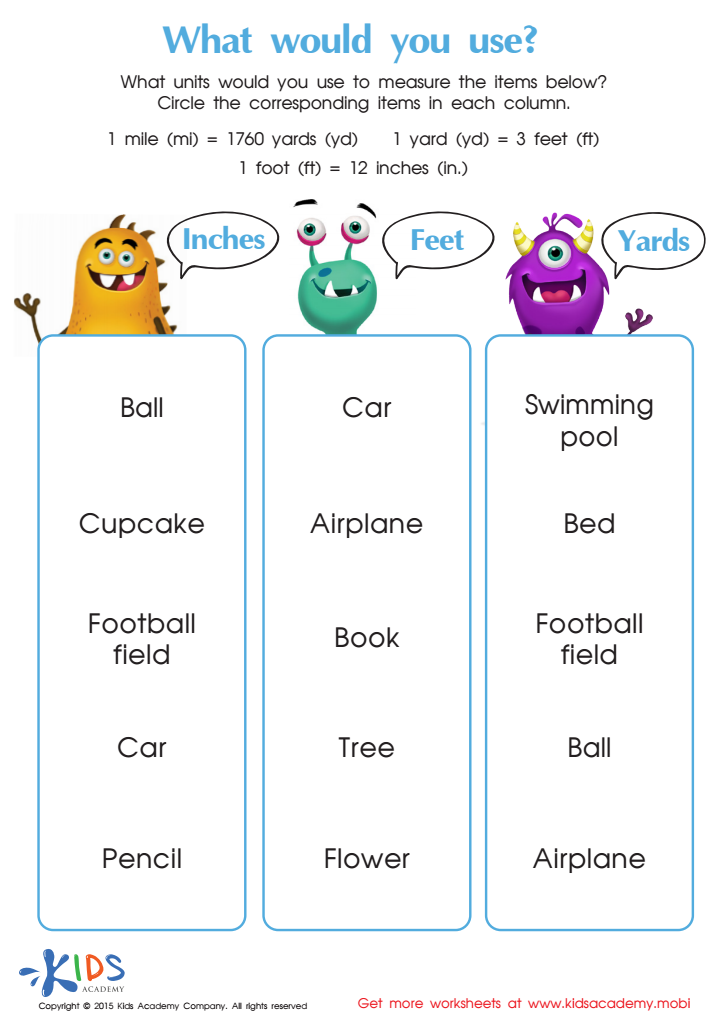
Learning about measuring objects in inches, feet and yards Worksheet
Download, cut and let your preschoolers learn and have fun estimating objects like pencils, airplanes and swimming pools in inches, feet and yards!
 Assign to My Students
Learning about measuring objects in inches, feet and yards Worksheet
Worksheet
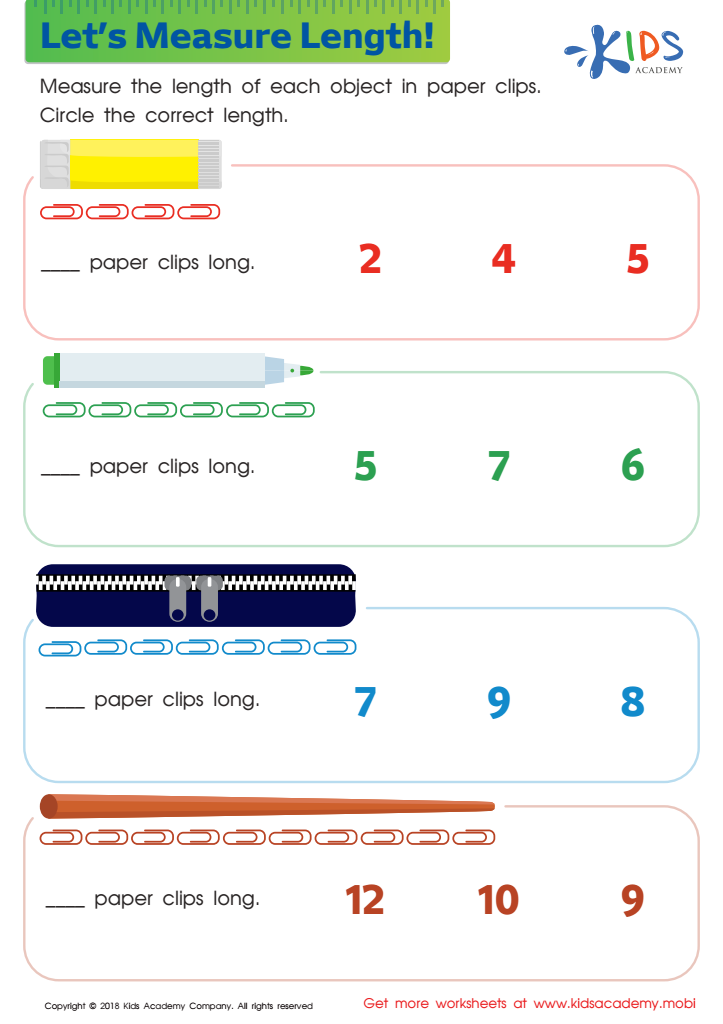
Lets Measure Length Worksheet
It's time to help your child take their measuring skills up a notch! This colorful PDF sheet from Kids Academy introduces kids to measuring with paperclips. Guide them through the page, showing them how to count the clips to measure each image. Then, circle the correct length for each to complete the sheet!
Lets Measure Length Worksheet
Worksheet
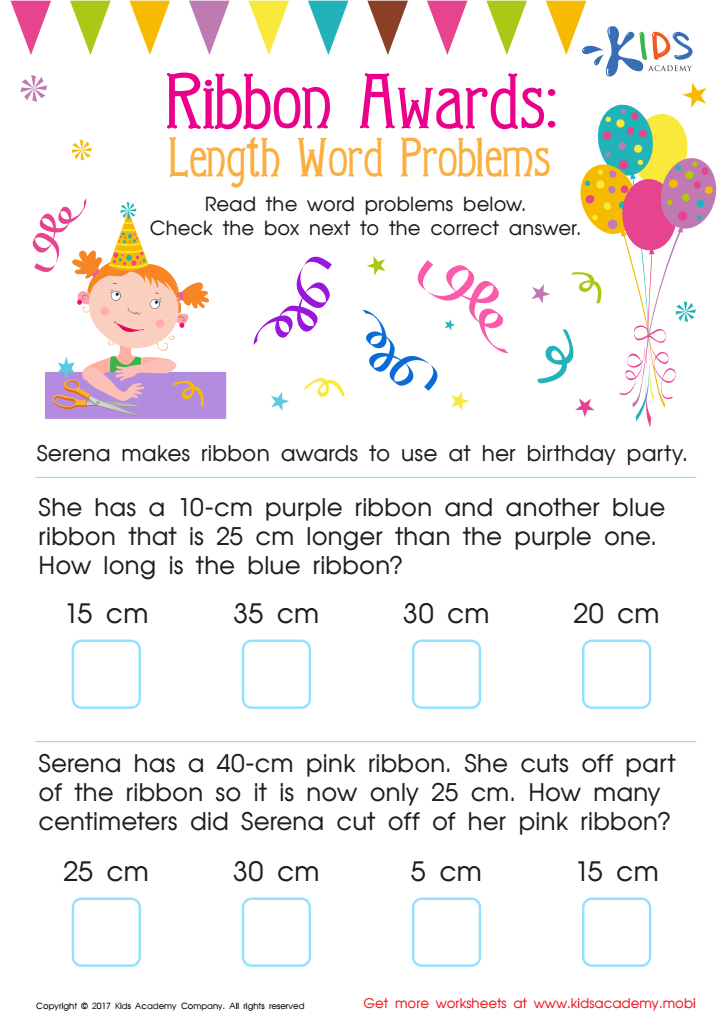
Length Word Problems Worksheet
Word problems help grade 2 students practice measurement using everyday scenarios. This worksheet provides practice in working with centimeters and inches, like measuring ribbon. It's a great way to learn and apply math skills.
Length Word Problems Worksheet
Worksheet
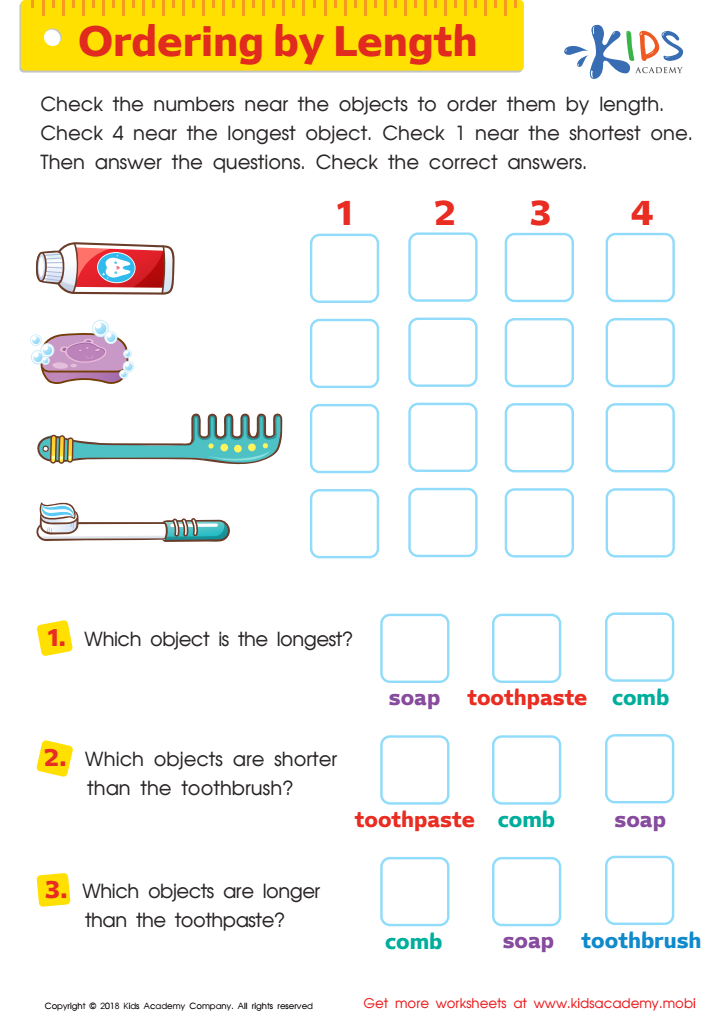
Ordering by Length Worksheet
Compare objects to learn about measurement! Before purchasing a ruler, get kids to understand length by comparing objects and labeling them as longer or shorter than others. Use this printable math worksheet to help children think about measurement. It will show pictures of objects and ask children to categorize them by length.
Ordering by Length Worksheet
Worksheet
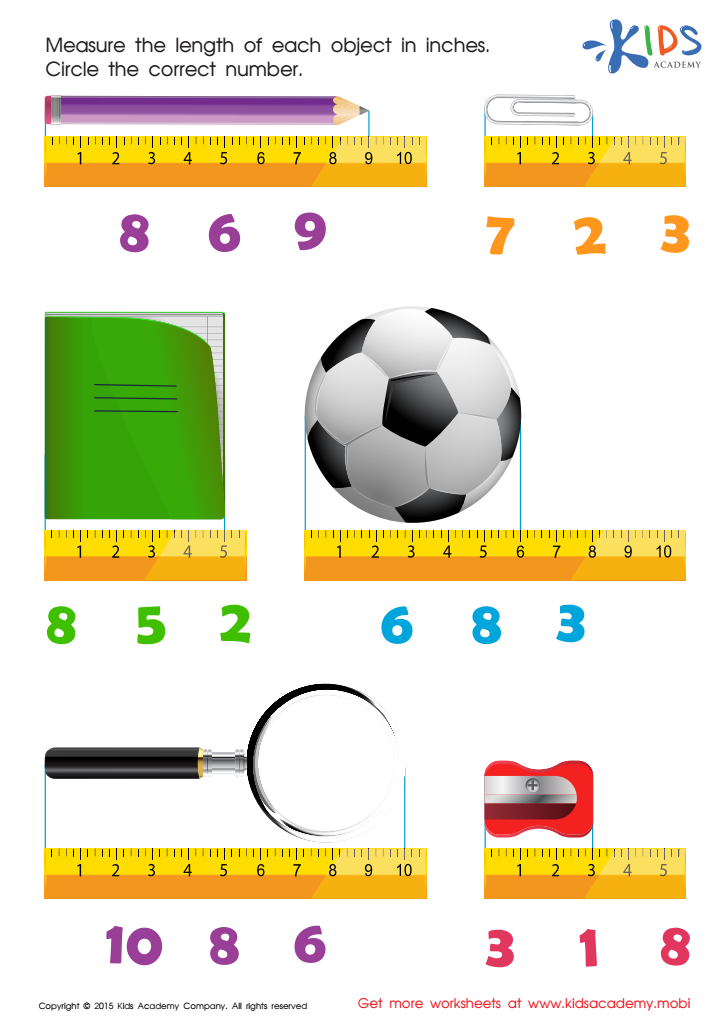
Learning measuring objects in inches Worksheet
Help your little learners gain confidence in using a ruler! Print out our free worksheet, cut out the inch ruler, and let them measure and record objects' width and length. Kids Academy has a variety of math worksheets to make learning math fun! Check out our website for more free printables!
Learning measuring objects in inches Worksheet
Worksheet
Join Kids Academy for Free
Who is primarily going to use this learning content?








Understanding the concept of comparing measurements is a crucial foundational skill for children aged 6-8. At this age, young learners are beginning to grasp the world of numbers, shapes, and sizes, which are fundamental components of mathematical comprehension.
Encouraging children to compare lengths helps in reinforcing their observation and analytical skills. It trains their minds to notice subtle differences and make logical judgments. By engaging with these concepts early on, children develop critical thinking skills that are not only vital in math but in everyday problem-solving scenarios.
Additionally, an early challenge with measurements introduces the idea of quantifying observations in a concrete manner. They begin to understand abstract concepts like greater than, less than, and equal to through practical, hands-on activities. This cognitive development process is extended to other areas, such as science, where measurement is a daily occurrence.
Moreover, fostering these skills boosts their confidence in handling more complex mathematical concepts later on. When children feel confident in their abilities to measure and compare lengths reliably, they are better prepared for higher-level math and its applications in real-world situations.
In simple terms, focusing on comparing lengths for ages 6-8 builds a strong mathematical foundation, promotes confidence, critical thinking, and prepares young learners for future academic endeavors. Parents and teachers play an essential role in creating opportunities that make these learning experiences both engaging and enriching.








