
Recognizing shapes Extra Challenge Worksheets for Ages 6-9
3 filtered results
Difficulty Level
Grade
Age
-
From - To
Subject
Activity
Standards
Elevate your child's learning experience with our "Recognizing Shapes Extra Challenge Worksheets" designed for ages 6-9! These engaging worksheets go beyond basic shape recognition to challenge and enhance critical thinking skills. Kids will enjoy a variety of fun activities, including shape sorting, pattern identification, and creative drawing tasks, all designed to reinforce shape knowledge while sparking their imagination. Perfect for use at home or in the classroom, each worksheet supports foundational geometry skills while fostering a love for learning. Help your child build confidence and mastery in recognizing shapes with these thoughtfully designed extra challenges!
Favorites
With answer key
Interactive
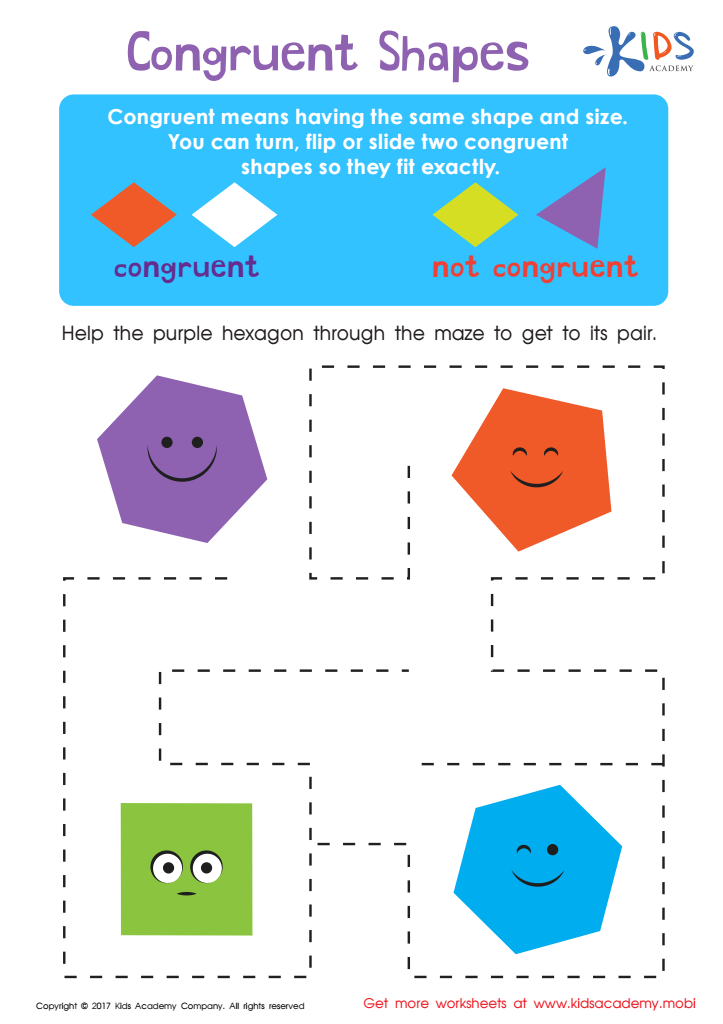
Congruent Shapes Worksheet
Help your child find the twin of the purple hexagon! This congruent shapes worksheet is great for increasing vocabulary while challenging mental rotation skills.
 Assign to My Students
Congruent Shapes Worksheet
Worksheet
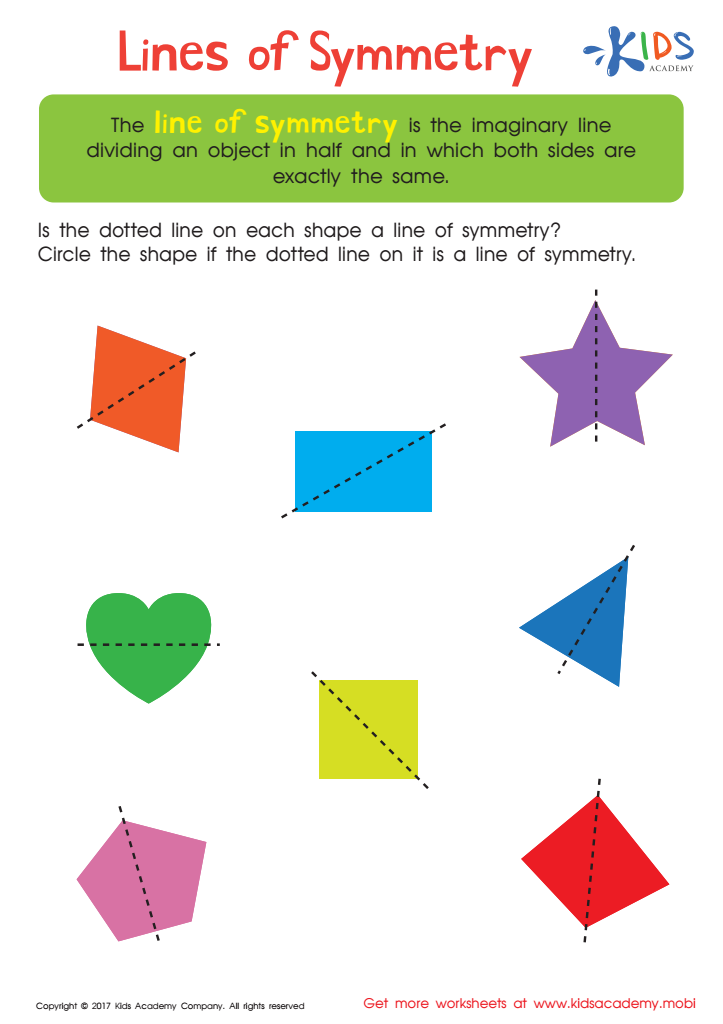
Lines of Symmetry Printable
Symmetry is a key math concept that kids must learn to develop their geometry skills. This fun worksheet helps build this skill, by encouraging kids to recognize symmetrical shapes and find equal parts.
Lines of Symmetry Printable
Worksheet
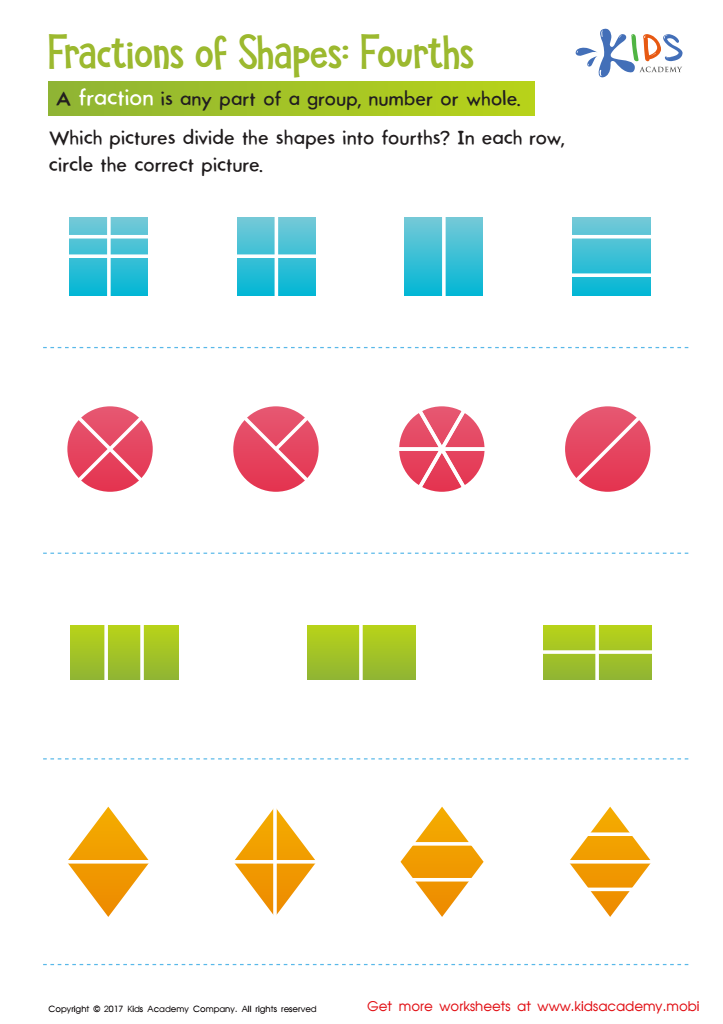
Fractions of Shapes Worksheet
It will also show them how fractions are represented in everyday shapes.
Fractions of Shapes Worksheet
Worksheet
Join Kids Academy for Free
Who is primarily going to use this learning content?








Recognizing shapes is a foundational skill that extends beyond mere geometry for children aged 6-9. Parents and teachers should care about this Extra Challenge because it supports cognitive development in several vital ways. Firstly, awareness of shapes fosters spatial reasoning, an essential skill for mathematics and science applications. Children who understand shapes can visualize and manipulate objects, enhancing their problem-solving abilities.
Moreover, shape recognition lays the groundwork for more complex mathematical concepts, such as symmetry, area, and perimeter. Engaging students in fun challenges improves their critical thinking and encourages them to explore their environment, building observational skills and the ability to classify objects.
Additionally, recognizing shapes aids in language development. As children describe shapes and their properties, they learn to articulate ideas clearly and effectively, fostering communication skills.
Furthermore, activities correlated with shape recognition promote social interaction, cooperation, and teamwork, particularly when done in groups. Encouraging children to share thoughts during challenges can enhance their engagement and enthusiasm for learning. In summary, emphasizing shape recognition during this formative period is crucial for holistic development, laying the groundwork for academic success, social skills, and a love for learning.








