
Understanding adjectives Extra Challenge Worksheets for Ages 6-9
3 filtered results
Difficulty Level
Grade
Age
-
From - To
Subject
Activity
Standards
Unlock the magic of descriptive language with our "Understanding Adjectives Extra Challenge Worksheets" designed for ages 6-9! These engaging worksheets are perfect for young learners who are ready to delve deeper into exploring adjectives. Each activity is crafted to enhance children's vocabulary, grammar skills, and creativity by challenging them to use adjectives in various contexts. Ideal for use at home or in the classroom, these worksheets not only reinforce fundamental language concepts but also stimulate critical thinking and language development. Let your child discover the joy of words and become a more expressive writer today!
Favorites
With answer key
Interactive
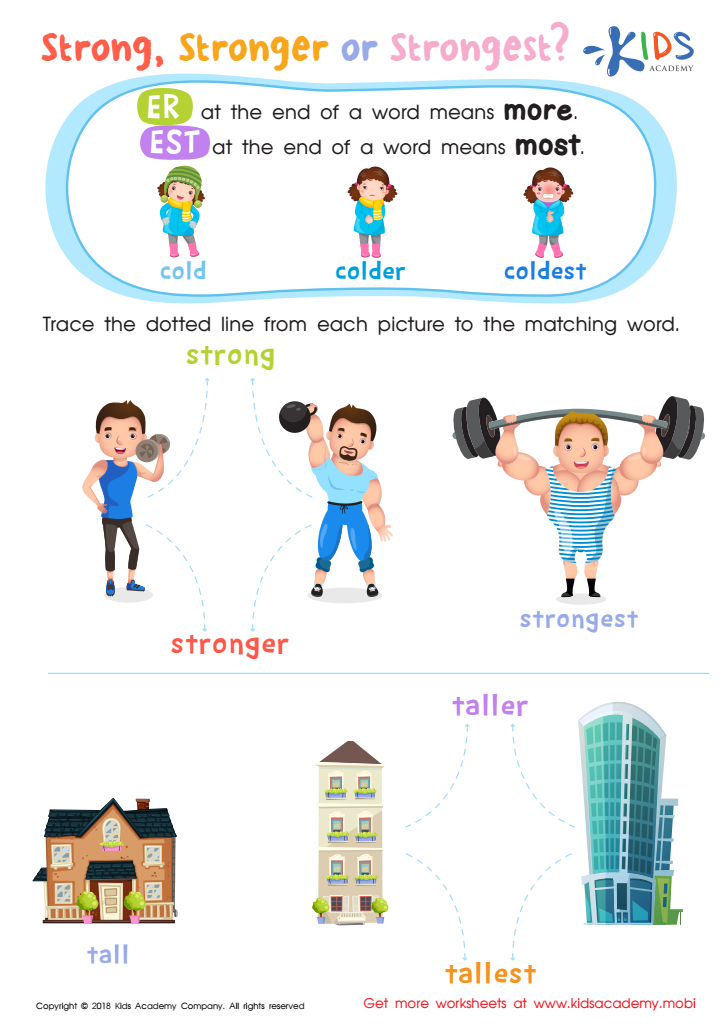
Strong or Stronger? Worksheet
Help your child understand the concept of size gradients with a fun worksheet. Explain to them that adding "-er" to words means "more" and "-est" means "most". Point to the pictures and have your little one trace the dotted line to the corresponding words to learn the concept of highest and lowest.
 Assign to My Students
Strong or Stronger? Worksheet
Worksheet
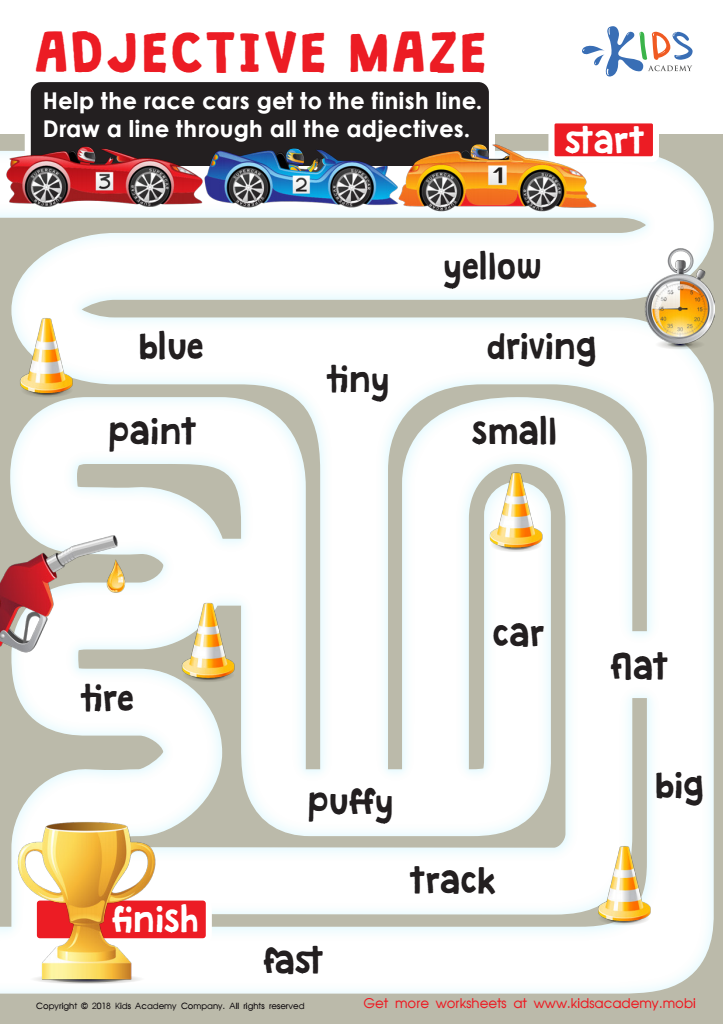
Adjective Maze Worksheet
Race your pencil to the finish line with Kids Academy's exciting maze worksheet! Remind your little racer that adjectives describe nouns - looks, sounds, and more. On your mark, get ready - zoom through the track and circle each adjective you see!
Adjective Maze Worksheet
Worksheet
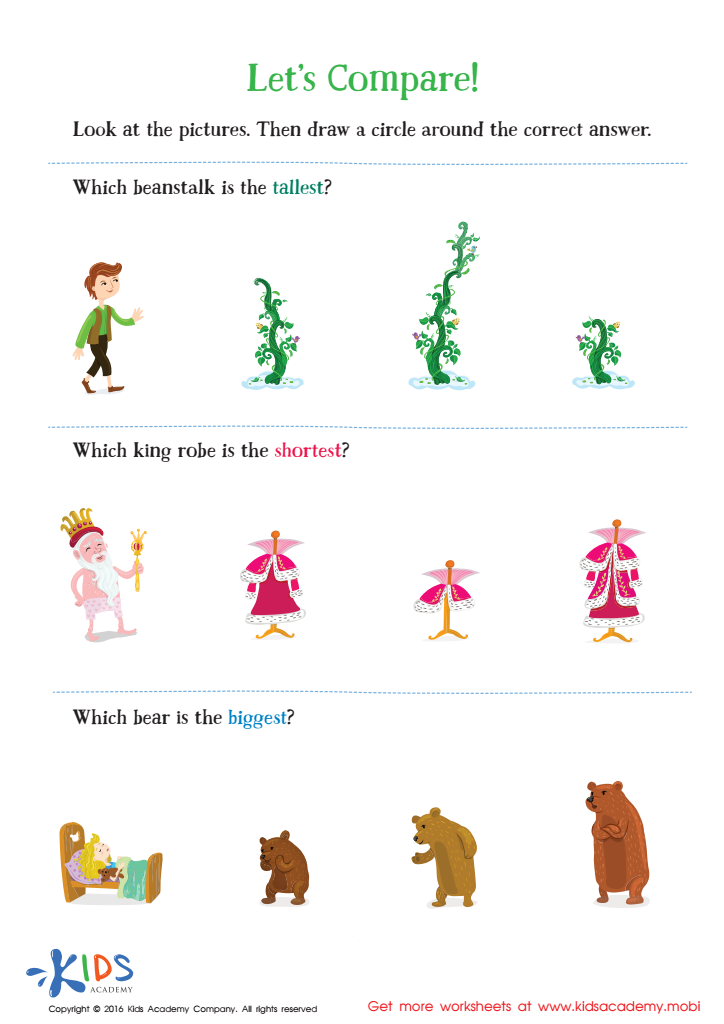
Fairy Tale Worksheet: Let's Compare
Preschoolers need to recognize different sizes of objects. This worksheet combines fun fairy tales with size practice, helping them read, problem solve, and sort through pictures. Your child will love the images and be eager to complete it. Enhance their learning by talking about the tales to build comprehension.
Fairy Tale Worksheet: Let's Compare
Worksheet
Join Kids Academy for Free
Who is primarily going to use this learning content?






Understanding adjectives is crucial for children ages 6-9 because it significantly aids their language development, reading comprehension, and writing skills. At this formative stage, children are expanding their vocabularies and learning how to express themselves more precisely. Adjectives add depth and detail to sentences, allowing children to convey more nuanced meaning and create vivid descriptions. This leads to improved storytelling and more engaging communication.
Moreover, familiarity with adjectives enhances reading comprehension. When children can grasp the descriptive language in texts, they better understand and appreciate the context and emotions conveyed in stories, which fosters a love for reading. It also assists in following instructions more accurately, as many directions include adjectives.
From an educational standpoint, teachers and parents who emphasize the learning of adjectives prepare children for the more complex language structures they will encounter in later grades. It builds a solid grammar foundation that is essential for learning other parts of speech and for language acquisition overall.
Encouraging an "extra challenge" with adjectives means going beyond basic understanding, encouraging creative thinking, and the skill to describe objects, people, and settings with more sophistication. This enriched language experience can foster confidence and enthusiasm for both oral and written communication.








