
Recognizing shapes Extra Challenge Worksheets for Ages 7-8
3 filtered results
Difficulty Level
Grade
Age
-
From - To
Subject
Activity
Standards
Introducing our "Recognizing Shapes Extra Challenge Worksheets" designed specifically for ages 7-8! These worksheets are perfect for young learners looking to boost their skills in shape recognition and classification. Engaging activities offer a variety of challenging tasks that encourage critical thinking and problem-solving, helping children delve deeper into their understanding of geometric forms. With fun illustrations and diverse exercises, these worksheets promote creativity while reinforcing essential math concepts. Ideal for classroom use or at-home learning, our Extra Challenge Worksheets ensure that every child enhances their shape recognition abilities in an enjoyable and stimulating way. Download and inspire today!
Favorites
With answer key
Interactive
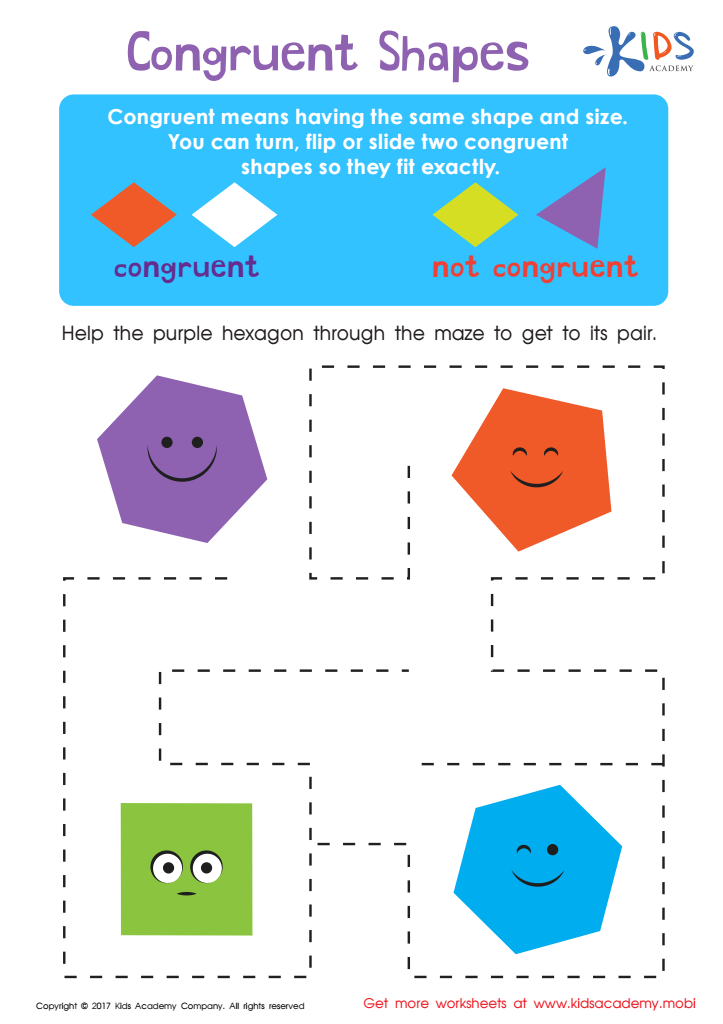
Congruent Shapes Worksheet
Help your child find the twin of the purple hexagon! This congruent shapes worksheet is great for increasing vocabulary while challenging mental rotation skills.
 Assign to My Students
Congruent Shapes Worksheet
Worksheet
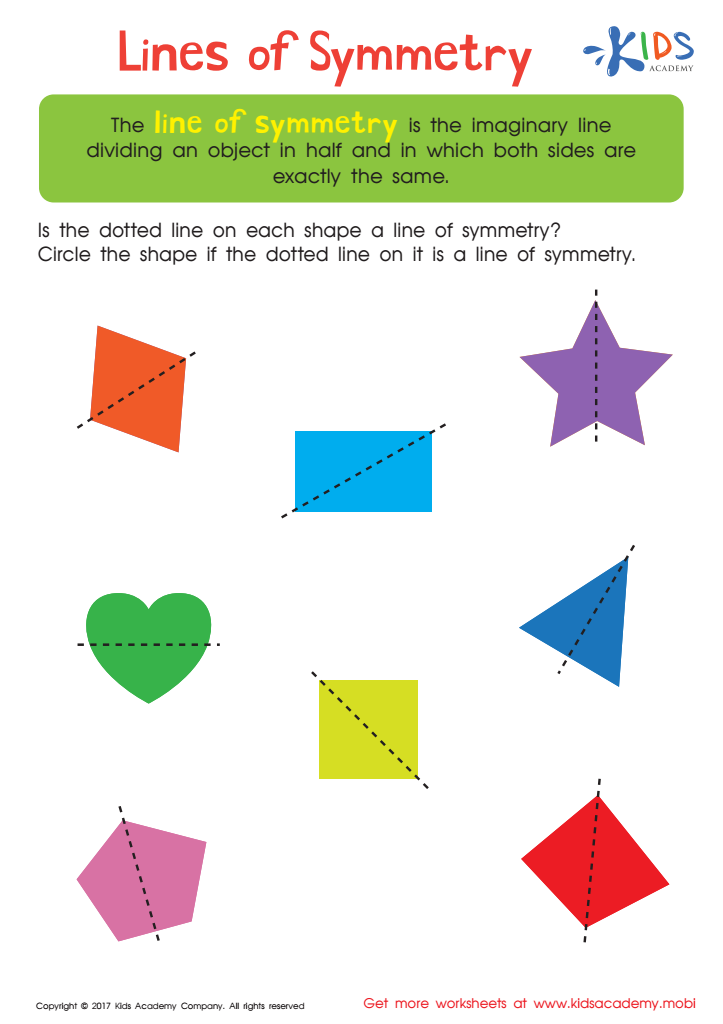
Lines of Symmetry Printable
Symmetry is a key math concept that kids must learn to develop their geometry skills. This fun worksheet helps build this skill, by encouraging kids to recognize symmetrical shapes and find equal parts.
Lines of Symmetry Printable
Worksheet
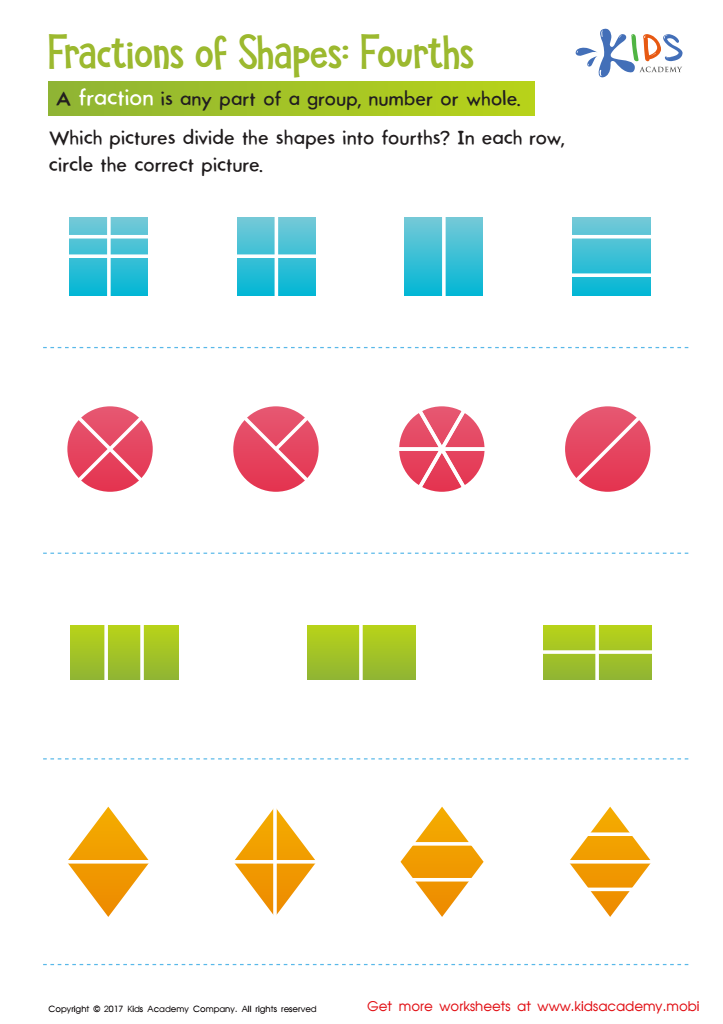
Fractions of Shapes Worksheet
It will also show them how fractions are represented in everyday shapes.
Fractions of Shapes Worksheet
Worksheet
Join Kids Academy for Free
Who is primarily going to use this learning content?








Recognizing shapes is a fundamental skill that contributes significantly to a child’s overall cognitive development, particularly for ages 7-8. At this stage, children are not only improving their geometric recognition but also enhancing critical thinking, spatial awareness, and problem-solving skills. Engaging in extra shape recognition challenges promotes a deeper understanding of properties, relationships, and dimensions, essential components in subjects like mathematics, science, and engineering.
For parents and teachers, encouraging these skills means providing children with opportunities to apply concepts in practical scenarios. The engagement with diverse shapes offers a fun way to integrate learning with everyday experiences, helping reinforce the significance of geometry in the world around them.
Beyond the academic benefits, shape recognition cultivates creativity and facilitates better organizational and planning abilities. It equips children with skills useful in artistic endeavors and various hands-on activities. Additionally, encouraging mastery in this area boosts a child's confidence, thus fostering a positive attitude towards learning. Overall, nurturing shape recognition not only lays a solid mathematical foundation but also enhances a child’s curiosity and imagination—qualities vital for lifelong learning and personal growth. Therefore, involving children in shape recognition challenges is a valuable investment in their future educational journeys.








