Mental math skills Extra Challenge Multiplication Worksheets for Ages 7-8
3 filtered results
Difficulty Level
Grade
Age
-
From - To
Subject
Activity
Standards
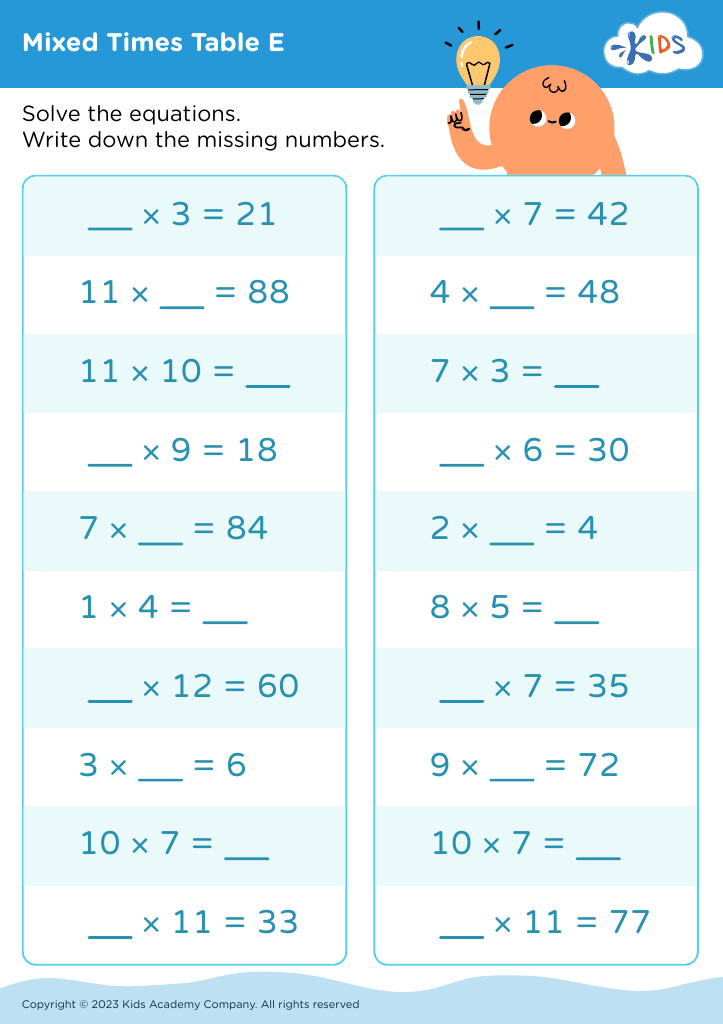
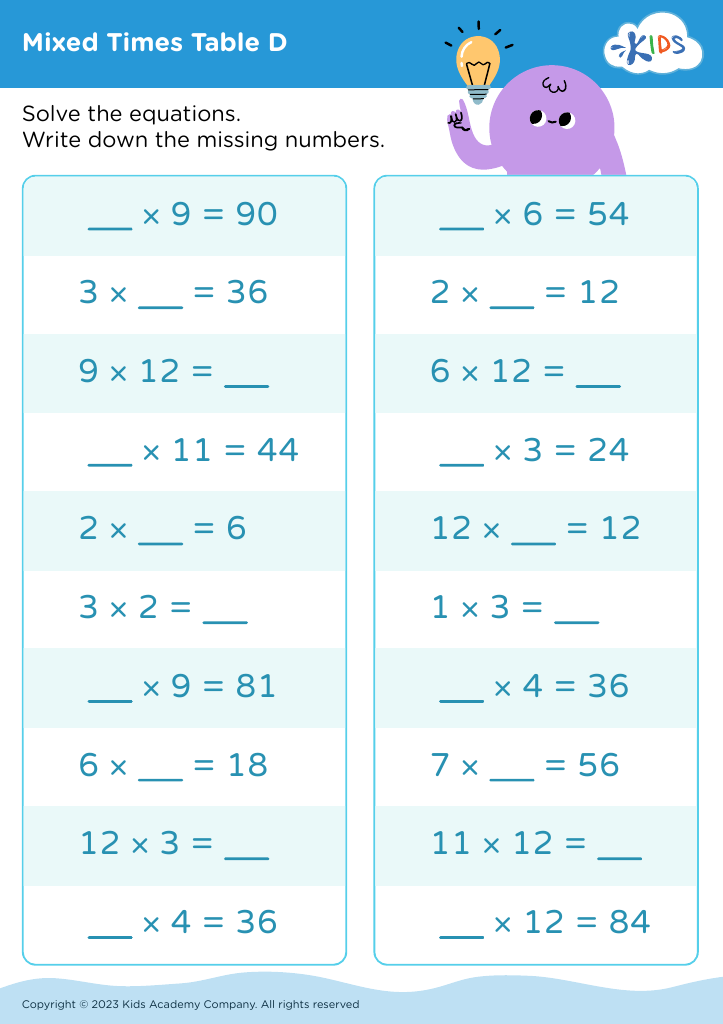
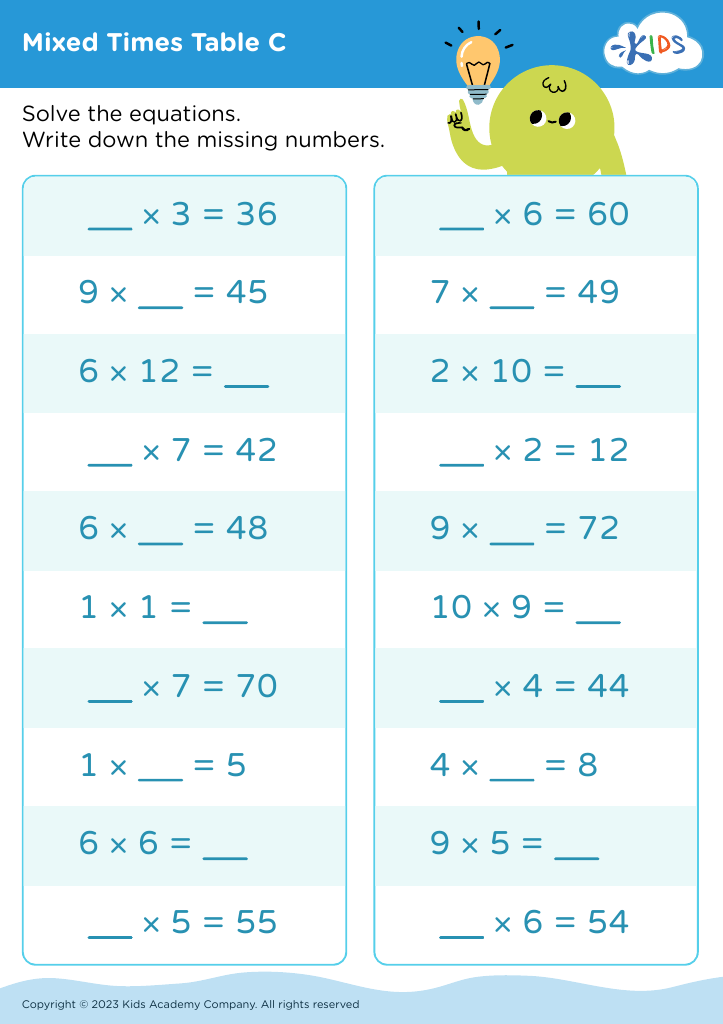
Enhance your child's math proficiency with our "Mental Math Skills Extra Challenge Multiplication Worksheets" designed specifically for ages 7-8. These engaging worksheets provide a fun and stimulating way to practice multiplication, improving both speed and accuracy. Tailored to challenge young minds, the exercises encourage critical thinking and problem-solving, reinforcing classroom learning. With a variety of problems, students can progressively build their mental math skills, boosting confidence in their mathematical abilities. Ideal for extra practice at home or in the classroom, these worksheets are perfect for eager learners ready to take their skills to the next level.
Favorites
With answer key
Interactive
Join Kids Academy for Free
Who is primarily going to use this learning content?








Developing mental math skills, especially through exercises like multiplication challenges, at ages 7-8 offers significant educational and cognitive benefits. At this pivotal stage, children's brains are highly receptive to learning new concepts and forming crucial neural connections. Strengthening mental math ability not only enhances computational fluency but also boosts problem-solving capabilities. It helps children perform calculations more quickly and accurately, thereby increasing their confidence in dealing with math both in and out of the classroom.
Moreover, mental math challenges encourage children to rely on numerical understanding rather than rote procedures. This deeper comprehension helps in recognizing mathematical patterns and improves overall number sense. Teachers and parents should support these skills, as proficient mental math forms a strong foundation for advanced math topics, ensuring future academic success.
Mental math also promotes cognitive skills like memory, concentration, and logical thinking. When children engage in such challenges, they learn to process information efficiently, improving general academic performance. Enjoyable and stimulating multiplication activities can, thus, turn math learning into an enjoyable and fulfilling exercise. By nurturing these skills early, parents and teachers can contribute significantly to children's long-term intellectual development and positive attitudes towards math.