Fraction visualization Extra Challenge Fractions of Shapes Worksheets for 7-Year-Olds
3 filtered results
Difficulty Level
Grade
Age
-
From - To
Subject
Activity
Standards
Explore our engaging "Fraction Visualization Extra Challenge Fractions of Shapes Worksheets" designed specifically for 7-year-olds! These worksheets provide an exciting opportunity for young learners to deepen their understanding of fractions through visual aids and interactive activities. By coloring, dividing, and recognizing various shapes, children will enhance their fraction skills while gaining confidence in math. Perfect for at-home practice or classroom enrichment, our resources ensure that learning is both fun and educational. Challenge your child with these visually stimulating worksheets that promote critical thinking and reinforce essential mathematical concepts. Start their fraction journey today for a brighter mathematical future!
Favorites
With answer key
Interactive
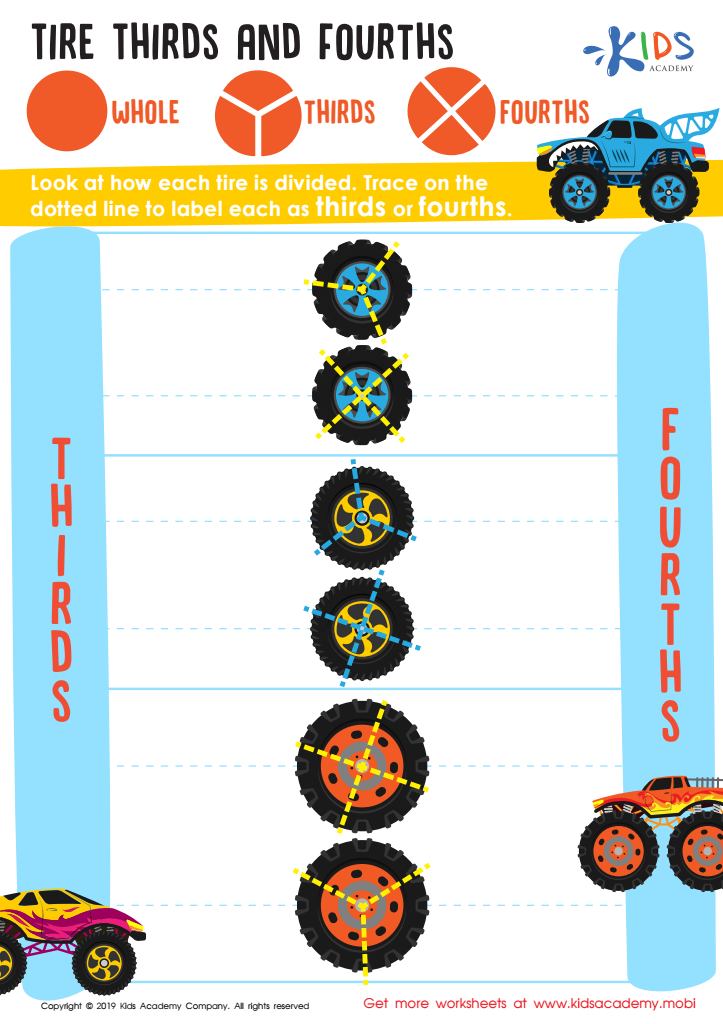
Tire Thirds and Fourths Worksheet
Learning geometry is key in your child's education. Have them identify and name shapes cut into 2, 3 and 4 parts. Test their knowledge with this worksheet - trace the dotted line to label each as third or fourth. Encourage them to keep learning!
 Assign to My Students
Tire Thirds and Fourths Worksheet
Worksheet
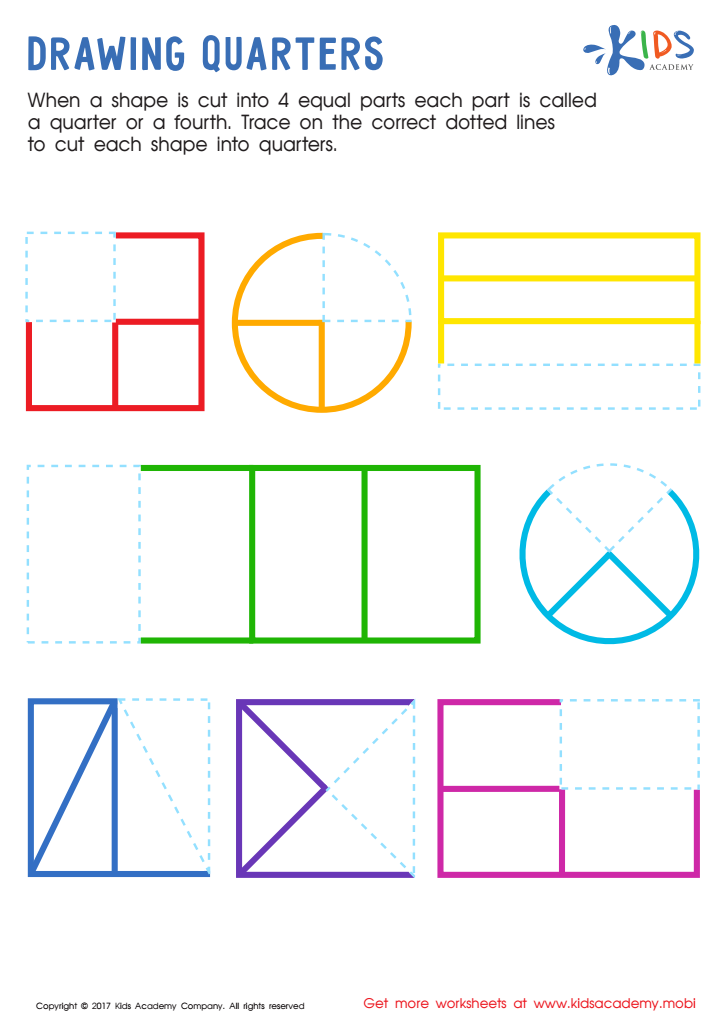
Drawing Quarters Worksheet
Help your kids divide shapes into quarters! Have them trace dotted lines to cut each shape into 4 equal parts. Each of the 4 parts is called a quarter or a fourth. This worksheet will help kids learn more about dividing shapes into four equal parts.
Drawing Quarters Worksheet
Worksheet
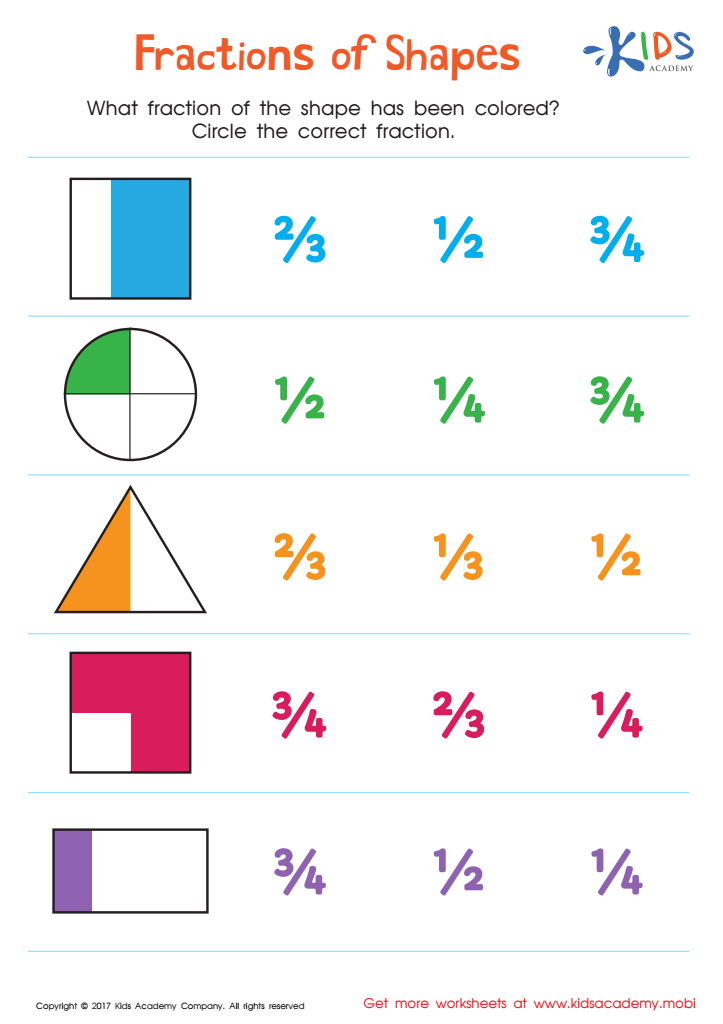
Fractions of Shapes: Math Concept Worksheet
Fractions can be tricky, but with pictures to illustrate them, they become much easier to understand. Our fractions of shapes worksheet is a great way to help children visualize fractions and gain a better understanding of them.
Fractions of Shapes: Math Concept Worksheet
Worksheet
Join Kids Academy for Free
Who is primarily going to use this learning content?








Parents and teachers should care about fraction visualization, especially with resources like "Extra Challenge Fractions of Shapes," for 7-year-olds because it lays a critical foundation for mathematical understanding. At this age, children begin to grasp the concept of part-whole relationships, an essential concept that extends beyond fractions into advanced math and everyday life.
Fraction visualization through shapes allows young learners to concretely see how parts can form a whole, promoting a deeper understanding that goes beyond mere memorization. Utilizing visual aids helps to cater to different learning styles, making math more accessible and enjoyable. For example, by dividing shapes into halves, quarters, or thirds, children can physically manipulate and recognize fractions, enhancing their spatial reasoning skills.
Moreover, mastering fractions at a young age fosters confidence, empowering students to tackle more complex mathematical concepts later. Understanding fractions also has implications in real-world contexts, such as cooking, dividing items, or understanding time. When parents and teachers actively engage in and support fractional learning, they encourage critical thinking and problem-solving skills that will serve children well throughout their educational journey. Encouraging visualization strategies helps establish a strong foundation, making future mathematical learning more intuitive and rewarding.