
Recognizing shapes Extra Challenge Worksheets for 8-Year-Olds
3 filtered results
Difficulty Level
Grade
Age
-
From - To
Subject
Activity
Standards
Boost your child's geometric skills with our "Recognizing Shapes Extra Challenge Worksheets" for 8-year-olds. These engaging and educational worksheets are designed to enhance shape recognition and spatial awareness through advanced and delightful exercises. Perfect for young learners seeking to deepen their understanding of geometry, our worksheets cover a variety of shapes and challenge students with puzzles, matching activities, and creative tasks. Ideal for classroom use or at-home practice, these printables offer a stimulating way to build critical thinking and problem-solving skills. Empower your 8-year-old to become a shape-savvy superstar with our expertly crafted challenge worksheets.
Favorites
With answer key
Interactive
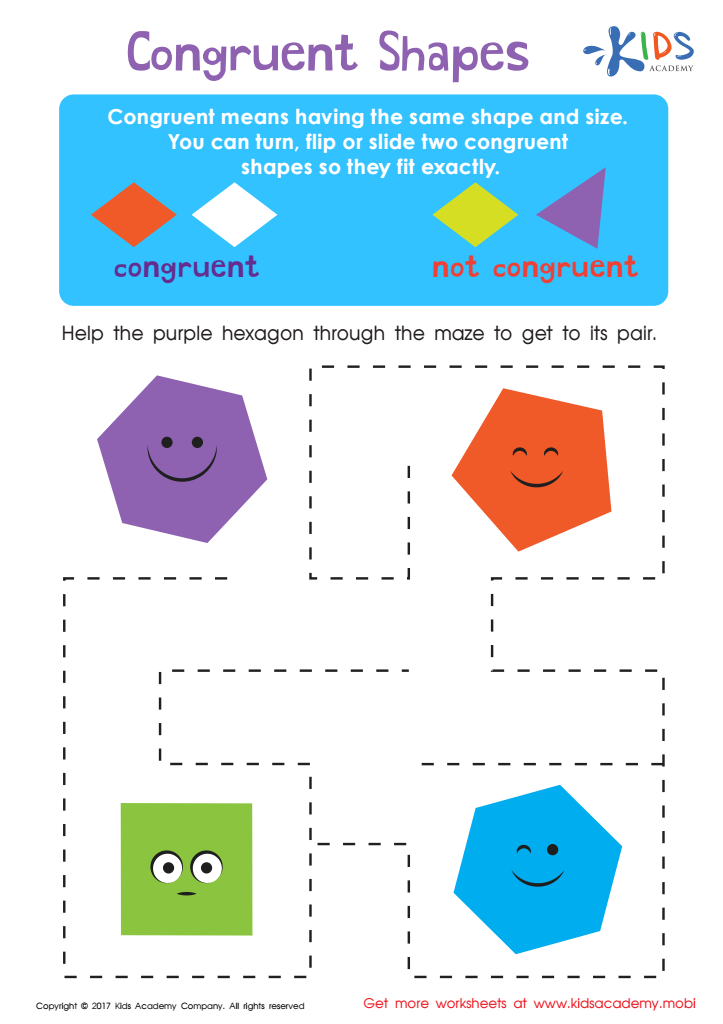
Congruent Shapes Worksheet
Help your child find the twin of the purple hexagon! This congruent shapes worksheet is great for increasing vocabulary while challenging mental rotation skills.
 Assign to My Students
Congruent Shapes Worksheet
Worksheet
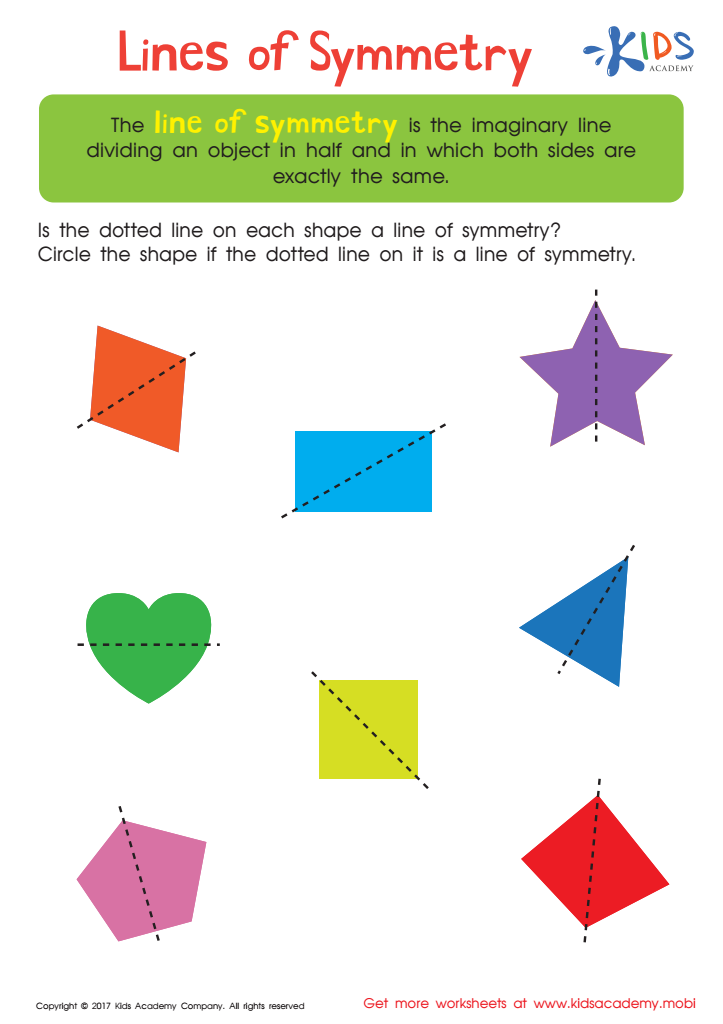
Lines of Symmetry Printable
Symmetry is a key math concept that kids must learn to develop their geometry skills. This fun worksheet helps build this skill, by encouraging kids to recognize symmetrical shapes and find equal parts.
Lines of Symmetry Printable
Worksheet
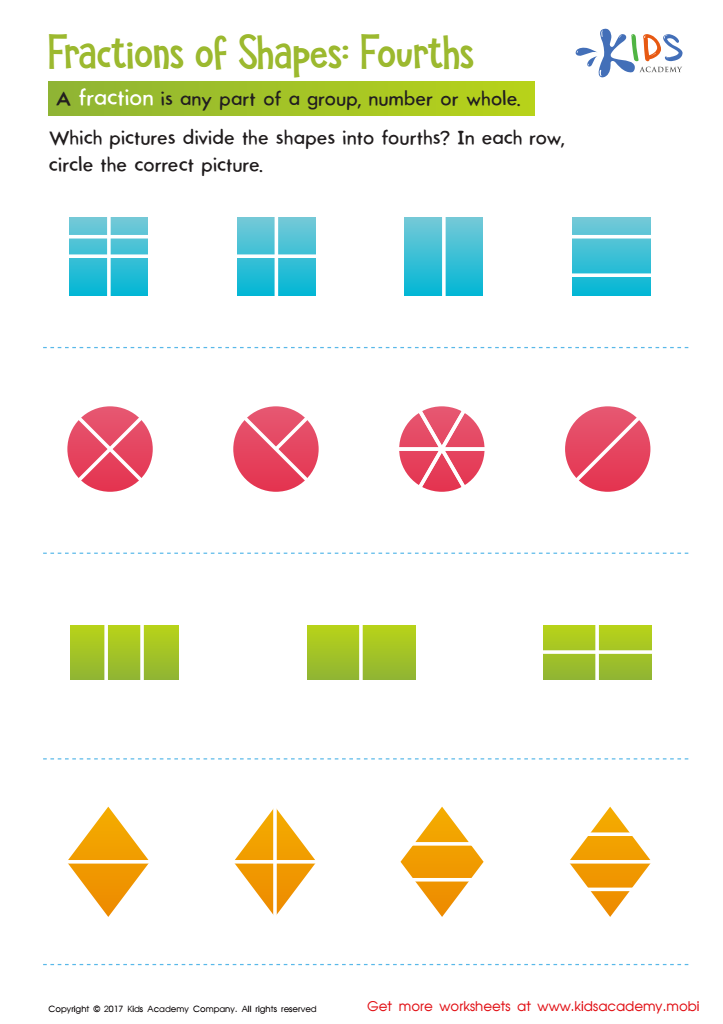
Fractions of Shapes Worksheet
It will also show them how fractions are represented in everyday shapes.
Fractions of Shapes Worksheet
Worksheet
Join Kids Academy for Free
Who is primarily going to use this learning content?








Recognizing shapes is a fundamental skill in early childhood education, and an Extra Challenge in this area can greatly benefit 8-year-olds. When parents or teachers engage children in recognizing and categorizing shapes, they foster essential cognitive development. Understanding shapes enhances spatial awareness, a critical skill in subjects like math, science, and even art. For instance, identifying shapes helps children grasp geometric concepts and properties, laying a solid foundation for more advanced math topics such as measurement and geometry.
An Extra Challenge involving shapes can also improve problem-solving skills and critical thinking. When children are tasked with identifying shapes in different orientations or finding complex shapes within a picture, they learn to approach problems from multiple angles and develop persistence in finding solutions.
Moreover, recognizing shapes strengthens language skills as children learn the vocabulary to describe and differentiate various shapes. This boosts their ability to communicate mathematical ideas clearly and effectively.
Socially, tackling these challenges can foster a love for learning and increase confidence. Children gain a sense of accomplishment when they master new tasks, which can lead to a lifelong interest in math and related fields. Therefore, paying attention to shape recognition and integrating extra challenges enriches overall development and prepares children for future academic success.








