Understanding plurals Extra Challenge Kindergarten Worksheets
3 filtered results
Difficulty Level
Grade
Age
-
From - To
Subject
Activity
Standards
Enhance your kindergarteners' understanding of plurals with our "Understanding Plurals Extra Challenge Worksheets"! Designed to make learning engaging and effective, these worksheets offer a variety of exercises that encourage young learners to identify and form plural nouns. Children will enjoy activities like matching images with corresponding plural words, filling in blanks, and completing fun puzzles. Each worksheet is tailored to reinforce their grasp of pluralization while developing critical thinking skills. Perfect for extra practice at home or in the classroom, these worksheets are a valuable resource for teachers and parents alike to support their child's literacy journey.
Favorites
With answer key
Interactive
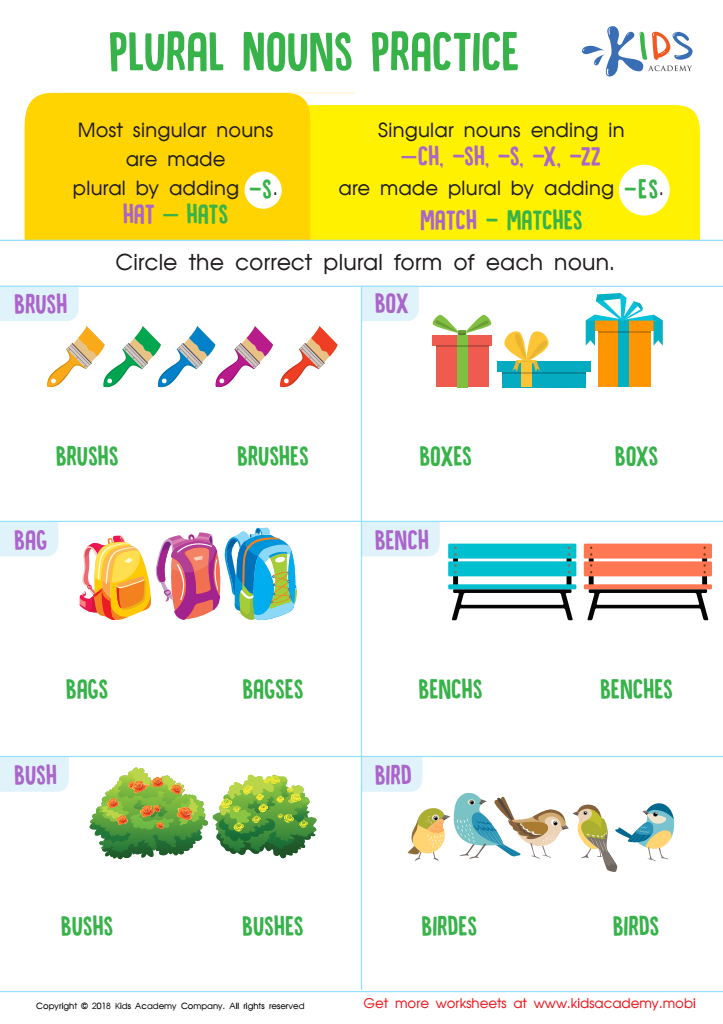
Plural Nouns Practice Worksheet
Explain to your child that most singular nouns become plural by adding "-s". E.g. "cat"->"cats". For words ending in "-ch", "-sh", "-s", "-x", or "-zz", add "-es". E.g. "buzz"->"buzzes". Then, get them to circle the right plural form of each noun on the worksheet.
 Assign to My Students
Plural Nouns Practice Worksheet
Worksheet
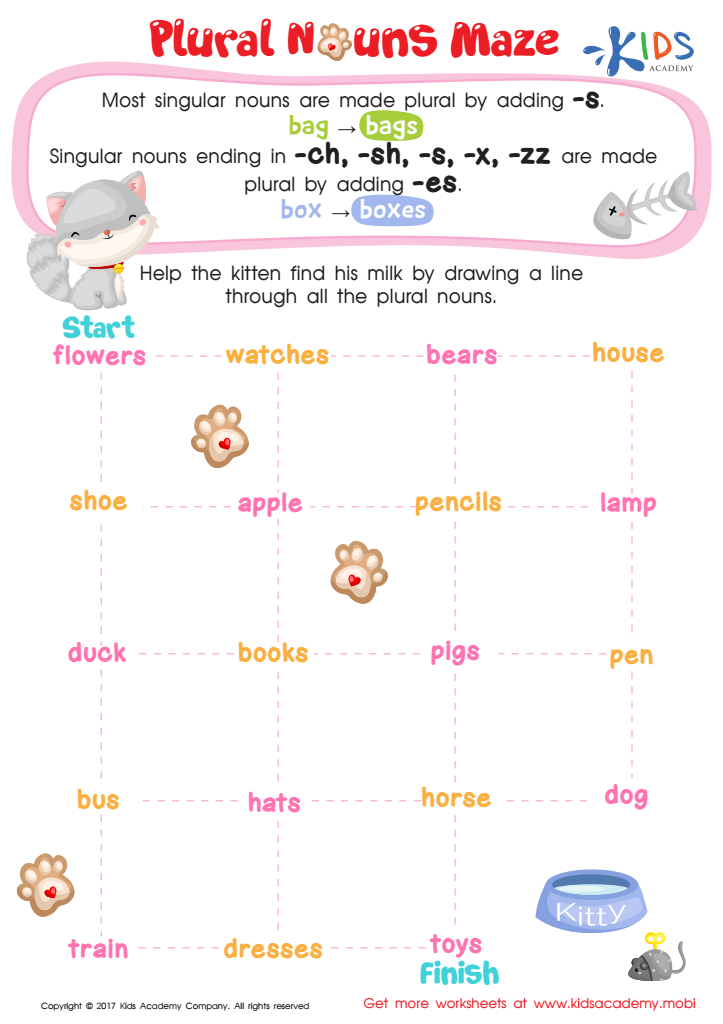
Plural Nouns Maze Worksheet
Oh no, the kitty needs her milk! Help your learner navigate the maze by drawing a line through the plural words. Review the grammar rules on -s and -es endings, then get to work to guide the kitten to her bowl! Download this PDF worksheet to start.
Plural Nouns Maze Worksheet
Worksheet
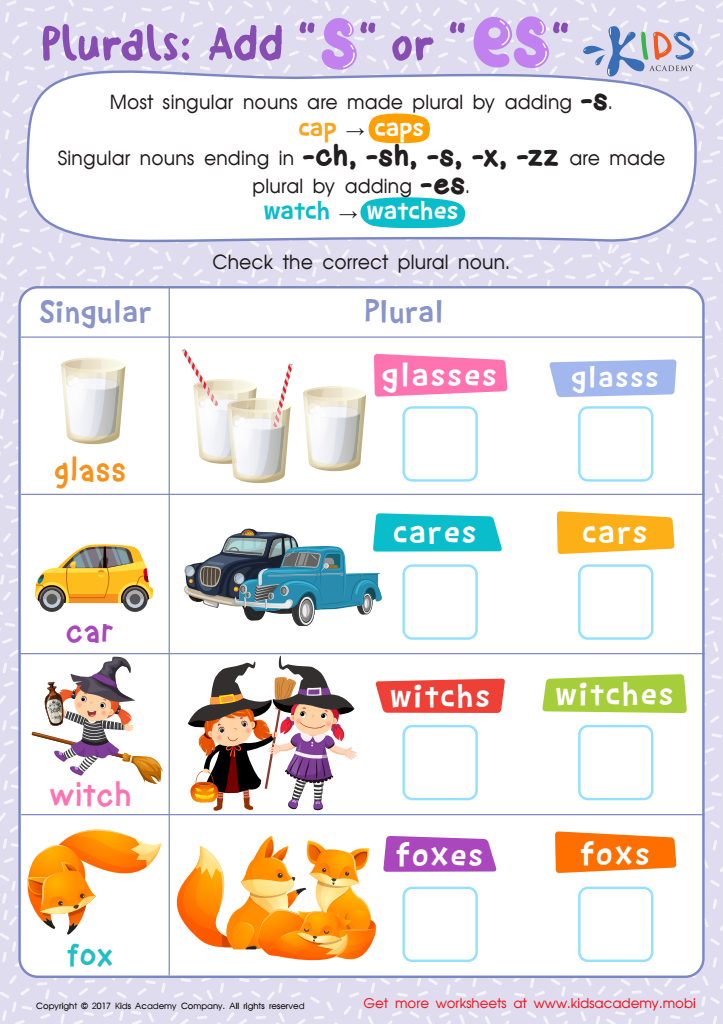
Plurals: "–es" or "–es"? Worksheet
Learning plural nouns can be tough for young readers. This worksheet shows them the difference between singular and plural spelling with cute images. Read each word and check the correct version. Remind them why the other ending can't be used.
Plurals: "–es" or "–es"? Worksheet
Worksheet
Join Kids Academy for Free
Who is primarily going to use this learning content?








Understanding plurals is crucial for kindergarten students as it forms the foundation for their language development and communication skills. For parents and teachers, grasping the concept of plurals helps in fostering literacy and supports a child’s ability to convey ideas accurately. Plurals allow young learners to express that there is more than one of something, enhancing their vocabulary and grammatical understanding.
In an early education environment, teaching plurals can open up discussions about quantities, encourage group activities, and deepen social interactions. When children learn to use plurals correctly, they are better equipped to participate in conversations, share experiences, and build relationships through language.
Additionally, understanding plurals prepares students for reading and writing, vital components of their educational journey. Being able to distinguish between singular and plural forms is foundational for constructing sentences and comprehending stories, thus improving overall literacy skills.
For parents, showing interest in plural concepts reinforces learning at home, supports homework, and promotes a love for reading. Ultimately, recognizing the significance of plural understanding helps shape children into more confident communicators, laying the groundwork for their future academic success and social interactions.