
Math fluency development Extra Challenge Worksheets
3 filtered results
Difficulty Level
Grade
Age
-
From - To
Subject
Activity
Standards
Enhance your students' mathematical abilities with our Math Fluency Development Extra Challenge Worksheets! Designed for early learners, these worksheets provide an engaging way to practice key math concepts, encourage critical thinking, and foster problem-solving skills. Tailored to challenge students beyond the basics, our resources include engaging prompts and varied question types to reinforce understanding in addition, subtraction, multiplication, and division. Ideal for differentiated instruction, homework, or classroom activities, these worksheets will boost confidence and proficiency in math. Explore our collection to give your young learners the extra challenges they need to thrive in their math journey!
Favorites
With answer key
Interactive
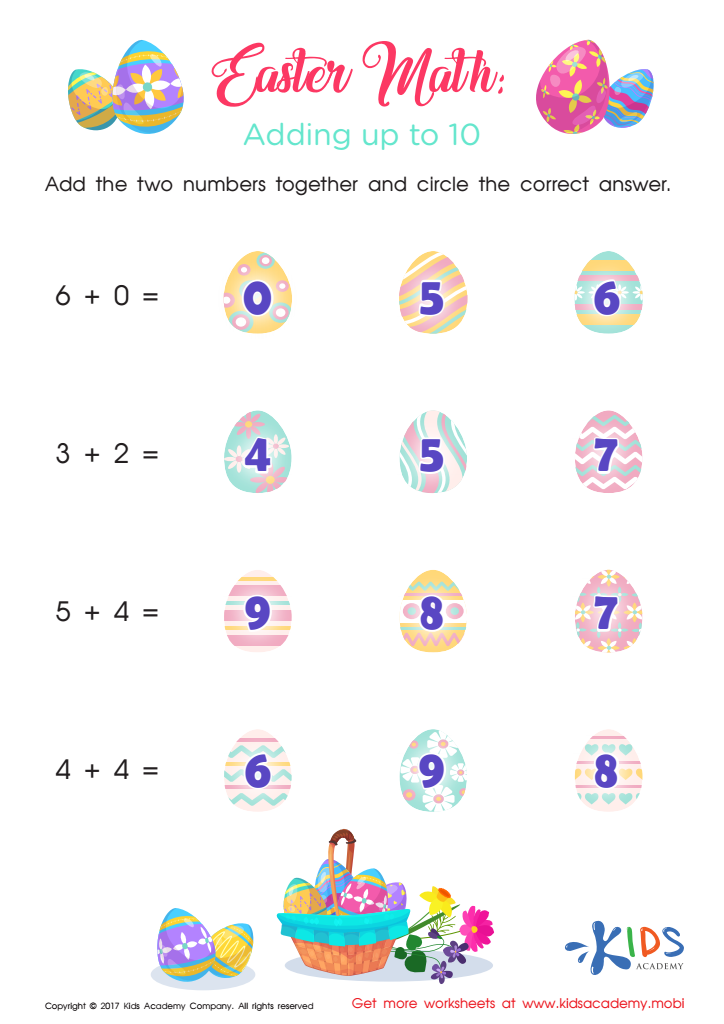
Addition Up To 10 Worksheet
This spring-themed worksheet helps your child master addition up to 10. Its bright colors and fun activities make it an enjoyable way to improve math skills.
 Assign to My Students
Addition Up To 10 Worksheet
Worksheet
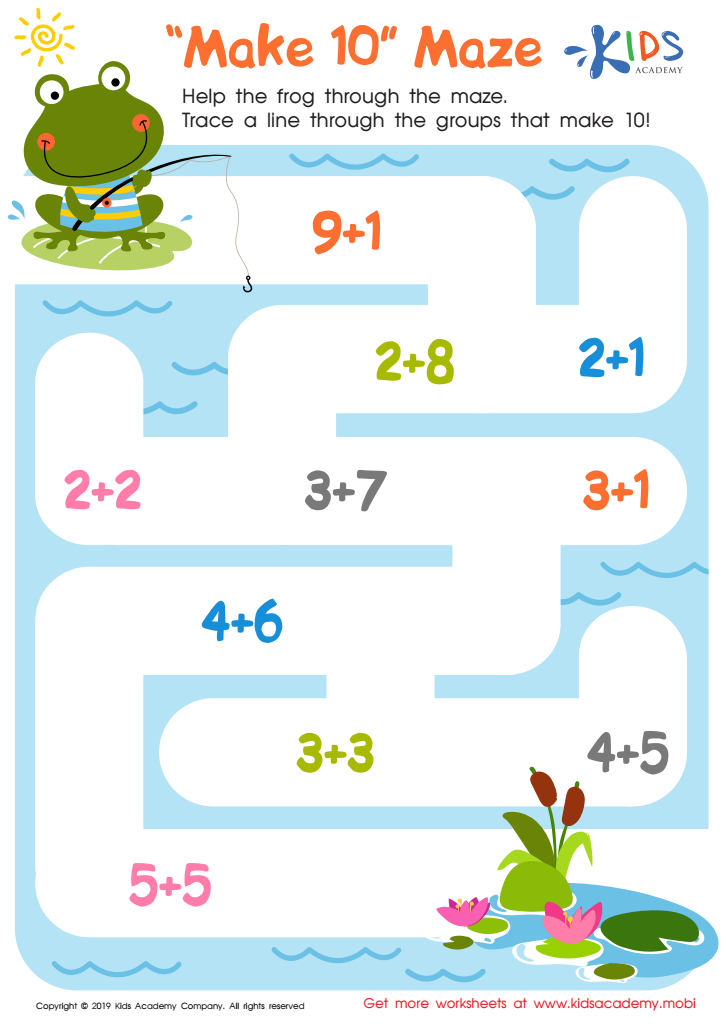
Make 10 Maze Worksheet
Help your child's frog friend make its way out of the maze! Mazes are an enjoyable way to get your kids to learn and can be a challenge. Have your kids take a look at this tracing sheet and help the frog make its way through the maze by tracing a line through the groups of equations that make 10. It’ll be a fun time for everyone!
Make 10 Maze Worksheet
Worksheet
Join Kids Academy for Free
Who is primarily going to use this learning content?








Math fluency—defined as the ability to solve mathematical problems quickly and accurately—is a critical skill for children. Parents and teachers should prioritize its development for several reasons. First, math fluency lays the groundwork for more advanced mathematical concepts. Without a solid foundation in basic operations, such as addition, subtraction, multiplication, and division, students may struggle with higher-order concepts like algebra and geometry.
Second, fluency contributes to student confidence and independence. When kids can manipulate numbers effortlessly, they are more likely to engage with math tasks, participate actively in class discussions, and seek out challenges instead of shying away from them. This confidence can help alleviate math anxiety, a common issue that can hinder academic performance.
Lastly, math fluency is integral to daily life. From managing finances to understanding measurements and statistics, having strong numerical skills ensures that children are prepared for real-world applications. Moreover, fostering math fluency encourages a mindset of perseverance and problem-solving, which are essential skills in any field. Overall, prioritizing math fluency can significantly impact a child's academic trajectory and lifelong success.








