
Understanding number patterns Kindergarten Math Worksheets
3 filtered results
Difficulty Level
Grade
Age
-
From - To
Subject
Activity
Standards
Discover an engaging collection of Kindergarten Math Worksheets focused on Understanding Number Patterns! These worksheets are designed to help young learners develop essential mathematical skills through fun and interactive activities. Children will explore sequences, identify patterns, and enhance their problem-solving abilities while building a strong foundation for future math concepts. Our user-friendly worksheets promote critical thinking and creativity, making math enjoyable for every child. Perfect for classroom settings or homeschooling, these resources encourage independent learning and can be easily printed. Start your child's math journey today by helping them recognize and understand number patterns with our engaging worksheets!
Favorites
With answer key
Interactive
 Assign to My Students
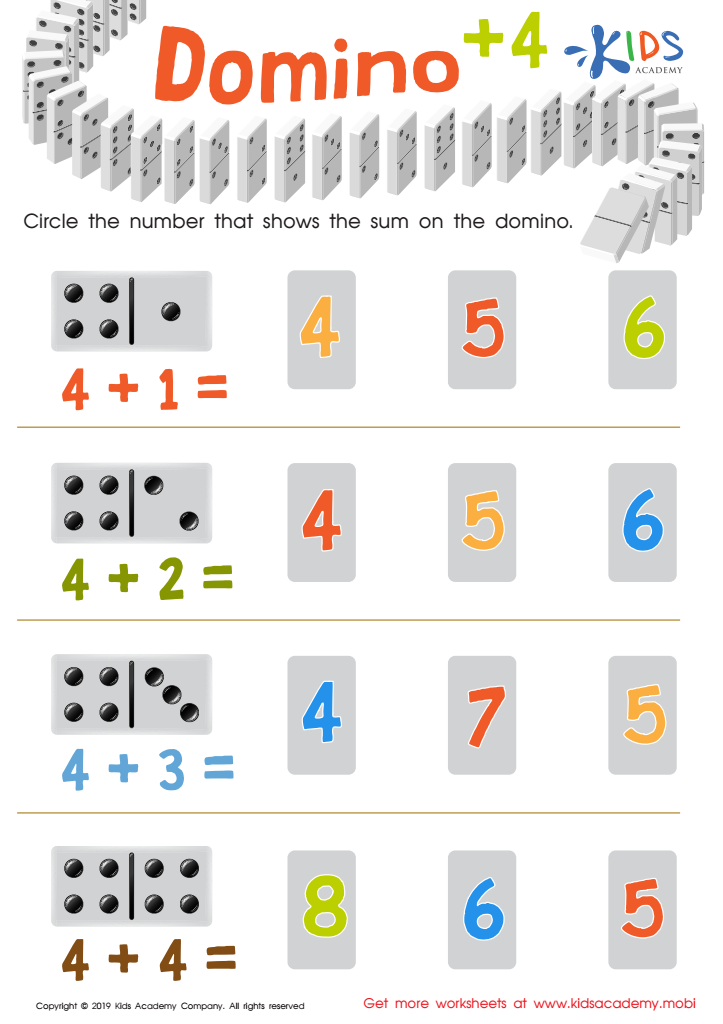
Domino +4 Worksheet
Ask your kids if they know what a domino is. Explain, then move on to solving the four simple equations on this printout, adding a number to 4. Help them find the sum and circle the number.
Domino +4 Worksheet
Worksheet
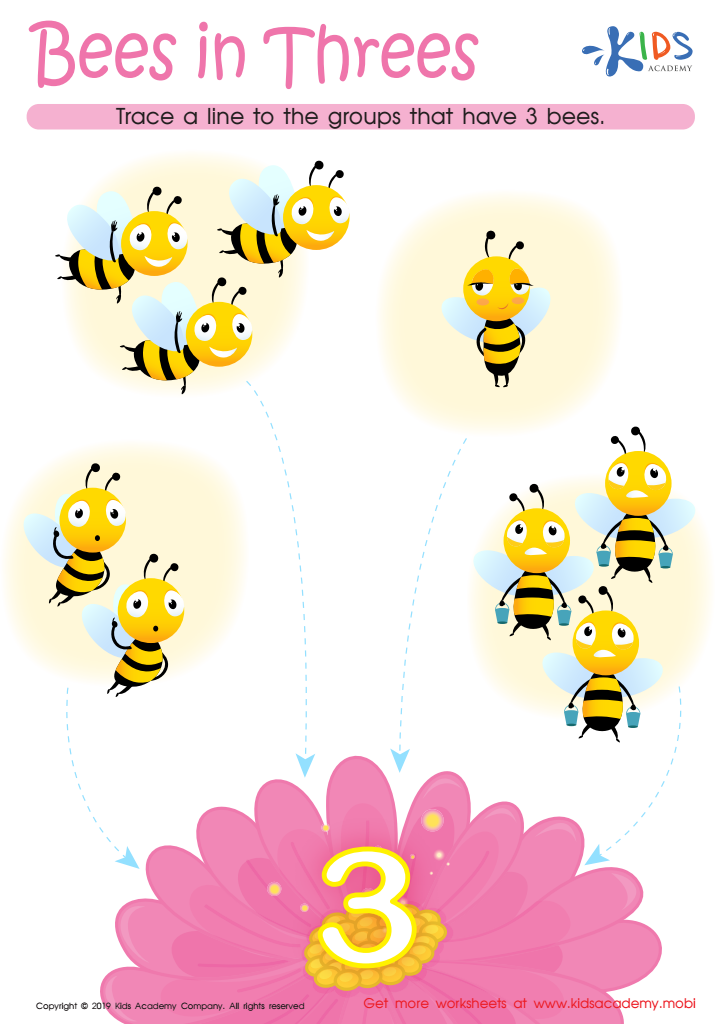
Bees in Threes Worksheet
Kids love learning numbers, especially 1, 2, 3! Counting bees with this fun worksheet? It's the bee's knees! They'll practice number recognition and counting skills while connecting groups of three to the number three. It's a great way to make math fun at home or school!
Bees in Threes Worksheet
Worksheet
Join Kids Academy for Free
Who is primarily going to use this learning content?







Understanding number patterns is essential in kindergarten math because it serves as a foundation for future mathematical learning. Early exposure to number patterns helps children develop critical thinking and problem-solving skills. By recognizing and exploring patterns, children learn to predict what comes next, enhancing their ability to engage with numbers in a structured way.
Patterns are everywhere in the world, from sequences in nature to routines in daily life, which makes grounding math in real-world contexts accessible for young learners. When children identify and create patterns, they enhance their cognitive skills, improve their logical reasoning, and develop a sense of order, which is crucial for advanced mathematical concepts later in their education.
Parents and teachers should care about instilling pattern recognition because it promotes early numeracy, which is a predictor of later academic success. Engaging children in activities involving patterns solidifies their understanding of numbers, serves to foster creativity, and boosts their confidence as they communicate mathematical ideas. Additionally, recognizing and creating patterns builds a solid basis for addition, subtraction, and other mathematical operations, ensuring students are better prepared for future learning challenges. Overall, a focus on number patterns nurtures essential skills that extend well beyond kindergarten math.








