Bee life cycle knowledge Worksheets for Kids
1 filtered results
-
From - To
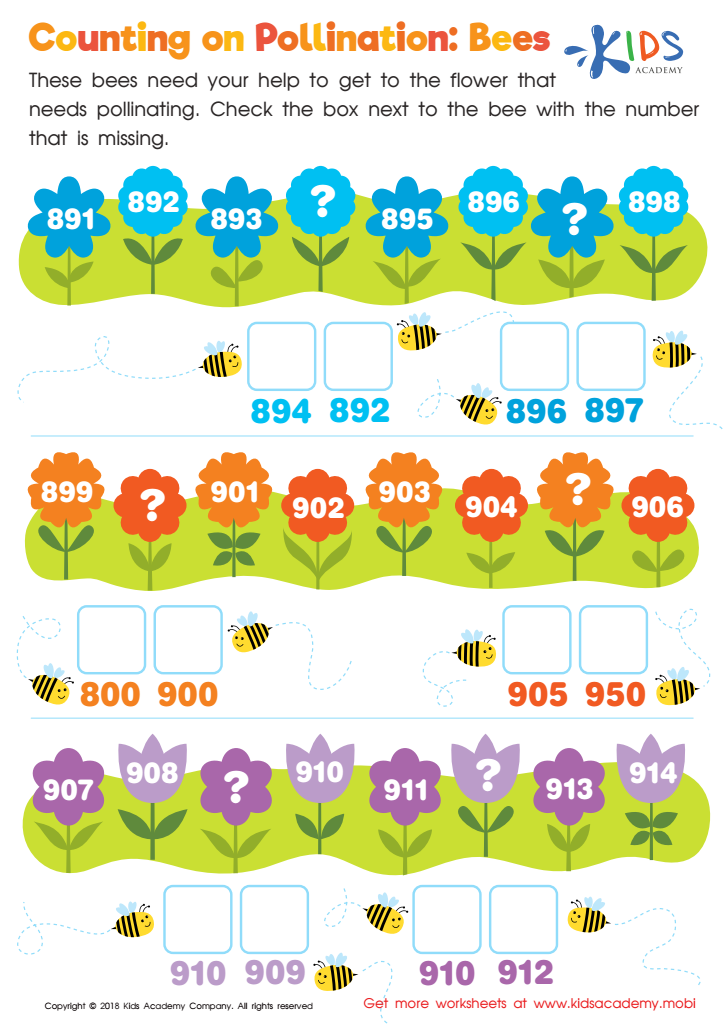
Counting on Pollination: Bees Worksheet
 Assign to My Students
Question/Answer

How does the mastery of the Bee life cycle knowledge skill affect a student's performance at an early age?
Mastery of the bee life cycle knowledge skill at an early age can enhance a student's performance by fostering curiosity, critical thinking, and scientific understanding. It helps in developing observation skills, encouraging environmental awareness, and promoting responsible actions towards ecosystem conservation. It also aids in understanding broader biological concepts, strengthening foundational science skills that are beneficial across various learning areas.
What does the Bee life cycle knowledge skill mean when it comes to Grade 2 Numbers learning?
The Bee life cycle knowledge skill in Grade 2 Numbers learning refers to integrating basic biological knowledge about bees into math lessons. For example, students might learn counting, sequencing, and number patterns by studying the stages of a bee's life cycle (egg, larva, pupa, adult) or by calculating the number of bees in a hive over time.
Why is the Bee life cycle knowledge skill important for Grade 2 students?
The Bee life cycle knowledge is important for Grade 2 students because it introduces them to basic biological concepts, ecosystem roles, and the importance of pollinators. Understanding the bee life cycle encourages curiosity about nature, teaches responsibility towards the environment, and highlights the interdependence between humans and pollinators for food production, fostering early awareness and appreciation for biodiversity.






.jpg)








