Encourages logical thinking Worksheets for Kids
2 filtered results
Difficulty Level
Grade
Age
-
From - To
Subject
Activity
Standards
Encourages Logical Thinking Worksheets provide an interactive and engaging way for students to develop their logical reasoning skills. These worksheets are specifically designed to boost critical thinking abilities, improve problem-solving techniques, and enhance cognitive skills in a practical manner.
Favorites
With answer key
Interactive
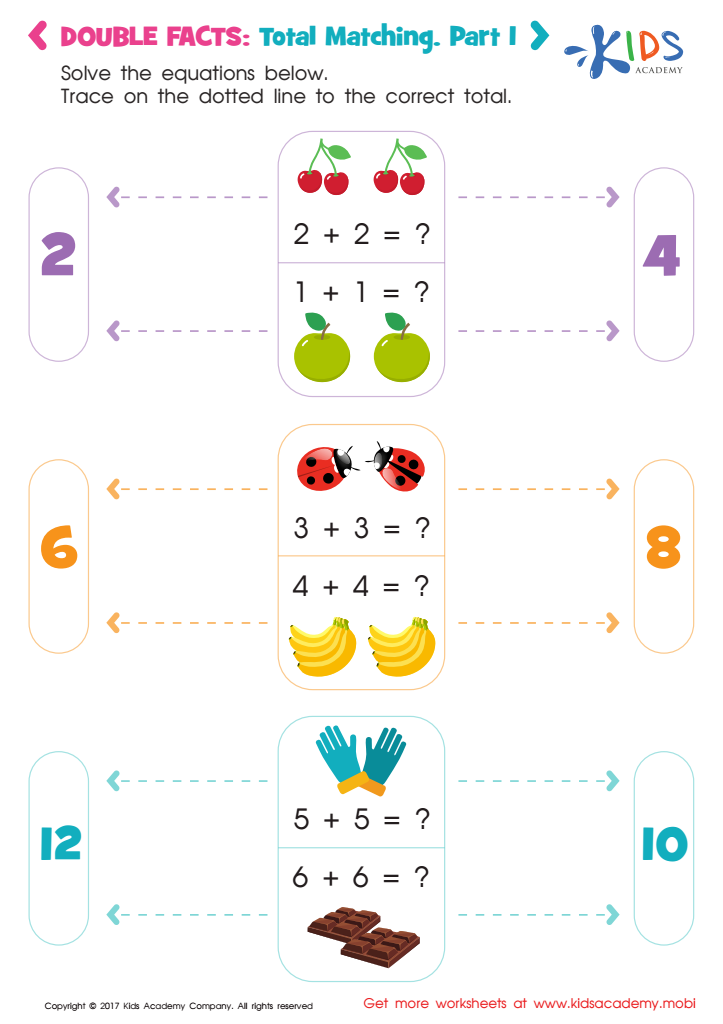
Double Facts: Total Matching Worksheet: Part 1
Help your students take their numbers knowledge further with this fun math worksheet! Solving equations has never been more fun; simply trace the dotted lines with a pencil to the correct answer. As your child gets the hang of it, watch them be amazed as math problems become playtime.
 Assign to My Students
Double Facts: Total Matching Worksheet: Part 1
Worksheet
Learning Skills
Question/Answer

What are some effective activities to train students’ Encourages logical thinking skill when teaching them about Numbers?
Effective activities for training students' logical thinking skills in numbers include puzzles, such as Sudoku and logic grids, problem-solving tasks that require step-by-step reasoning, sequencing activities, number patterns and sequences identification, mathematical riddles, and playing strategy-based games like chess. Incorporating real-life scenarios that require budget planning or measurement conversion can also enhance logical thinking in relation to numbers.
How to test a Grade 1 student’s Encourages logical thinking skills?
To test a Grade 1 student's logical thinking skills, use simple puzzles and pattern recognition exercises. Employ age-appropriate logic games that involve sequencing, categorization, and problem-solving tasks. You can also use story-based questions that ask the child to predict what happens next or to identify the solution to a simple problem, encouraging them to explain their reasoning.
What does the Encourages logical thinking skill mean when it comes to Grade 1 Numbers learning?
Encouraging logical thinking skill in Grade 1 Numbers learning means fostering the ability in children to recognize patterns, understand relationships between numbers, and solve problems systematically. It involves teaching them to approach mathematical tasks with reasoning, making connections, and applying basic concepts to new situations, thereby developing a foundational skill set for more advanced mathematical thinking and problem-solving.
Join Kids Academy for Free
Who is primarily going to use this learning content?