Improves fine motor skills (writing) Worksheets for Kids
1 filtered results
Difficulty Level
Grade
Age
-
From - To
Subject
Activity
Standards
Worksheets improve fine motor skills crucial for writing in young learners. They target hand-eye coordination, vital for proper pencil grip and legible handwriting. Children develop concentration and attention to detail through tracing, dot-to-dot, and coloring tasks, enhancing their focus and writing engagement. These activities also build hand and finger muscle strength and dexterity, promoting the muscle memory needed for complex writing. Additionally, they boost confidence and encourage a love for writing, as kids feel accomplished improving their skills. Such worksheets are key for children's holistic growth, setting them up for academic success.
Favorites
With answer key
Interactive
Question/Answer

How to test a Preschool student’s Improves fine motor skills (writing) skills?
To test a preschool student's improvement in fine motor skills for writing, observe and assess their ability to perform tasks such as tracing shapes, drawing simple figures, copying letters or numbers, and coloring within lines. Use a variety of these tasks to evaluate coordination, grip, control, and precision in their hand movements.
How to train the Improves fine motor skills (writing) skill in Preschool students learning about Adding at the Zoo?
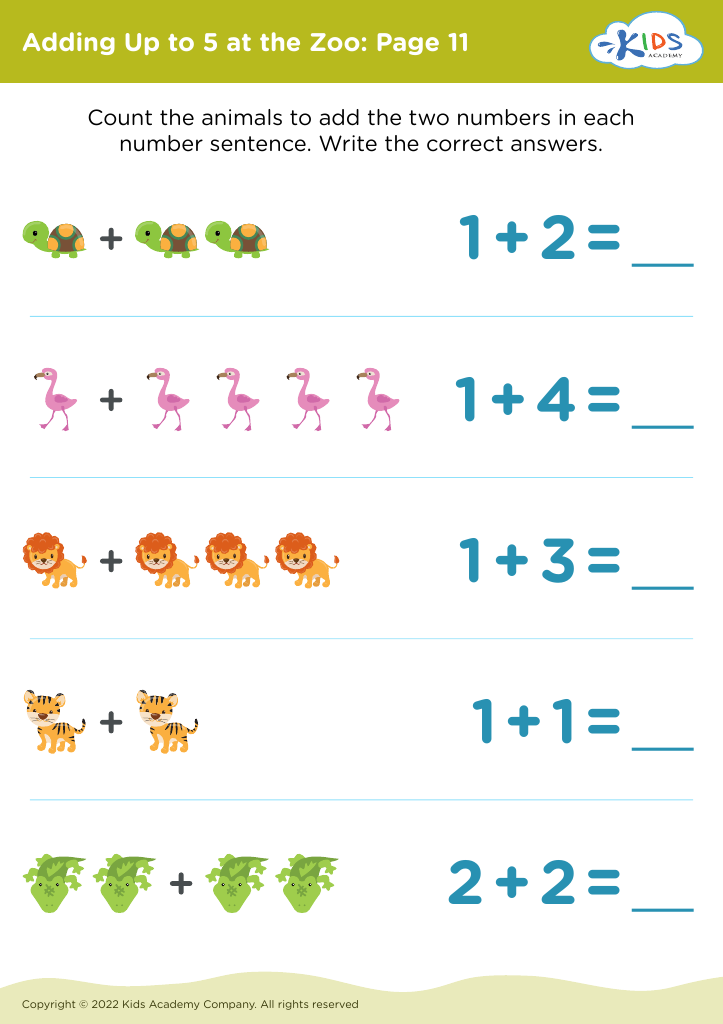
To train fine motor skills in preschool students learning about Adding at the Zoo, incorporate activities like counting and placing small animal figurines on designated spots, using finger paint to create animal patterns while practicing numbers, and tracing or drawing animals and their enclosures with pencils or crayons, emphasizing the strokes needed to write numbers associated with addition exercises.
How does the mastery of the Improves fine motor skills (writing) skill affect a student's performance at an early age?
The mastery of fine motor skills, particularly in writing, at an early age significantly enhances a student's academic performance. It supports the development of handwriting proficiency, which is crucial for note-taking, completing assignments efficiently, and expressing ideas clearly. Improved fine motor skills also foster independence, confidence in learning tasks, and can positively impact reading development and overall academic success.
Join Kids Academy for Free
Who is primarily going to use this learning content?