Recognize 'long e' sounds Worksheets for Kids
1 filtered results
Difficulty Level
Grade
Age
-
From - To
Subject
Activity
Standards
Long 'e' sound worksheets help learners master word pronunciation and spelling. These resources aid in recognizing the 'e' sound, a challenge for many English speakers. Exercises in the worksheets train learners to distinguish words like "heat," "beak," and "tea," improving listening skills. They also enhance pronunciation, fluency, and understanding. Additionally, these worksheets bolster spelling patterns for the 'long e' sound as users match words to spellings, improving their spelling and vocabulary retention. Engaging with these tools builds phonetic awareness and boosts confidence in using the 'long e' sound in communication.
Favorites
With answer key
Interactive
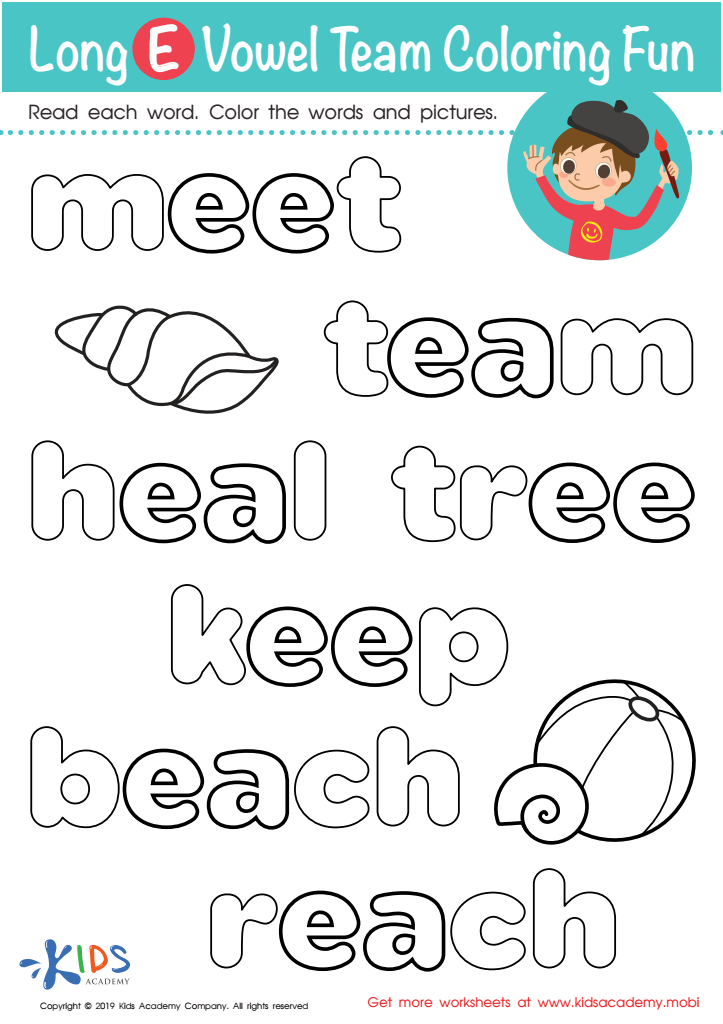
Long E Vowel Team Coloring Worksheet
Divide your students into teams and have them read words with long E sounds, such as "meet" and "team." Let them recognize that the sound can be created with either "ee" or "ea" letter pairings. Then, have the teams color words and pictures with the appropriate letters. This will make your phonics lesson fun and effective.
Download (PDF)
 Assign to My Students
Assign to My Students
Long E Vowel Team Coloring Worksheet
Worksheet
Question/Answer

What are some effective activities to train students’ Recognize 'long e' sounds skill when teaching them about Long Vowels?
Effective activities for teaching students to recognize 'long e' sounds include interactive games (like sorting or matching games with 'ee' and 'ea' words), using songs or chants that highlight the 'long e' sound, reading aloud books rich in 'long e' words, and engaging in word hunts in texts or around the classroom to find and list 'long e' words.
How to train the Recognize 'long e' sounds skill in Grade 2 students learning about Long Vowels?
To train Grade 2 students in recognizing 'long e' sounds, incorporate activities such as phonemic awareness games, word sorting (e.g., 'ee' vs. 'ea' words), reading aloud stories or poems with a focus on 'long e' sounds, and interactive spelling exercises. Use visual aids like flashcards and engage students in writing sentences or stories using 'long e' words.
Why is the Recognize 'long e' sounds skill important for Grade 2 students?
The Recognize 'long e' sounds skill is crucial for Grade 2 students as it enhances their reading and spelling abilities. By distinguishing this sound, students can better decode words, increasing their reading fluency and comprehension. It also aids in their vocabulary expansion, as they can correctly pronounce and understand more words, fostering their overall literacy development.
Join Kids Academy for Free
Who is primarily going to use this learning content?