Recognizing 3D shapes Worksheets for Kids
1 filtered results
-
From - To
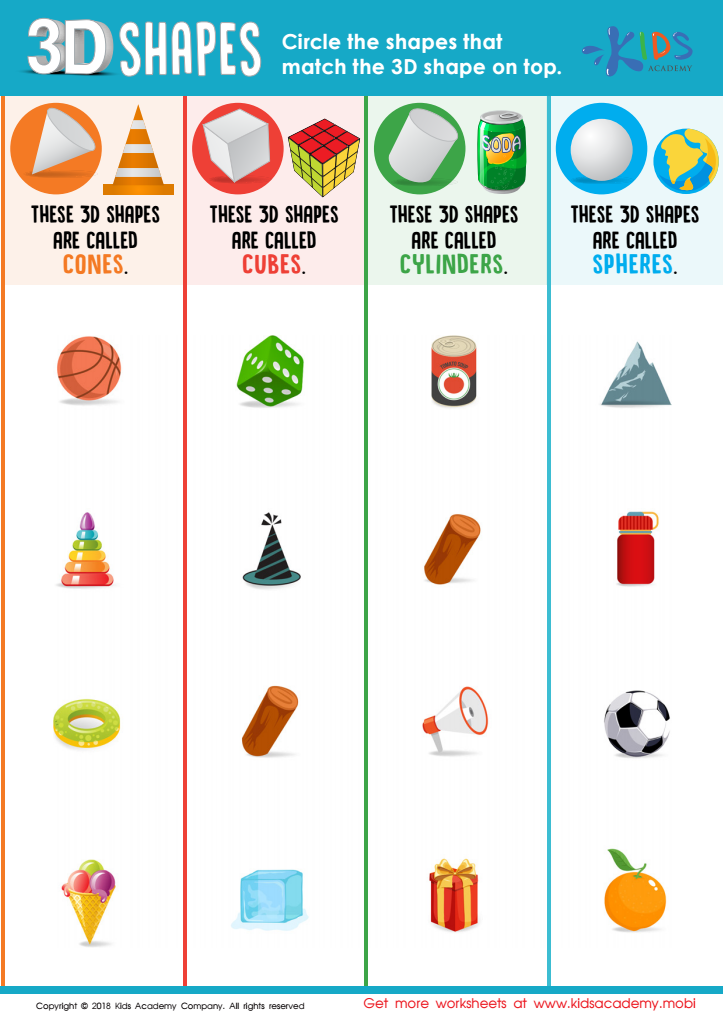
3D Shapes Worksheet
 Assign to My Students
Question/Answer

How to train the Recognizing 3D shapes skill in Kindergarten students learning about Geometry?
To train Kindergarten students in recognizing 3D shapes, engage them with hands-on activities such as building blocks, sorting and matching games with physical 3D shape models, and interactive 3D shape puzzles. Incorporate storytelling with 3D shape characters, use visual aids like flashcards, and encourage exploration of everyday objects to identify and compare their shapes.
What does the Recognizing 3D shapes skill mean when it comes to Kindergarten Geometry learning?
The Recognizing 3D Shapes skill in Kindergarten Geometry learning involves teaching children to identify and name basic three-dimensional shapes such as cubes, spheres, cones, cylinders, and pyramids. This skill helps young learners understand and articulate the differences between these shapes by observing their properties, like the number of faces, edges, and vertices, in their everyday environment.
How does the mastery of the Recognizing 3D shapes skill affect a student's performance at an early age?
Mastery of recognizing 3D shapes at an early age significantly enhances a student's spatial awareness, critical thinking, and problem-solving skills. It lays the foundation for understanding complex mathematical concepts, improves geometry comprehension, and facilitates the development of visualization skills. Early mastery also boosts confidence and academic performance in mathematics and related subjects.