Visual spatial understanding Worksheets for Kids
1 filtered results
-
From - To
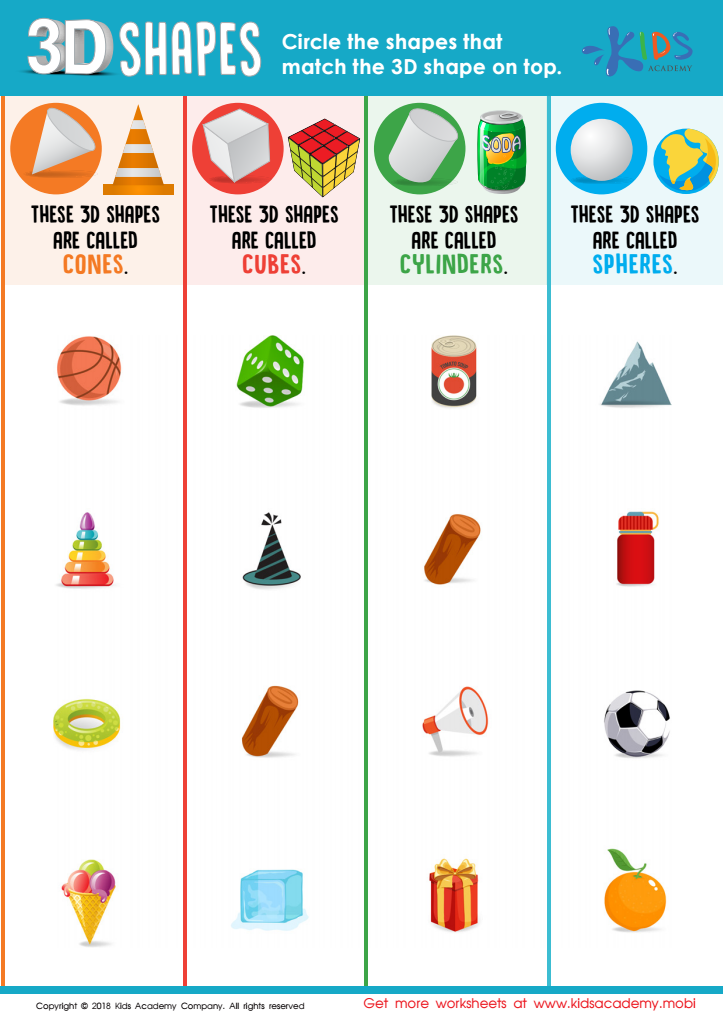
3D Shapes Worksheet
 Assign to My Students
Question/Answer

How to train the Visual spatial understanding skill in Kindergarten students learning about Geometry?
To train visual-spatial understanding in kindergarten students learning about geometry, engage them in hands-on activities like building with blocks, tangrams, puzzle solving, and drawing shapes. Use manipulatives to explore and compare geometric shapes, encouraging discussions about their properties.
Why is the Visual spatial understanding skill important for Kindergarten students?
The visual-spatial understanding skill is crucial for kindergarten students because it lays the foundation for critical cognitive functions. It helps in developing their ability to recognize shapes, sizes, and patterns, enhancing problem-solving, math, and reading readiness. Moreover, it supports the development of fine motor skills and spatial awareness, essential for everyday tasks and academic success.
How does the mastery of the Visual spatial understanding skill affect a student's performance at an early age?
Mastery of visual spatial understanding at an early age significantly enhances a student's performance by improving their ability to interpret, comprehend, and navigate the spatial relationships between objects. This foundational skill contributes to better problem-solving, mathematical reasoning, reading comprehension, and science learning, thereby promoting overall academic success and effective daily functioning.