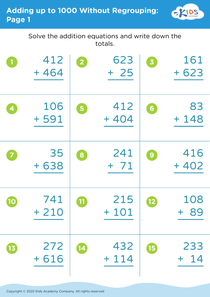
Simplifying Fractions Adding up to 1000 with Regrouping Worksheets
3 filtered results
-
From - To
Discover our "Simplifying Fractions Adding Up to 1000 with Regrouping Worksheets" designed to enhance your child's math skills in a fun and engaging way. These worksheets focus on simplifying fractions while mastering addition up to 1000, encouraging critical thinking and problem-solving. Through carefully crafted exercises, students can practice regrouping techniques, reinforcing their understanding of mathematical concepts. Ideal for early-grade learners, our worksheets provide clear instructions, step-by-step examples, and colorful visuals to maintain interest and motivate students. Empower your child with essential math skills and boost their confidence with our effective, easy-to-use fraction worksheets!
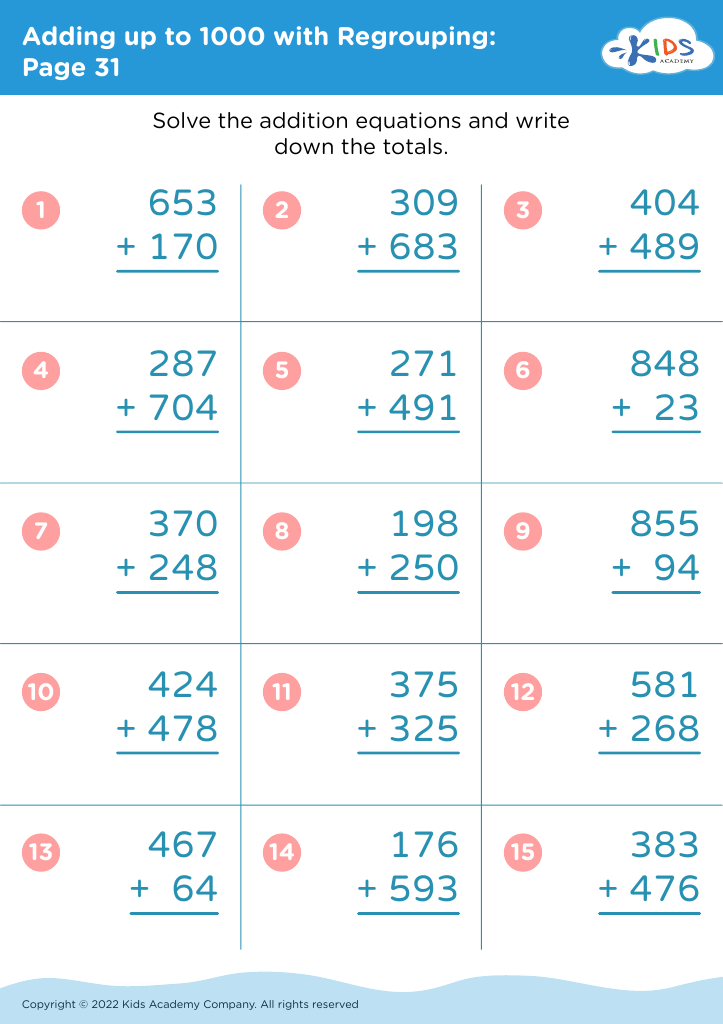
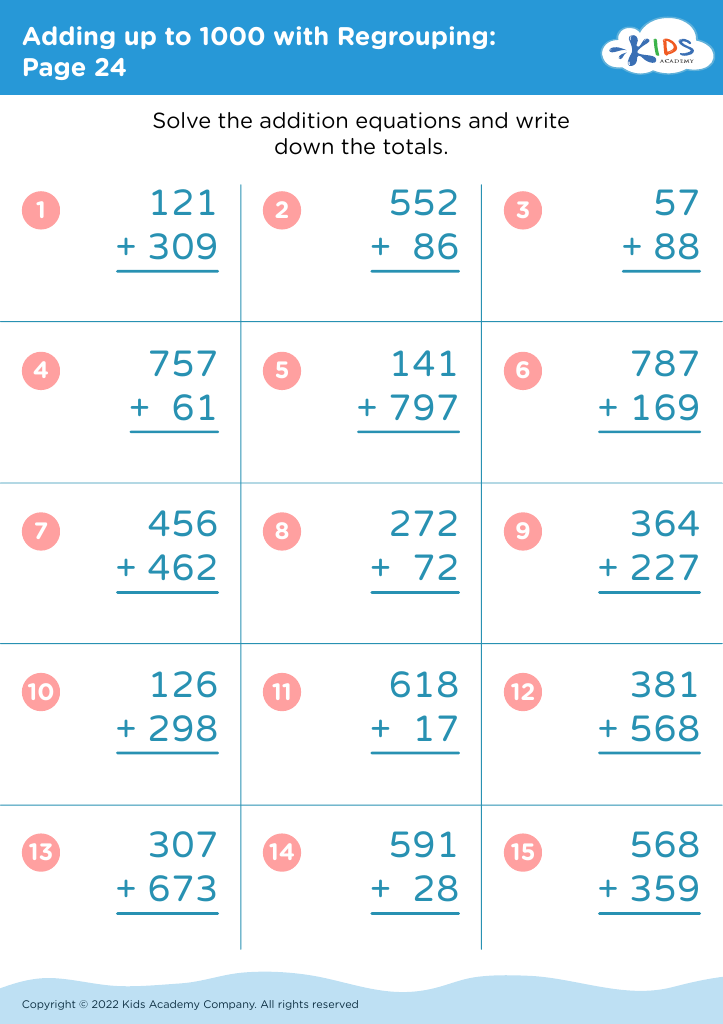
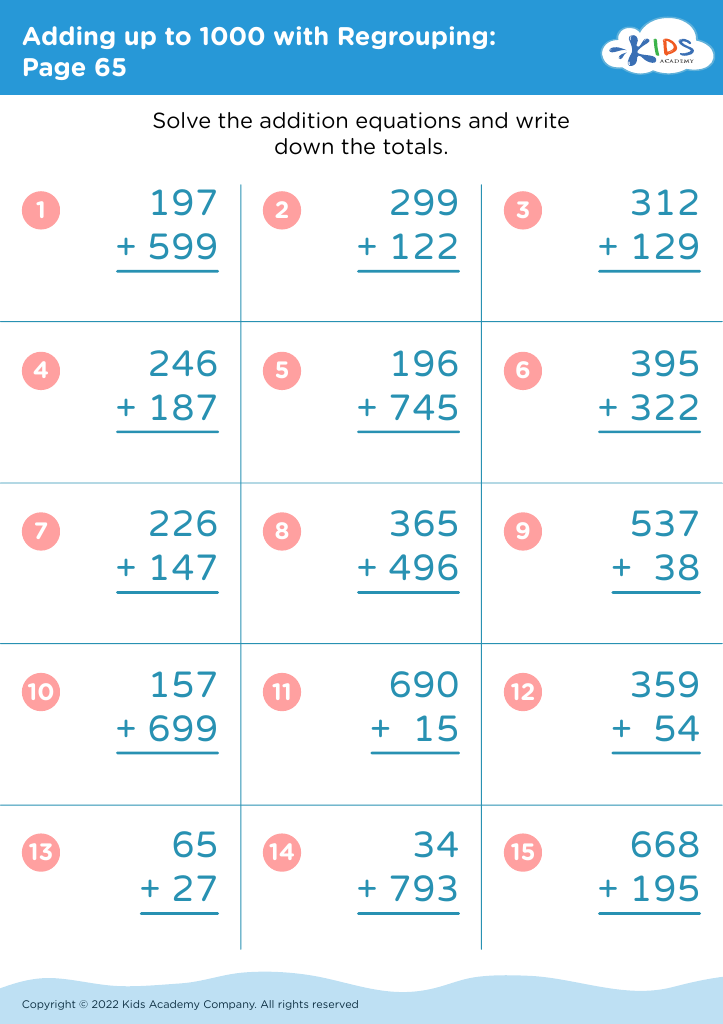


Parents and teachers should care about simplifying fractions that add up to 1000 with regrouping because it develops crucial mathematical skills in young learners. Mastering this concept enhances students’ understanding of fractions, helping them grasp the relationship between parts and wholes. Simplifying fractions allows students to work with smaller, more manageable numbers, making complex problems less intimidating and easier to solve.
Moreover, learning to add and regroup fractions teaches students vital problem-solving skills. It fosters critical thinking as they determine how to correctly adjust their fractions to reach a common denominator and regroup when necessary. This foundational knowledge is essential for later mathematical concepts, including algebra and beyond.
Furthermore, this skill paves the way for practical application in real life, from cooking to budgeting and interpreting data. It empowers students to assess and break down problems systematically. When parents and teachers collaborate to reinforce these skills, they create a supportive learning environment, bridging the gap between classroom instruction and at-home practice. Ultimately, simplifying fractions is not just a mathematical exercise; it equips children with tools they will use throughout their academic and everyday lives, leading to greater confidence and success in mathematics.