Shape Recognition Adding up to 1000 Without Regrouping Worksheets
3 filtered results
-
From - To
Enhance your child's math skills with our engaging Shape Recognition Worksheets focused on adding up to 1000 without regrouping. Designed for early learners, these worksheets combine essential math practice with vibrant visuals, helping children identify and understand various shapes while honing their addition skills. Our comprehensive resources make learning enjoyable and effective, fostering confidence and competence in young mathematicians. With intuitive exercises and colorful illustrations, students will explore the world of shapes and numbers seamlessly. Download our worksheets today and watch as your child grows from shape recognition to mastering addition—all while having fun! Perfect for home or classroom use.
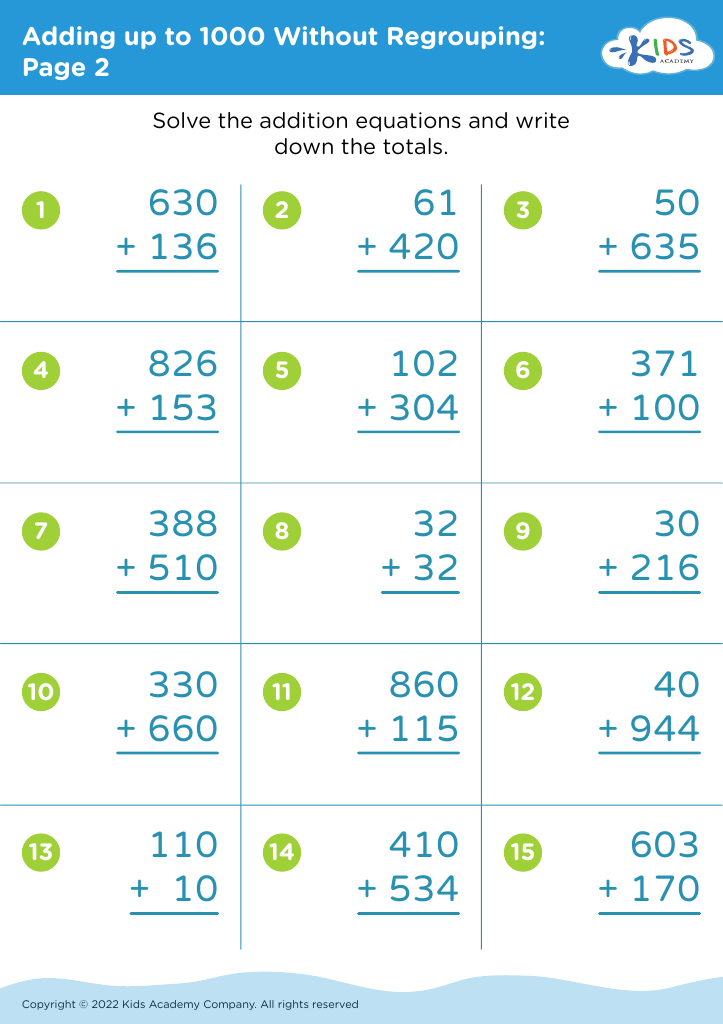
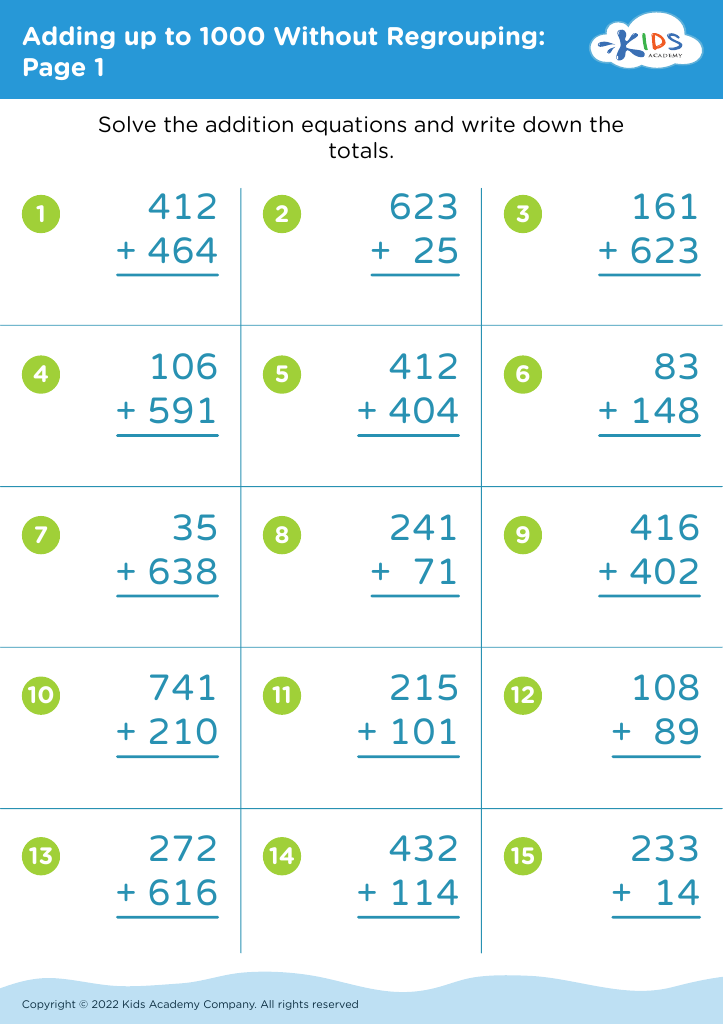
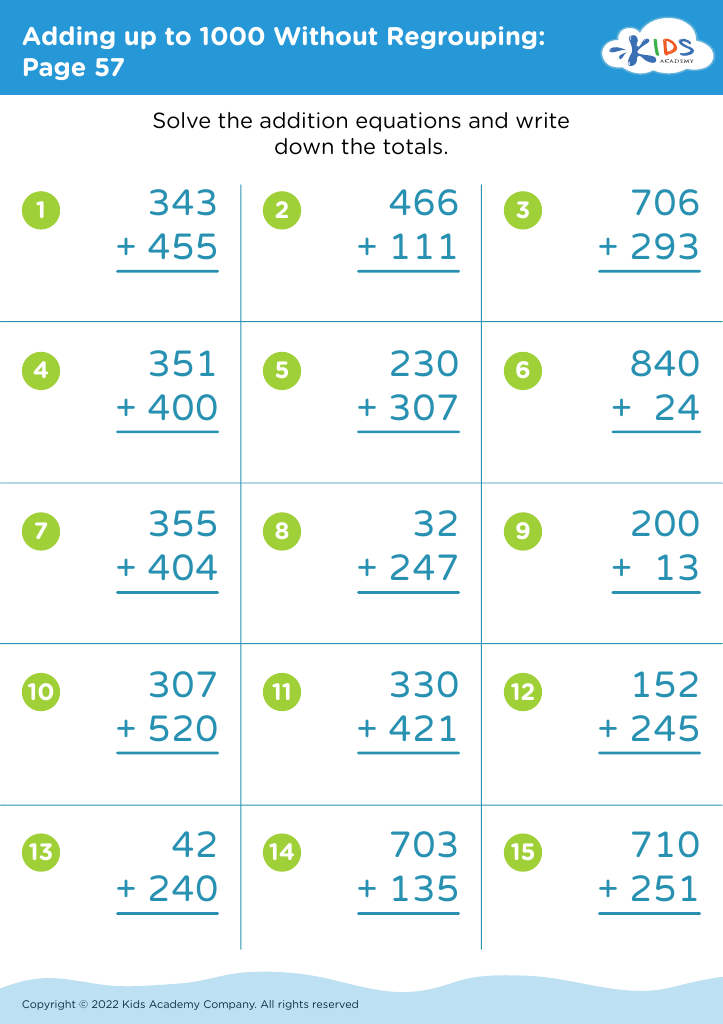


Shape recognition and addition without regrouping are fundamental skills that significantly impact a child's overall development in early education. Familiarity with shapes fosters critical thinking as children learn to identify, compare, and classify different geometric forms. This skill enhances their spatial awareness, which is crucial in everyday activities and serves as a foundation for subjects such as math and science.
When teaching addition without regrouping, children confidently combine numbers to achieve sums up to 1,000, building their numerical literacy. This skill encourages mental math, helping kids develop an intuition for numbers and improving their ability to solve problems. Mastering these concepts prepares students for more complex arithmetic and enhances their future learning experiences.
Moreover, these skills promote cognitive development by enhancing memory, attention, and logical reasoning abilities. Engaging in activities that involve shape recognition and addition encourages creativity, motivation, and a sense of achievement, fostering a love for learning.
For parents and teachers, nurturing these skills not only prepares children academically but also lays the groundwork for essential life skills such as critical thinking, problem-solving, and decision-making. Ultimately, instilling competence in these areas boosts children's confidence and prepares them for future academic success.