Basic Addition Skills Adding up to 1000 Worksheets
3 filtered results
-
From - To
Enhance your child’s math proficiency with our "Basic Addition Skills Adding up to 1000 Worksheets". These comprehensive, printable worksheets are designed to help young learners master addition within 1000. Tailored for ease and effectiveness, each worksheet offers a range of problems that reinforce fundamental arithmetic skills and boost confidence. Perfect for classroom use or supplementary home practice, these engaging exercises are essential tools for solidifying a child's understanding of larger number addition. Available in varied formats to maintain interest, our worksheets ensure a balanced learning experience, paving the way for more advanced math success. Download and start adding fun to learning today!
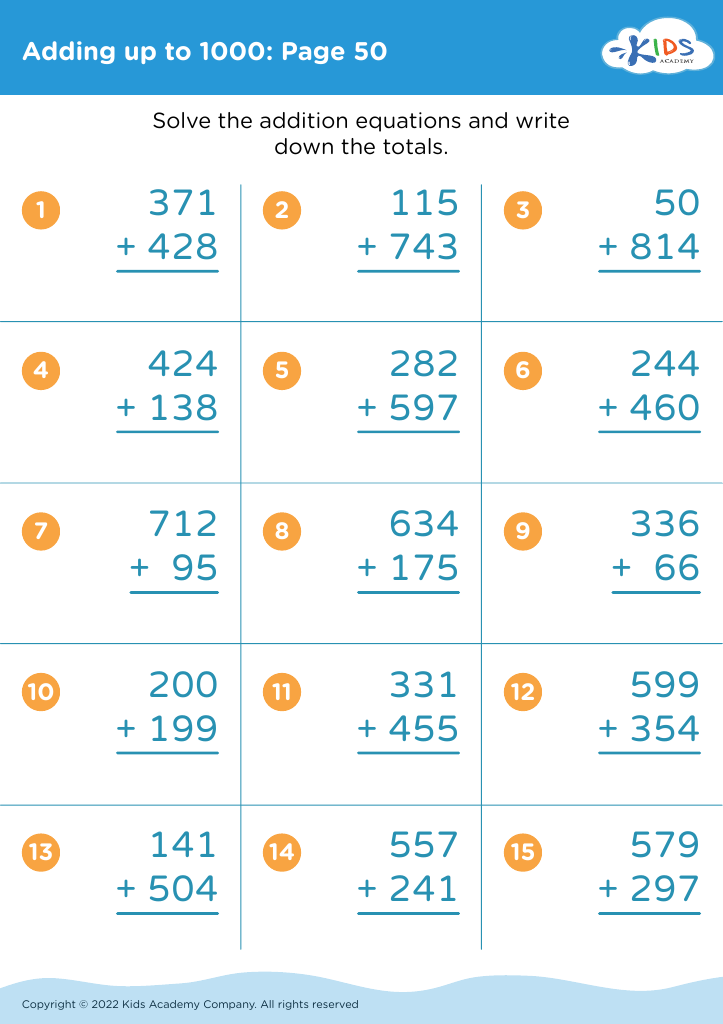
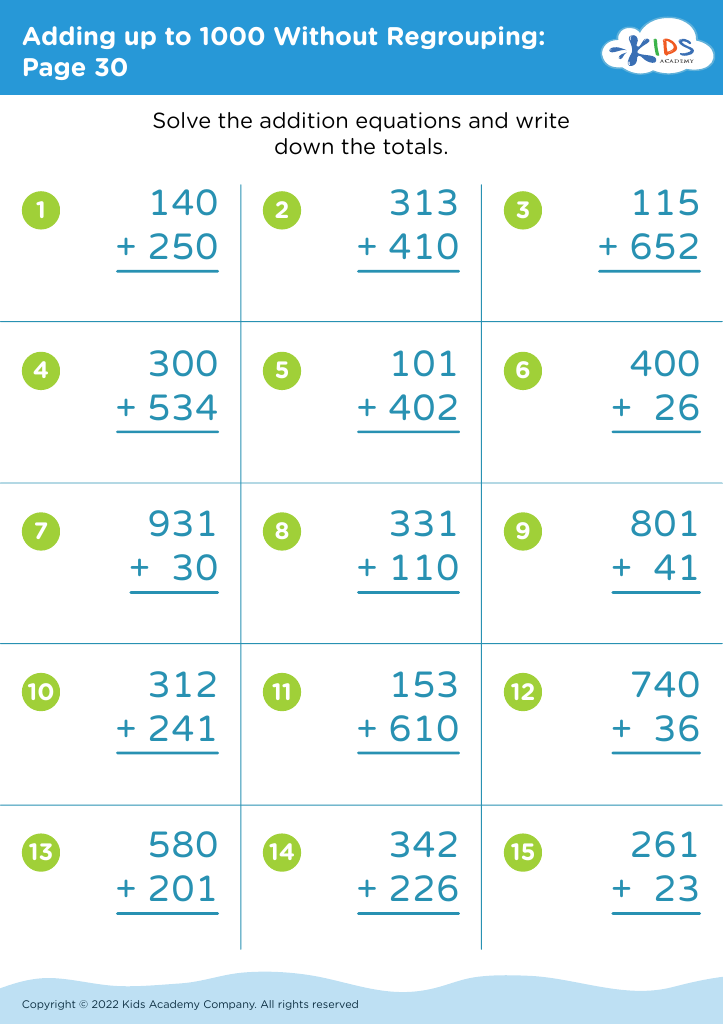
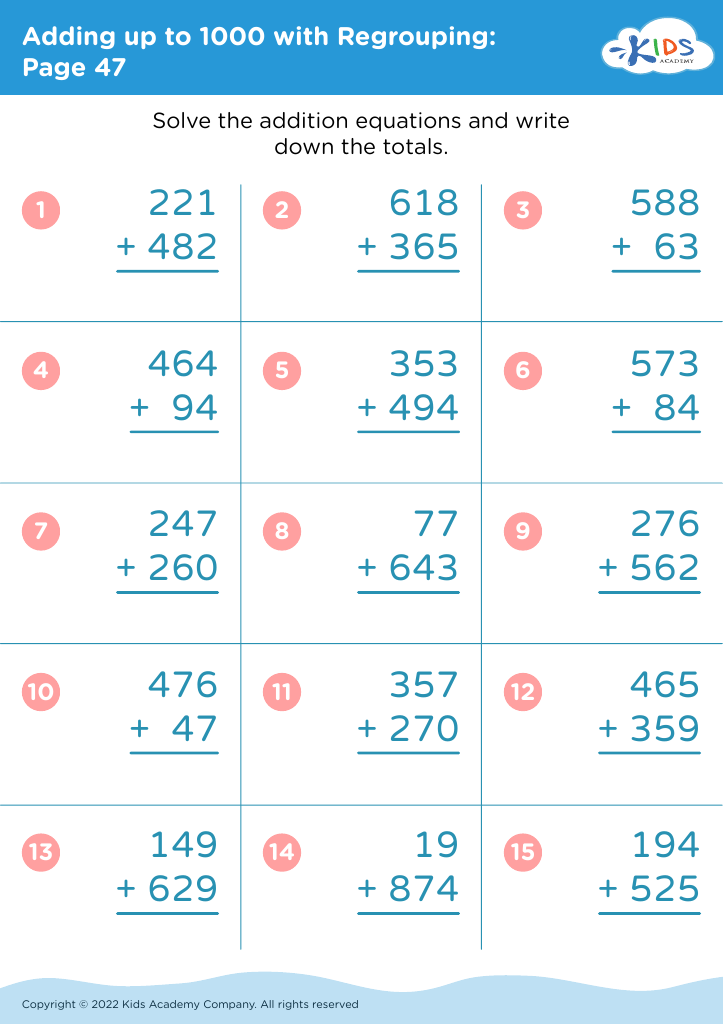



Parents and teachers should care about basic addition skills adding up to 1000 because they form the foundation for more complex mathematical understanding and real-world problem-solving. Children who grasp these skills can confidently tackle everyday tasks, such as managing money, telling time, and measuring ingredients. Proficiency in addition up to 1000 develops mental agility, enhancing a child's ability to perform calculations quickly and accurately. This foundational knowledge also supports future learning in subjects like multiplication, division, and fractions.
Moreover, mastering basic addition boost children's confidence and fosters positive attitudes towards math, which can influence their overall academic performance and lifelong interest in learning. Inconsistent or weak skills in basic addition can lead to frustration and difficulty in higher-level math and science classes, potentially limiting educational and career opportunities.
For parents, supporting these skills at home reinforces what children learn in school, creates an engaged learning environment, and strengthens the child-parent relationship through shared educational activities. Teachers need students to have strong basic addition skills to build a cohesive learning progression; without these fundamental skills, they have to address these gaps continuously, which can hinder the entire class's progression. Together, parents and teachers lay the groundwork for solid, future-proof educational development by prioritizing basic addition skills.








