Develop counting skills Adding up to 1000 Worksheets
3 filtered results
-
From - To
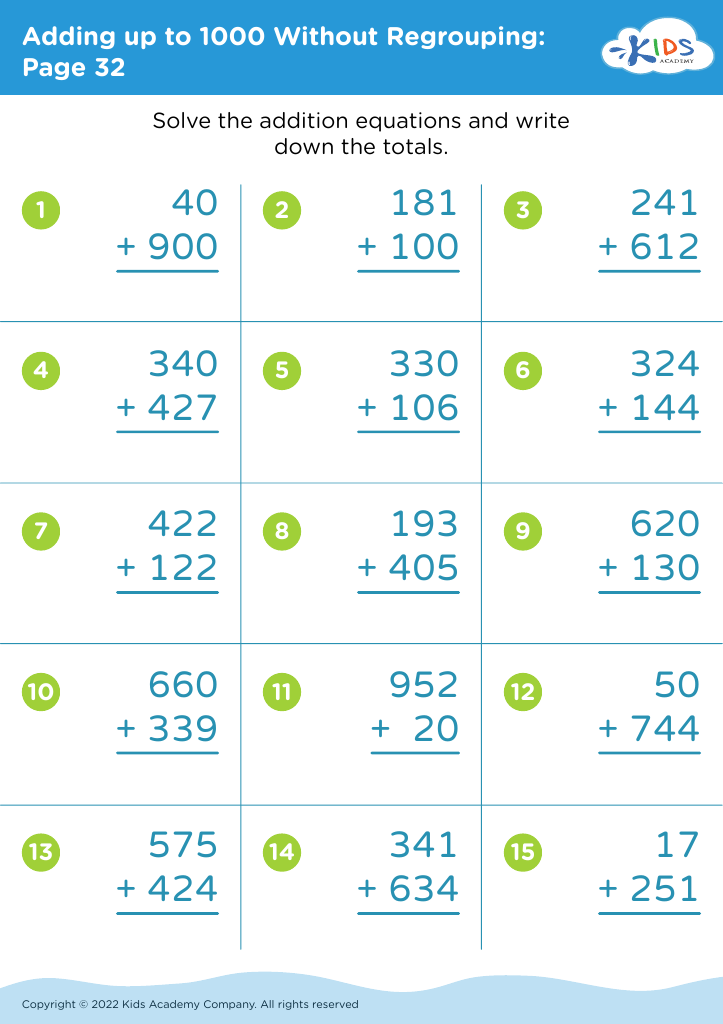
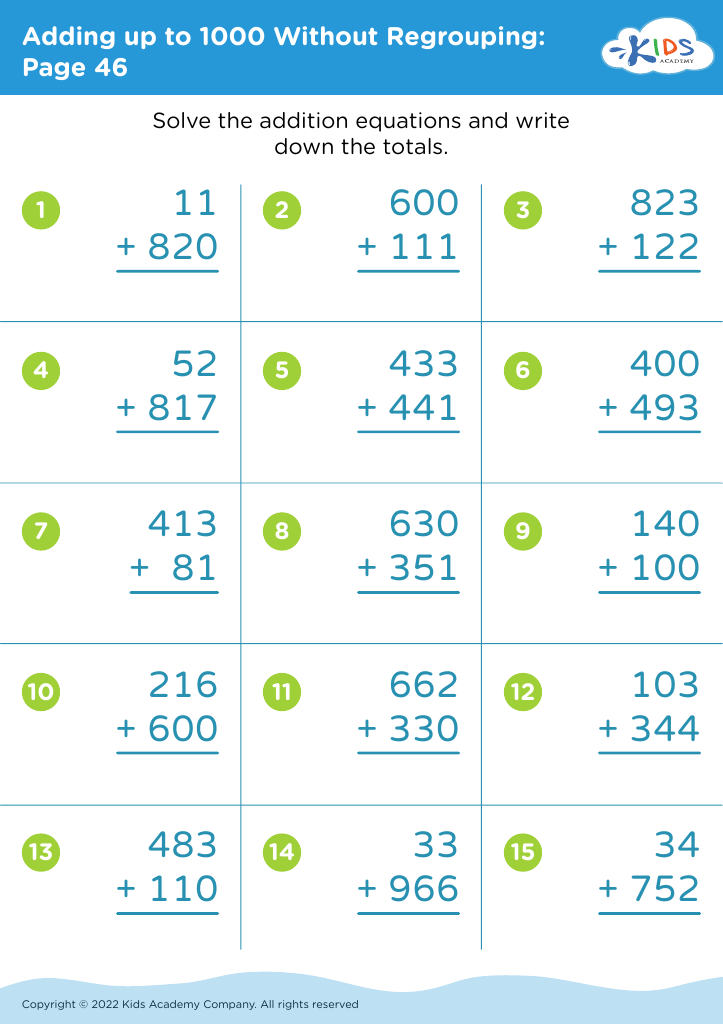
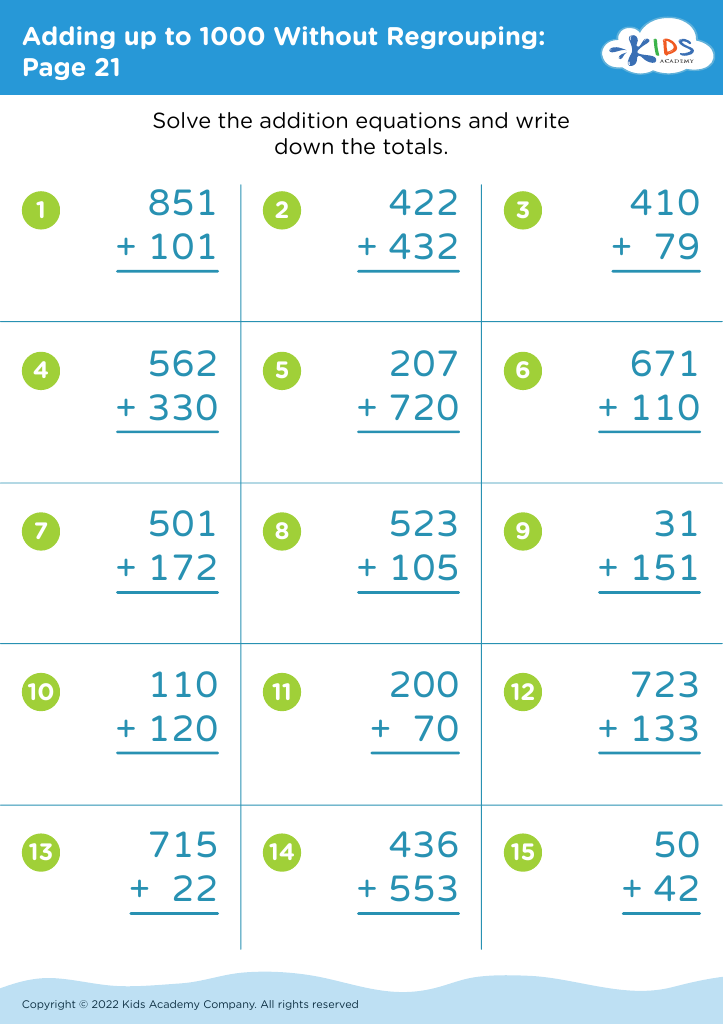
Enhance your child's counting abilities with our comprehensive "Develop Counting Skills Adding up to 1000 Worksheets". These carefully designed worksheets from Kids Academy are perfect for kids to practice and master addition up to 1000. Through engaging exercises and captivating visuals, children will strengthen their understanding of larger numbers, build mental arithmetic skills, and gain confidence in their counting capabilities. Ideal for both classroom and home use, these printable worksheets offer strategic practice to improve accuracy and speed in math calculations, laying a solid foundation for future math success. Download now to make learning addition both enjoyable and educational!



Developing counting skills and being able to add numbers up to 1000 holds significant importance for young learners and their guardians. As foundational math proficiency underpins nearly every aspect of mathematical learning and comprehension, nurturing these abilities at an early age is crucial.
First, counting and adding to 1000 enhance children's number sense, or their understanding of numbers and their relationships. This fundamental competency paves the way for more advanced math topics like multiplication, division, fractions, and even algebra. The ability to comprehend large numbers is integrated into daily life—consider shopping, cooking, or even playing sports—and thus fluency here can foster practical life skills.
Secondly, these math abilities are critical for academic success and confidence in the school setting. Early proficiency in math not only affects performance in future math courses but also indirectly supports success in other subjects, contributing to a well-rounded education.
Thirdly, engaging in counting and basic arithmetic aids in cognitive development. Skills like problem-solving, analytical thinking, and logical reasoning are all nurtured through consistent math practice.
Parents and teachers play vital roles in guiding children through these milestones, helping them develop a positive attitude toward math. In an increasingly data-driven world, ensuring kids are comfortable with these fundamentals helps equip them for a wide array of future opportunities.








