Problem-solving practice Adding up to 1000 Worksheets
3 filtered results
-
From - To
Enhance your students' mathematical skills with our "Problem-Solving Practice: Adding up to 1000 Worksheets." These engaging worksheets are designed to reinforce critical thinking and problem-solving abilities while mastering addition concepts. Perfect for early-grade learners, they provide a variety of problems that challenge students to apply their knowledge in practical situations. Each worksheet encourages kids to strategize and think independently, making math both fun and applicable. With clear instructions and an array of practice questions, educators can seamlessly integrate these resources into their lesson plans, aiding students in building a strong foundation in math while boosting their confidence. Start learning today!
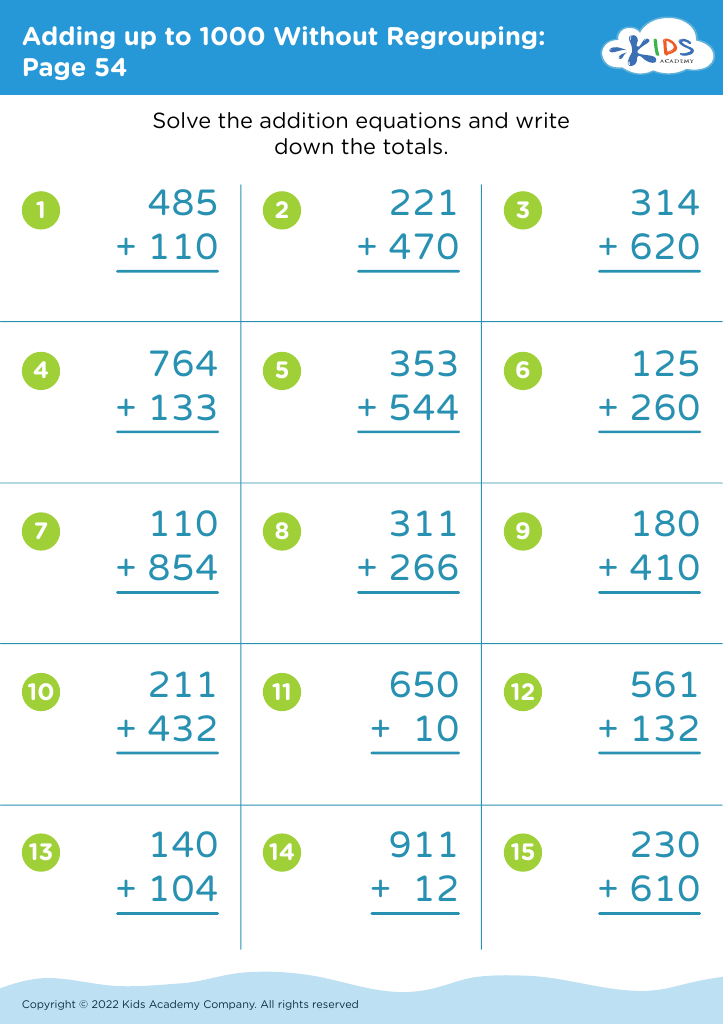
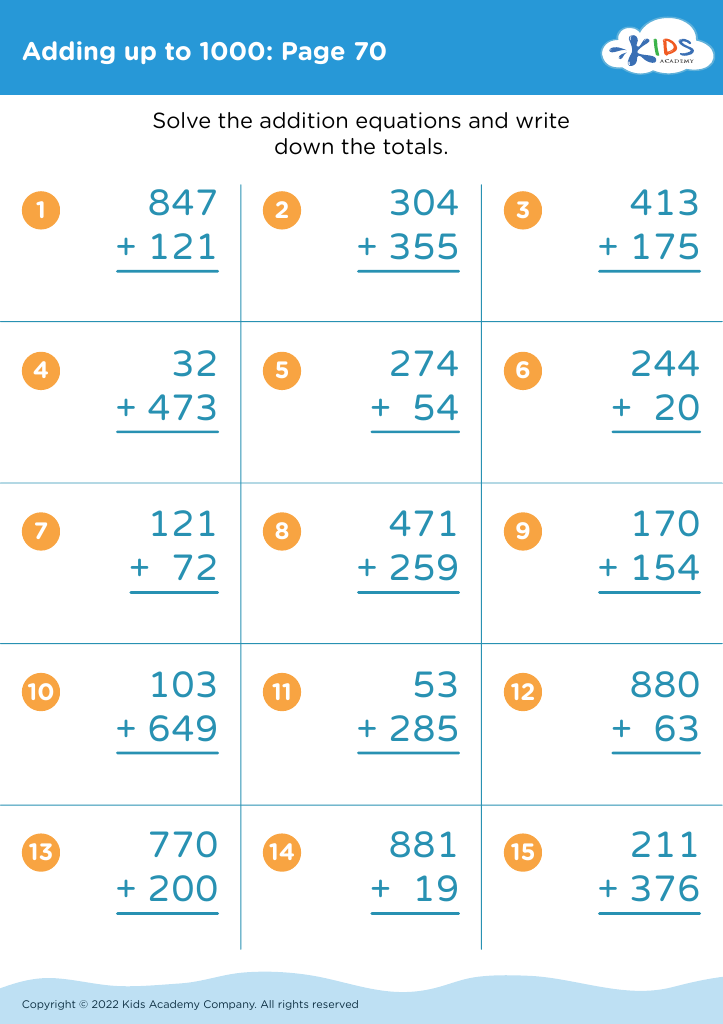
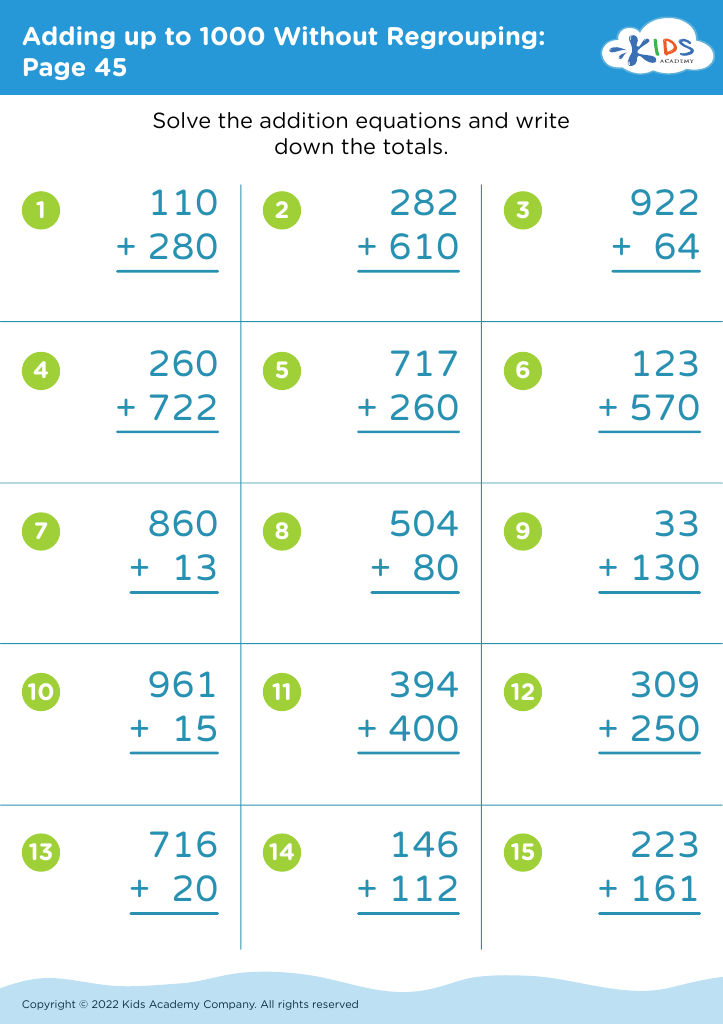



Problem-solving practice, especially when it involves adding up to 1000, is pivotal in a child’s mathematical journey. First, it enhances critical thinking skills, essential for tackling real-life challenges. As children work on problem-solving tasks that involve large sums, they develop the ability to analyze situations, make decisions, and evaluate outcomes. This foundational skill will not only aid them academically but will also be beneficial in everyday life.
Second, engaging with these problems builds students' confidence in their mathematical abilities. As they successfully tackle addition problems while striving to reach 1000, they experience a sense of achievement that fosters a positive attitude towards learning math. Increased confidence can lead to participation in higher-level math studies later on, promoting a continuous growth mindset.
Additionally, practicing problem-solving enriches teamwork and communication skills. When children work in groups to solve these problems, they learn to articulate their thought processes, listen to others, and negotiate solutions.
Lastly, integrating fun and challenging problem-solving activities at home or in the classroom encourages lifelong learning habits. Thus, parents and teachers should prioritize problem-solving practice as it is crucial not only for mastering math but for nurturing versatile, resilient, and capable individuals ready to face future challenges.








