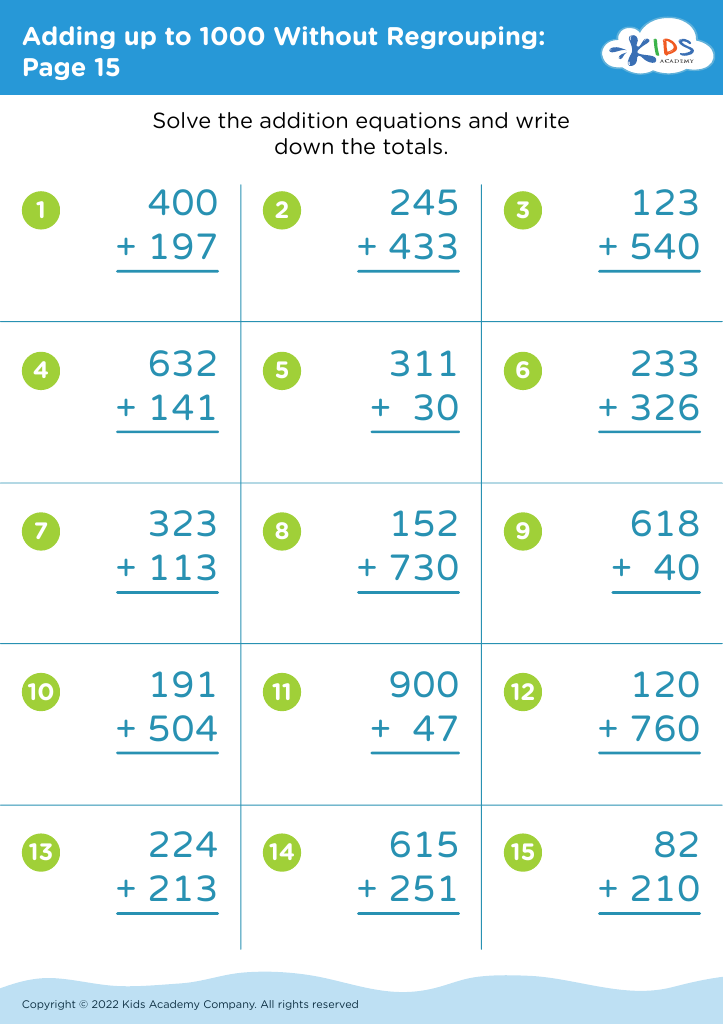



Teaching problem-solving skills using addition up to 1000 is essential for young learners because it lays the foundation for broader mathematical understanding and encourages the development of critical thinking skills. When children practice adding numbers to 1000, they not only become proficient in basic arithmetic but also develop strategies for breaking down complex problems into manageable parts.
Mastery of addition within this range helps children gain confidence in mathematics, reducing anxiety about more complex math topics they will encounter later. Furthermore, problem-solving with larger numbers promotes persistence and resilience. Children learn that complex problems can have multiple solutions and that persevering through mistakes is essential for success.
This skill is not confined to math; it integrates into everyday life, from managing finances to making logical decisions. Parents and teachers who focus on these skills are helping students build a toolkit for future academic and life challenges.
Moreover, engaging students in problem-solving activities can make learning mathematics more interactive and fun. It transforms a potentially abstract, rote-learning process into an engaging, brain-stimulating challenge. This holistic approach to learning thus supports comprehensive intellectual and personal growth, making problem-solving skills an invaluable part of early education.








