Understand multiplication Adding up to 1000 Worksheets
3 filtered results
-
From - To
Welcome to our "Understand Multiplication Adding Up to 1000 Worksheets" page! These engaging worksheets are designed to help young learners grasp the fundamental concept of multiplication. By reinforcing their skills in adding numbers up to 1000, students will develop a strong mathematical foundation. Each worksheet offers fun and challenging problems that encourage problem-solving and critical thinking. With clear instructions and various exercises, teachers can easily incorporate them into lessons or homework. These resources foster confidence in multiplication, making learning enjoyable and effective. Explore our collection today and watch your students excel in their understanding of multiplication!
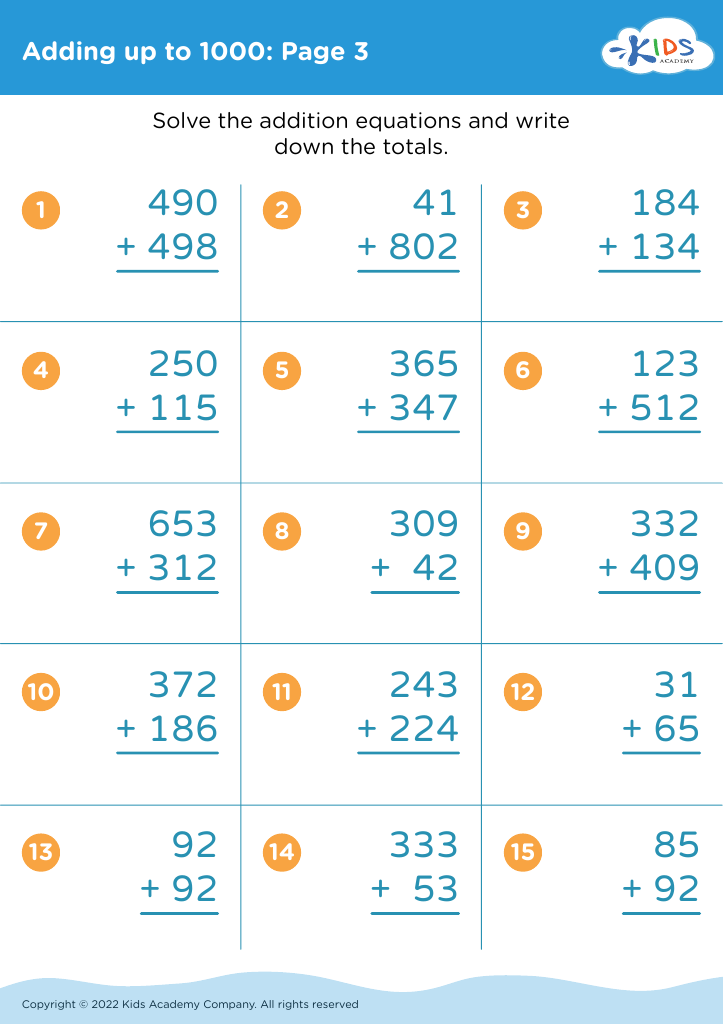
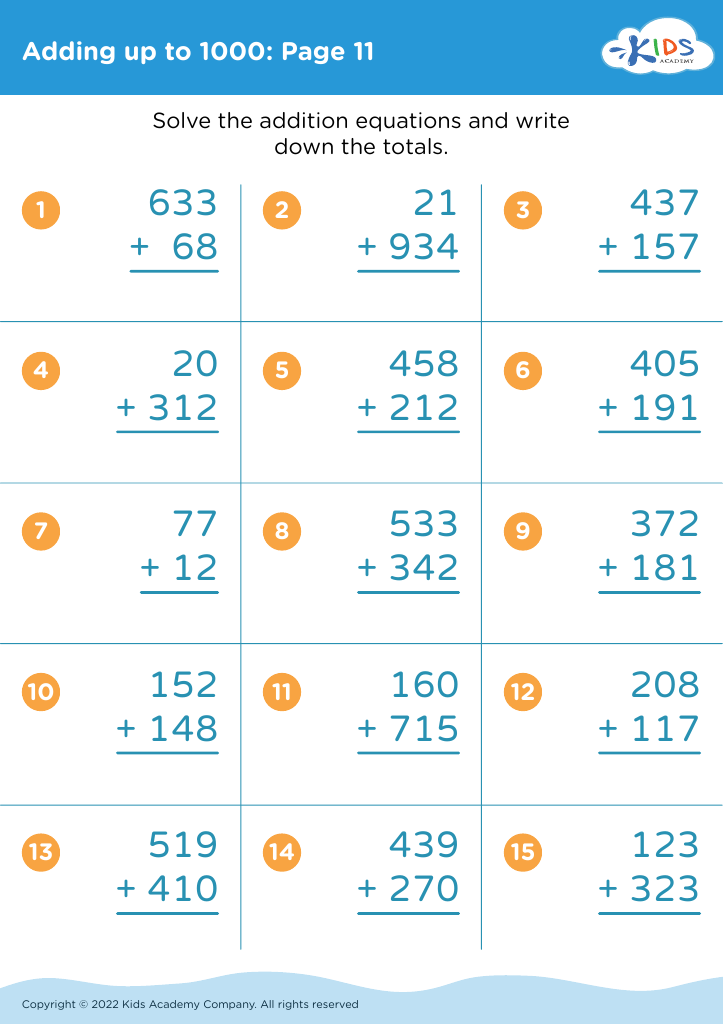
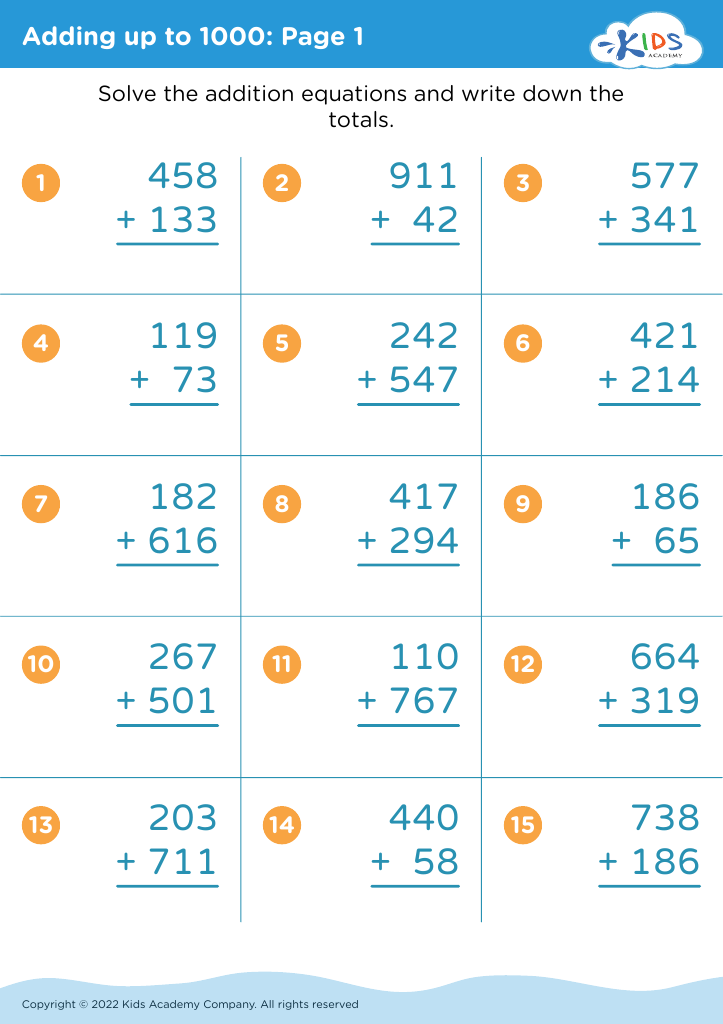



Understanding multiplication, especially when it involves numbers up to 1000, is crucial in a child's educational journey. This foundational math skill not only forms the basis for more complex mathematical concepts but also plays a critical role in everyday life. For parents and teachers, fostering a solid grasp of multiplication helps children develop problem-solving skills, enhances their logical reasoning, and improves their confidence in math.
When students understand multiplication, they can approach real-world situations—like budgeting, shopping, or planning events—more effectively. Multiplication provides a framework for comprehending larger numbers; as children master it, they can tackle more advanced math such as division, fractions, and percentages with ease.
Furthermore, strong multiplication skills enhance children’s overall academic performance. Research shows that students who excel in basic math operations often perform better in science, technology, engineering, and math (STEM) fields, making them more competitive in future educational and career choices.
By prioritizing multiplication, parents and teachers equip children not only with essential mathematical tools but also with critical thinking skills that benefit them in varied life scenarios, promoting lifelong learning and adaptability.








