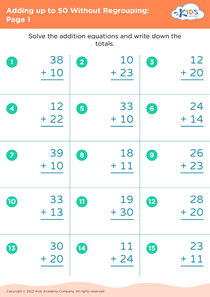
Addition skills Adding up to 50 with Regrouping Worksheets
3 filtered results
-
From - To
Unlock your child's potential in mathematics with our "Addition Skills: Adding Up to 50 with Regrouping Worksheets." Specifically designed for early learners, these worksheets simplify the process of mastering addition strategies that involve regrouping. Your child will gain confidence and proficiency in adding two-digit numbers through engaging exercises tailored for their learning needs. Each worksheet fosters critical thinking while reinforcing essential math concepts, making addition fun and manageable. With colorful illustrations and a variety of problems, students will develop the skills necessary for more complex calculations. Enhance your child's math journey today with our user-friendly regrouping worksheets!
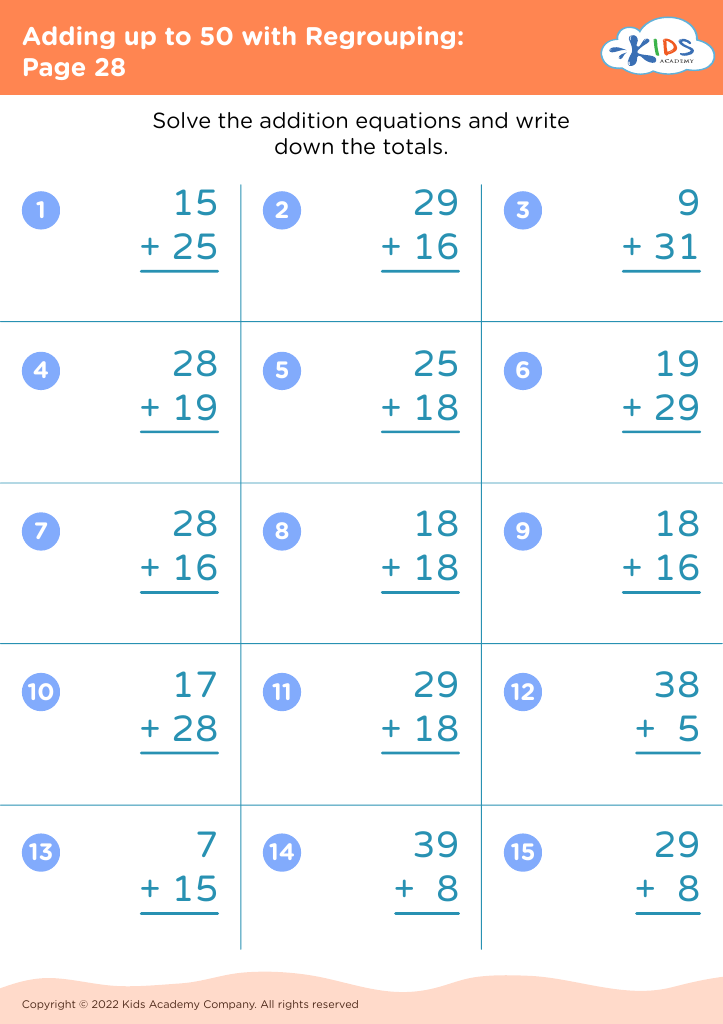
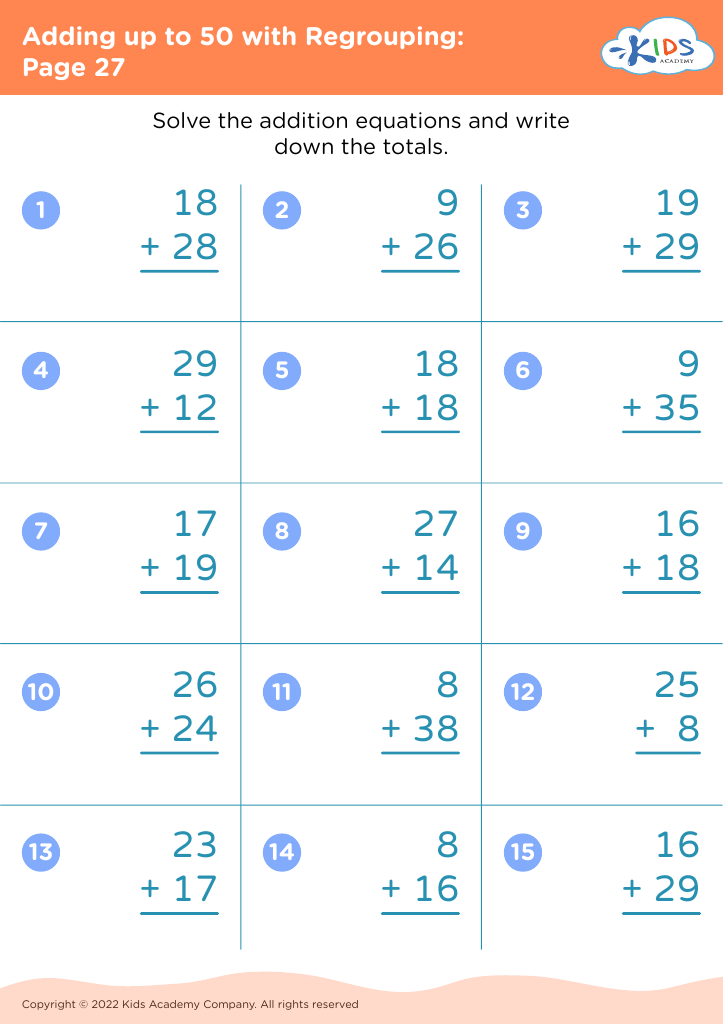
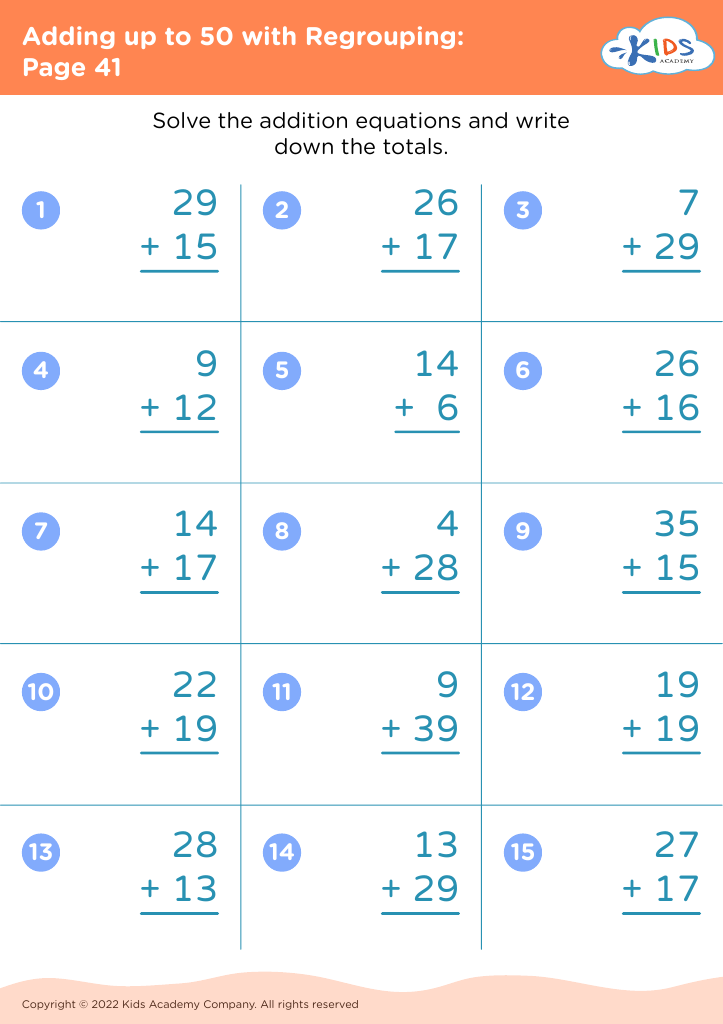


Addition skills, particularly adding up to 50 with regrouping, are crucial for children’s foundational math development and overall academic success. Parents and teachers should prioritize these skills for several reasons.
Firstly, understanding regrouping helps students master the concept of place value. When children learn to regroup, they grasp the idea of tens and ones, which is essential for more complex mathematical operations encountered later in their education, such as subtraction, multiplication, and long division.
Moreover, strong addition skills foster confidence and encourage children to engage further in math-related activities. A solid grasp of these skills promotes problem-solving abilities—skills that are invaluable in everyday life and future career paths.
Practicing addition up to 50 introduces young learners to practical applications, such as budgeting or measuring, helping them draw connections between math and real-world scenarios. This builds their relevance and engagement in the subject.
Finally, developing these foundational skills can bridge the gap between home and school learning. When parents reinforce addition principles at home, it strengthens their child’s understanding and opens lines of communication about academic progress, ultimately fostering a productive partnership in their child’s education.