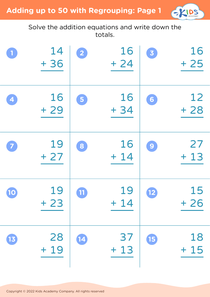
Recognizing Patterns Adding up to 50 Without Regrouping Worksheets
4 filtered results
-
From - To
"Recognizing Patterns Adding up to 50 Without Regrouping Worksheets" are designed to simplify math for young learners by focusing on basic addition skills. Ideal for early-grade students, these printable worksheets help kids recognize arithmetic patterns to add up to 50 effortlessly. The visual aids and structured exercises eliminate the need for regrouping, making mastering addition easier and more fun. Perfect for enhancing understanding of number sequences and improving problem-solving abilities. Start nurturing your child’s math confidence and foundational skills with these engaging, educational worksheets from Kids Academy. Boost proficiency in a supportive and straightforward way!
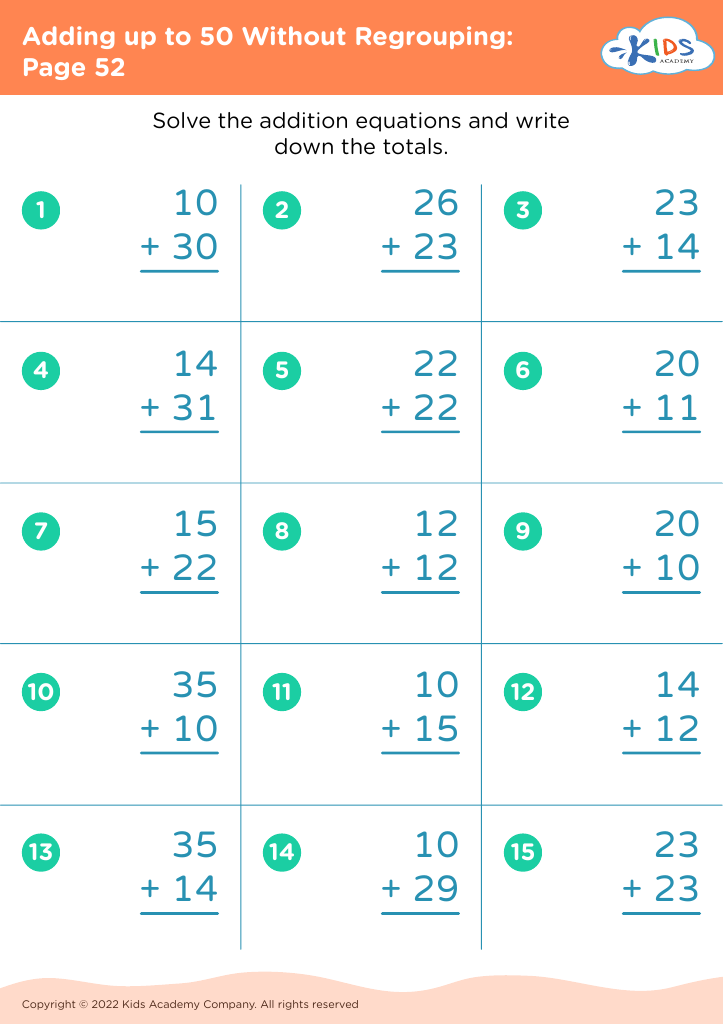
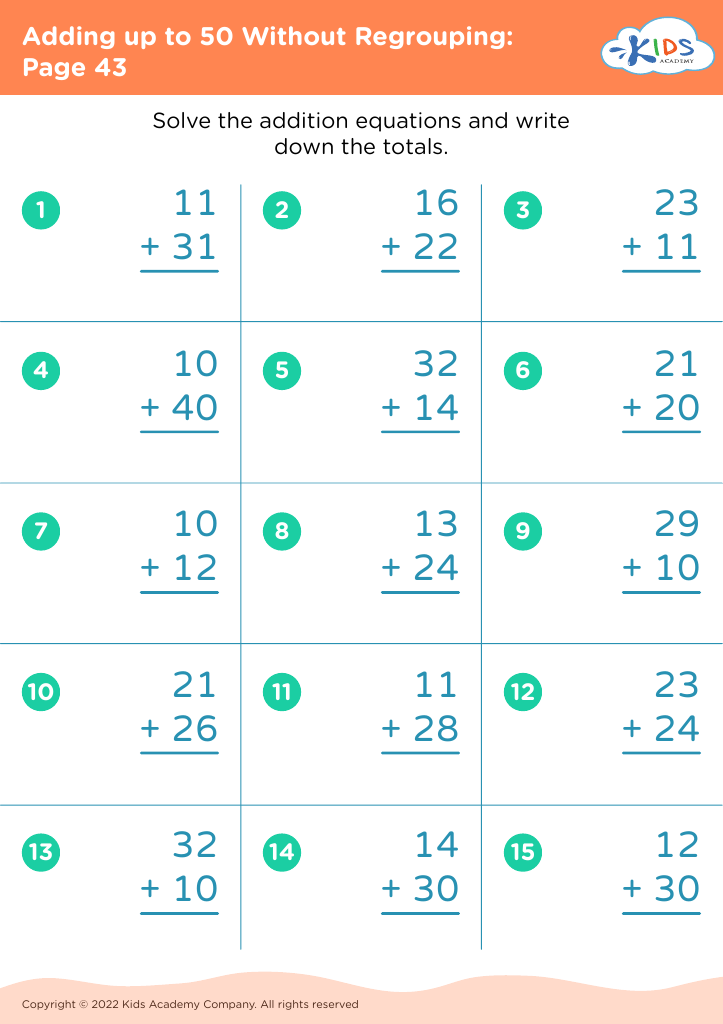
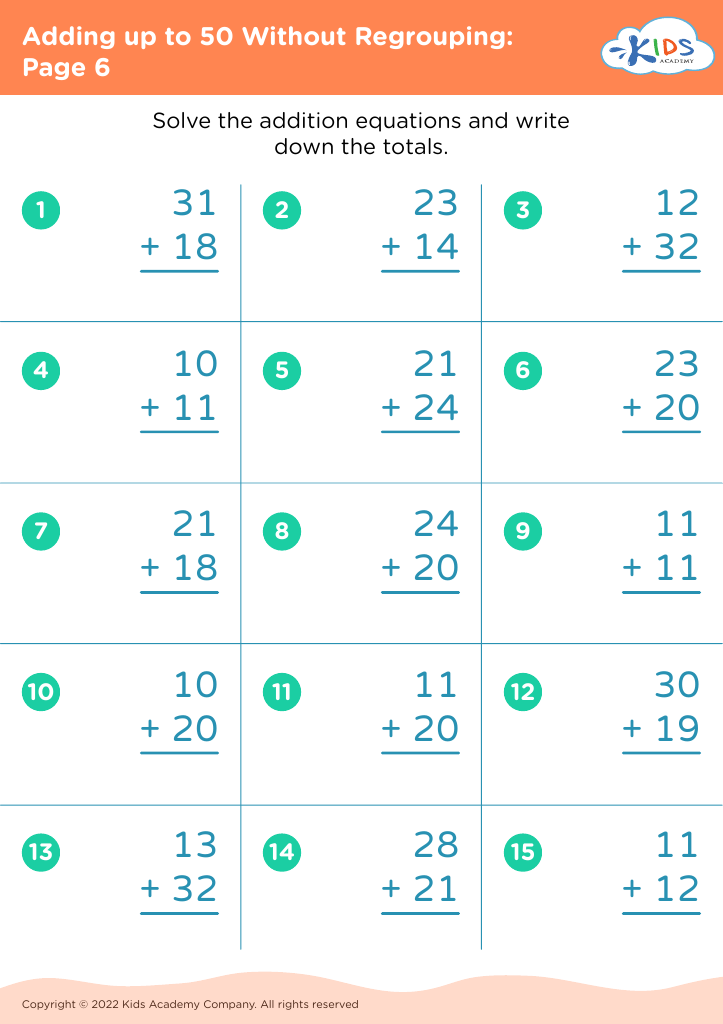
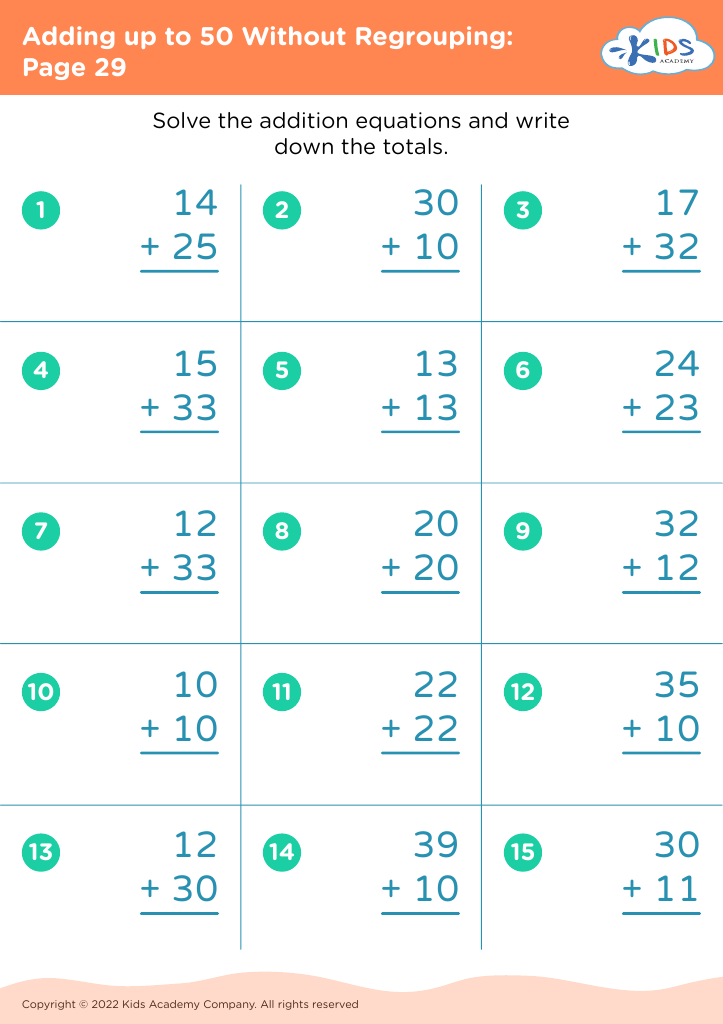


Recognizing patterns while adding numbers up to 50 without regrouping is an essential skill for young learners, and it should be a priority for both parents and teachers for several reasons. First, this capability strengthens foundational arithmetic skills, building a strong base for future math learning endeavors. When children easily recognize repetitive patterns and sums, they develop confident number sense, enhancing their ability to perform more complex calculations with ease later on.
Secondly, practicing addition within this limit fosters cognitive development by improving memory as well as problem-solving abilities. Through consistent practice, children start recognizing common addition facts without needing to count each time, speeding up their computation skills. This mental agility also translates to other subjects and real-life scenarios, where quick, accurate logistics can be invaluable.
Another critical reason is the boost in confidence and motivation that children experience when they master these skills. Realizing that they can quickly and accurately complete calculations makes them feel capable and eager to tackle more challenging tasks. Lastly, patterns in early math practice pave the way for understanding more sophisticated mathematical concepts like multiplication, division, and algebra. Establishing a solid mathematical foundation right from the early grades, thus, sets children up for long-term academic success.