Fine Motor Skills Normal Letter E Worksheets for Ages 3-4
3 filtered results
Difficulty Level
Grade
Age
-
From - To
Subject
Activity
Standards
Discover our "Fine Motor Skills Normal Letter E Worksheets for Ages 3-4," designed to enhance your child's fine motor skills and letter recognition! These engaging, educator-approved worksheets help young learners practice writing the letter E through fun tracing and coloring activities. Perfect for preschool and kindergarten aged children, our worksheets promote hand-eye coordination and pencil control, laying a strong foundation for future writing success. Stimulate your child's curiosity and passion for learning with our playful and effective Letter E worksheets. Download now and make learning a joyful adventure for your little one!
Favorites
With answer key
Interactive
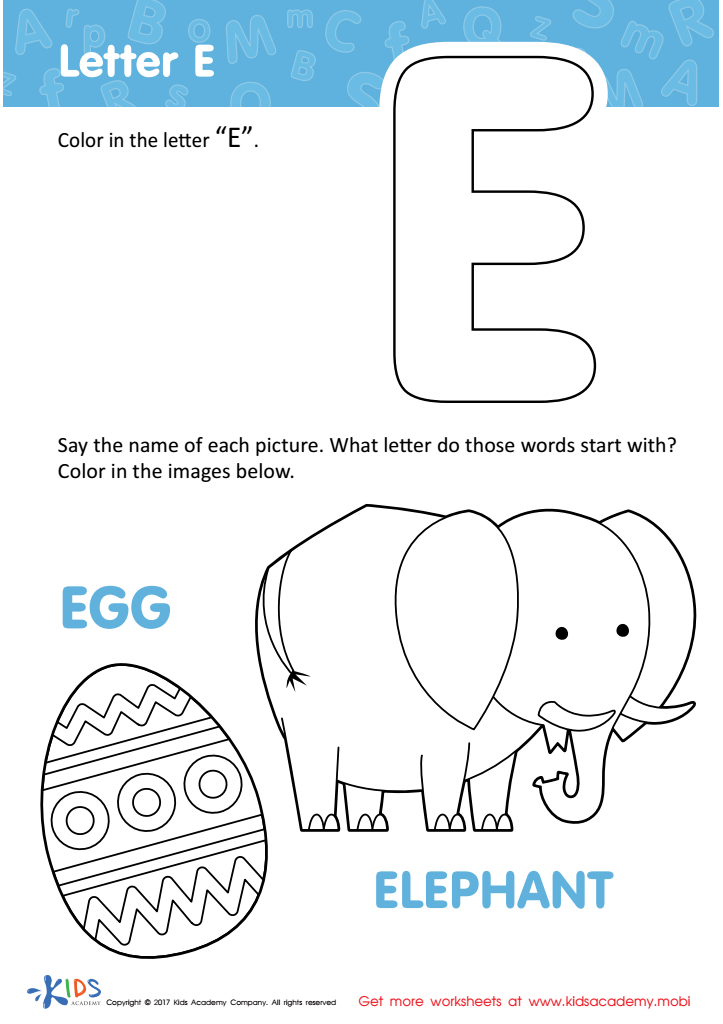
Letter E Coloring Sheet
Coloring pages are great for teaching kids the alphabet and words! This "E" page features a cute elephant and Easter egg. Kids will love it and learn the letter "E" at the same time. 80 words
Download (PDF)
 Assign to My Students
Assign to My Students
Letter E Coloring Sheet
Worksheet
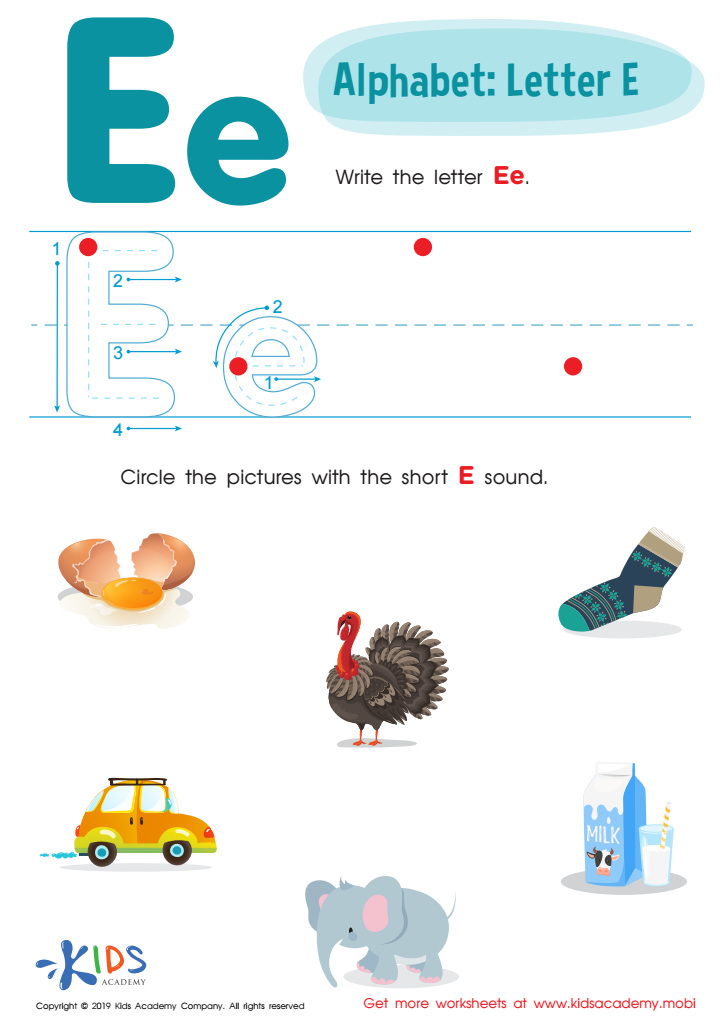
Letter E Tracing Worksheet
Students trace and write uppercase and lowercase letter E. They sound out "E" words, choosing those with short "E" sounds. Preschoolers identify the difference between the 'E' sounds in words like "egg" and "turkey." A tracing sheet helps them to understand.
Letter E Tracing Worksheet
Worksheet
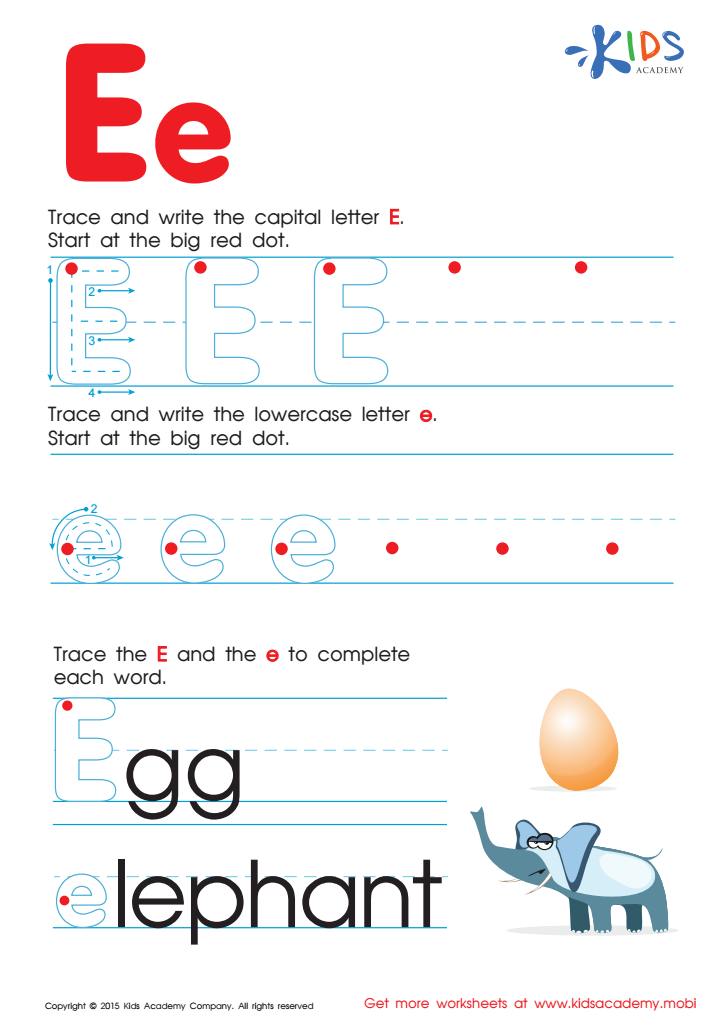
Letter E Tracing Page
Trace and write the uppercase and lowercase "E" starting at the big red dot. Complete words to perfect letter writing. Egg and Elephant must be written carefully. More alphabet worksheets for kindergarten are available for download to spend more time with your children learning.
Letter E Tracing Page
Worksheet
Join Kids Academy for Free
Who is primarily going to use this learning content?







Parents and teachers should prioritize the development of fine motor skills in 3- to 4-year-olds because these skills are critical for children's overall development and academic success. At this age, children are developing the muscles in their hands and fingers needed for tasks like writing, using scissors, and buttoning clothes. One key aspect of fine motor development is learning to write letters correctly, such as the letter "E."
Mastering the normal formation of the letter "E" improves children's handwriting, setting a foundation for legible and efficient writing in the future. Learning to write the letter "E" involves holding a pencil correctly, controlling hand movements, and understanding spatial orientation—all essential components of fine motor skill development. These skills extend beyond just writing; they also play a role in coloring, drawing, and other classroom tasks that demand precision and coordination.
Early proficiency in fine motor activities promotes cognitive development and boosts self-esteem as children gain independence in daily tasks. It supports their ability to focus and follow instructions, key aspects of early learning environments. Therefore, nurturing fine motor skills through activities that teach proper letter formation is vital for a child’s academic and personal growth.