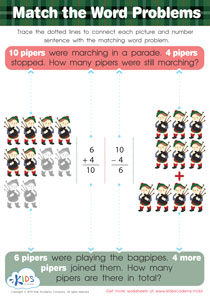
Mental math practice Normal Addition Worksheets for Ages 3-4
3 filtered results
Difficulty Level
Grade
Age
-
From - To
Subject
Activity
Standards
Boost your toddler’s math skills with our Mental Math Practice Normal Addition Worksheets tailored for ages 3-4. These engaging worksheets are designed to help your preschooler master basic addition concepts effortlessly. Each worksheet promotes cognitive development and reinforces early math principles through fun, visually appealing activities that hold your child’s attention. Perfect for home or classroom use, our addition practices enhance your little one's problem-solving abilities, laying a strong foundation for future mathematical success. Download now and set the stage for a lifetime of love for numbers and mental math proficiency!
Favorites
With answer key
Interactive
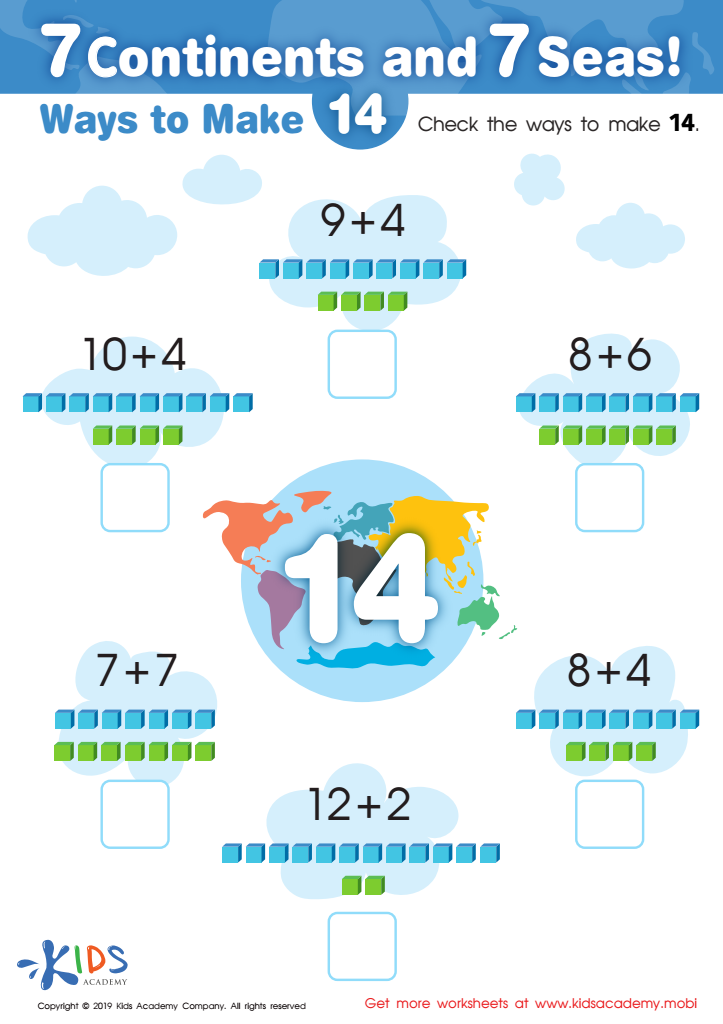
7 Continents and 7 Seas Worksheet
Remind kids of the continents and show them how different numbers can add up to the same figure. Give examples, like 2+2 =4, and 3+1 =4. Ask if they can provide other examples, then work through the simple additions in this worksheet with them. Ask them to circle all equations that make 14.
 Assign to My Students
7 Continents and 7 Seas Worksheet
Worksheet
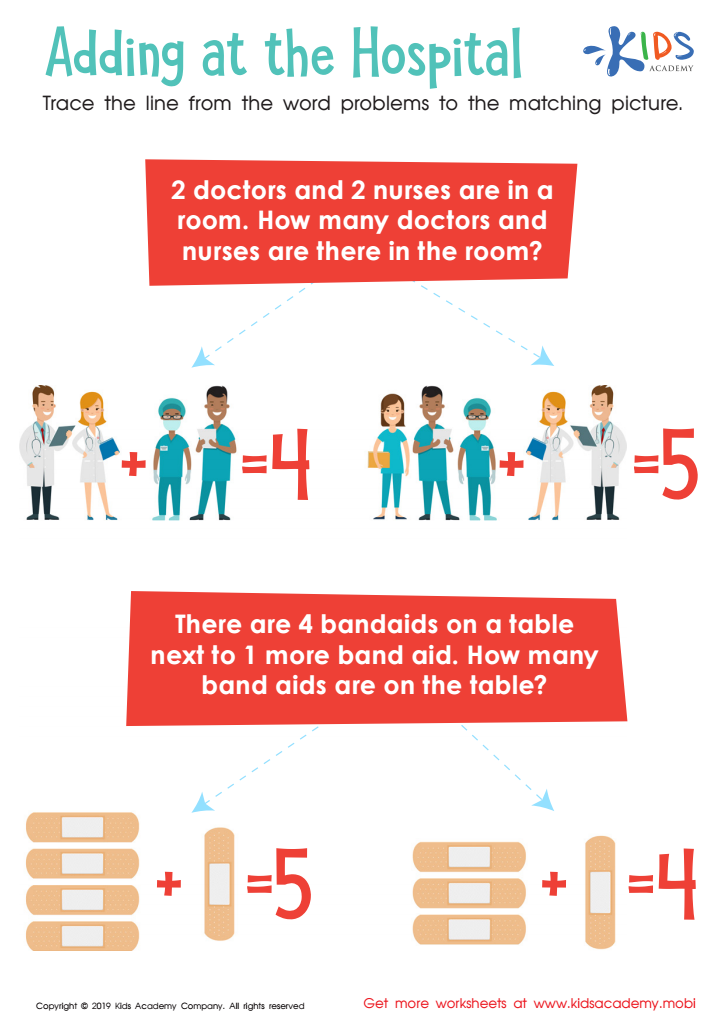
Adding at the Hospital Worksheet
A hospital visit doesn't have to be scary for kids. With this worksheet, they can count along with doctors and nurses, by reading the word problems and tracing lines to the corresponding picture. Guide them through it and you'll help them have a fun experience.
Adding at the Hospital Worksheet
Worksheet
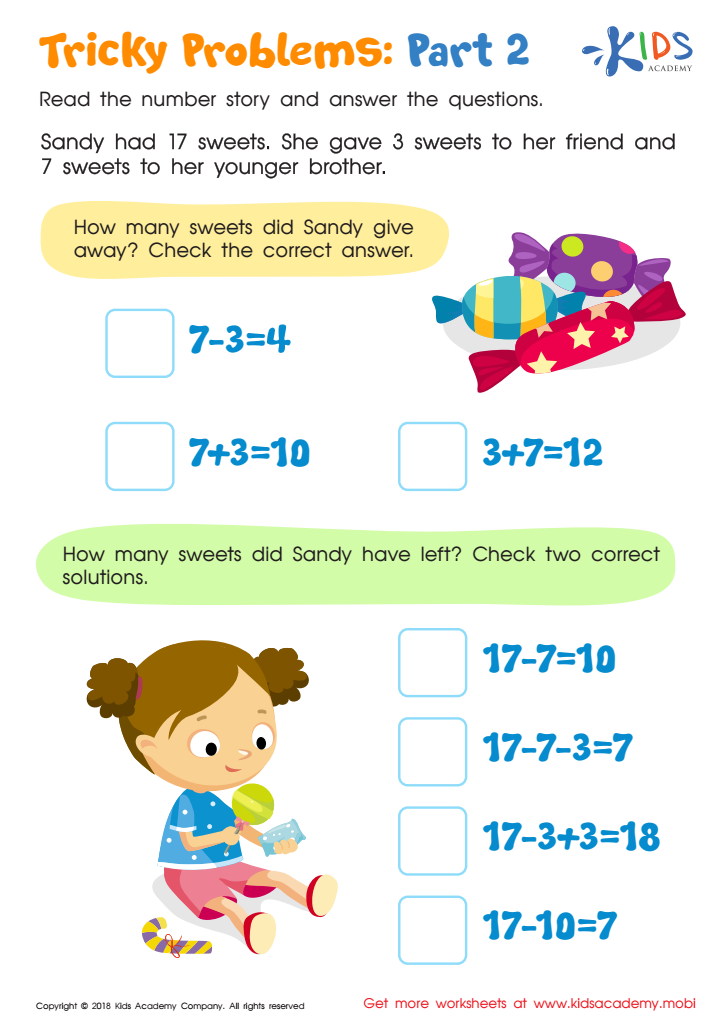
Tricky Problems Worksheet: Part 2
Help your little math learner visualize number stories with this engaging worksheet. They'll connect pictures to the story and use math facts to find the sums. After that, they'll be able to identify the correct number sentences to match. Let them practice and get better at problem solving!
Tricky Problems Worksheet: Part 2
Worksheet
Join Kids Academy for Free
Who is primarily going to use this learning content?








Parents and teachers should place a high emphasis on mental math practice, particularly normal addition, for children ages 3-4 because it lays the foundation for essential cognitive development. At this tender age, children's brains are exceptionally receptive to new information and skills. Introducing mental math engages their brain in a way that fosters numeracy, problem-solving skills, and logical thinking.
Practicing addition at this early age promotes number sense, which is the ability to understand, relate, and connect numbers effectively. This foundational skill is crucial for future mathematical learning and overall academic success. Furthermore, early exposure to addition aids in developing concentration, memory, and the ability to perform mental calculations, reducing dependence on fingers or physical aids.
Engaging toddlers in math through fun and interactive activities boosts their confidence. It also nurtures a positive attitude towards math, counteracting any potential anxiety associated with the subject. Early mathematical practice not only supports cognitive abilities but also enhances everyday life skills. For instance, understanding quantities, following simple rules, and making decisions.
Ultimately, instilling these math foundations sets the stage for a child's educational journey. They will become more adept and comfortable with the increasing complexity of mathematical concepts they encounter as they grow.