
Mental math practice Normal Addition & Subtraction Worksheets for Ages 3-5
3 filtered results
Difficulty Level
Grade
Age
-
From - To
Subject
Activity
Standards
Introduce your little learners to explosive fun with our Mental Math Practice Normal Addition & Subtraction Worksheets, specially designed for ages 3-5! These enchanting worksheets are an ideal way to develop early math skills, focusing on basic addition and subtraction in a playful manner. Encourage mental arithmetic with visually appealing exercises that build confidence and foundational skills. Perfect for both classroom settings and at-home learning, our engaging activities make math a delightful adventure. Empower your child for a bright academic future with Kids Academy, where learning is just as exciting as it is educational. These worksheets inspire math excellence every step of the way!
Favorites
With answer key
Interactive
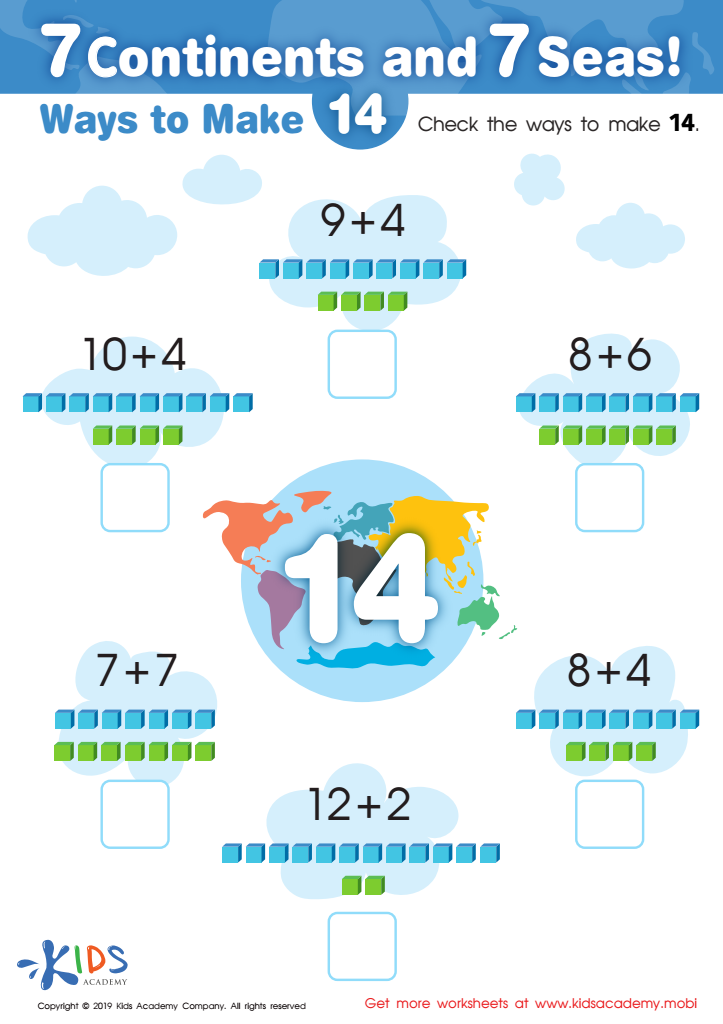
7 Continents and 7 Seas Worksheet
Remind kids of the continents and show them how different numbers can add up to the same figure. Give examples, like 2+2 =4, and 3+1 =4. Ask if they can provide other examples, then work through the simple additions in this worksheet with them. Ask them to circle all equations that make 14.
 Assign to My Students
7 Continents and 7 Seas Worksheet
Worksheet
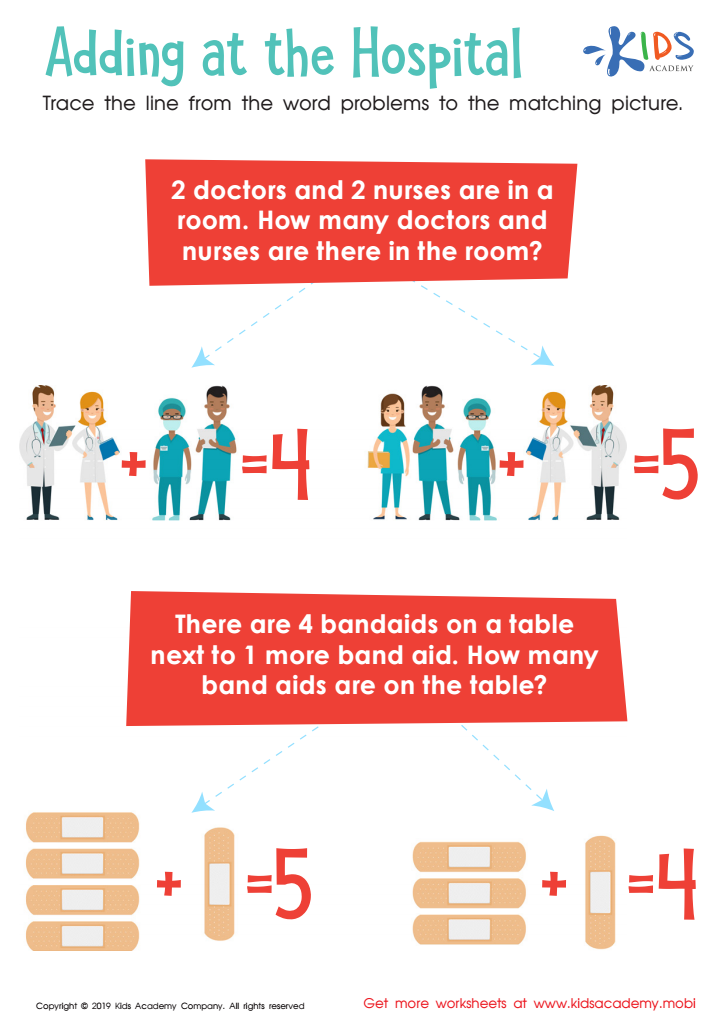
Adding at the Hospital Worksheet
A hospital visit doesn't have to be scary for kids. With this worksheet, they can count along with doctors and nurses, by reading the word problems and tracing lines to the corresponding picture. Guide them through it and you'll help them have a fun experience.
Adding at the Hospital Worksheet
Worksheet
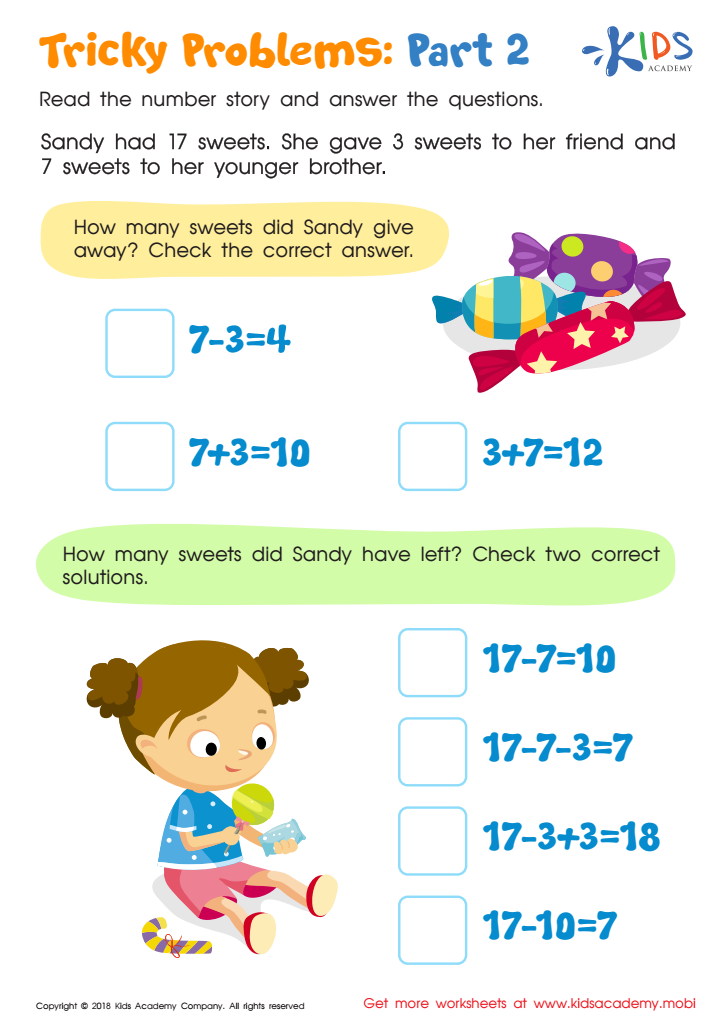
Tricky Problems Worksheet: Part 2
Help your little math learner visualize number stories with this engaging worksheet. They'll connect pictures to the story and use math facts to find the sums. After that, they'll be able to identify the correct number sentences to match. Let them practice and get better at problem solving!
Tricky Problems Worksheet: Part 2
Worksheet
Join Kids Academy for Free
Who is primarily going to use this learning content?








Parents and teachers should highly value mental math practice for young children, especially in the areas of normal addition and subtraction, because these foundational skills play a crucial role in their overall cognitive development. For children ages 3-5, engaging in mental math helps them develop number sense, which is the intuitive understanding of numbers, their relationships, and how they are affected by operations like addition and subtraction.
Introducing mental math practice at an early age encourages children to think critically and solve problems in their heads, fostering strong, flexible mathematical thinking early on. Such practice enhances their memory, concentration, and the ability to process information quickly. Kids who are proficient in mental math often find math concepts easier to grasp in their later academic years, giving them a solid foundation for more complex mathematical operations and problem-solving skills.
Furthermore, confidence in math gained through early mental practice can have a positive impact on a child's self-esteem and enthusiasm for learning. This is especially relevant since math anxiety can develop at a young age. Regular practice can make math fun and less intimidating, paving the way for a positive attitude towards the subject.
Incorporating mental math activities such as simple addition and subtraction in daily routines also assists in the development of other essential life skills, like logical reasoning and critical thinking, which are beneficial beyond the realm of mathematics. Thus, prioritizing mental math practice nurtures a child's intellectual growth, boosts academic readiness, and builds a lifelong love of learning.








