
Alphabetical order understanding Normal Letter Recognition Worksheets for Ages 3-9
3 filtered results
Difficulty Level
Grade
Age
-
From - To
Subject
Activity
Standards
Introducing our Alphabetical Order Understanding Normal Letter Recognition Worksheets, specially designed for ages 3-9. These engaging worksheets help children master the basics of letter recognition and alphabetical order, vital foundations for early literacy skills. Through fun and interactive exercises, kids learn to identify, differentiate, and sequence letters, enhancing their understanding of the alphabet and improving their reading readiness. Perfect for preschool to early elementary levels, our worksheets ensure a gradual learning curve adapted to each child's pace. Download now to support your child’s journey towards alphabetical confidence and a love for learning.
Favorites
With answer key
Interactive

Letter G Tracing Page
Get ready to trace the letter "G" – with a big red spot as the starting point, trace the lines and watch the letter appear. Uppercase and lowercase letters are both easy and fun to write. Give it a go and finish the word "go". Play the guitar and say "hello" to a funny ghost!
Letter G Tracing Page
Worksheet
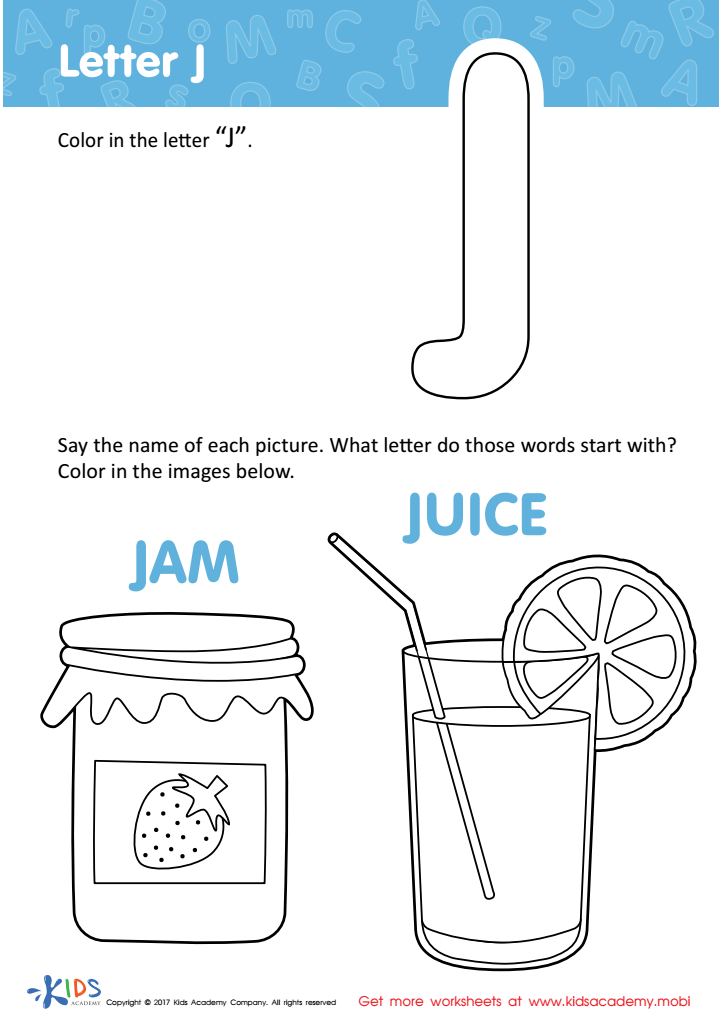
Letter J Coloring Sheet
Practice the letter 'J' with your little one with this fun coloring page! Pictures of jar, juice, jam and jelly make it an enjoyable experience for kids. Learning the letter and coloring is fun for even the youngest learners.
Download (PDF)
 Assign to My Students
Assign to My Students
Letter J Coloring Sheet
Worksheet
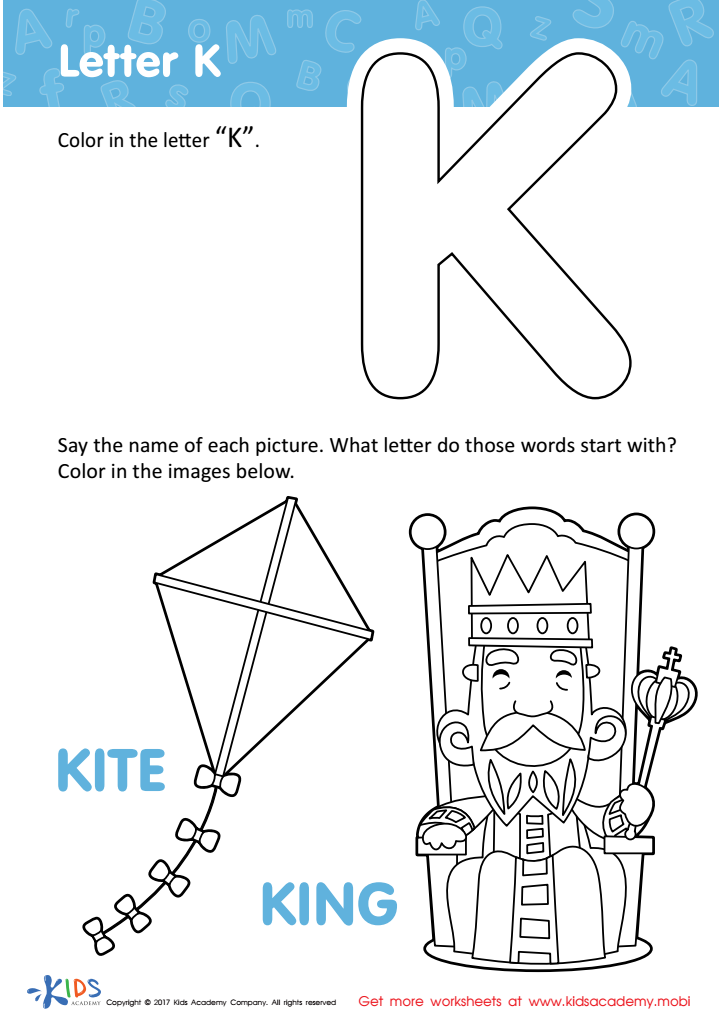
Letter K Coloring Sheet
This letter K coloring page captivates your child's creativity while learning the letter! Showcasing a king and kite, common words for their age group, it's sure to spark their imagination.
Download (PDF)
Assign to My Students
Assign to My Students
Letter K Coloring Sheet
Worksheet
Join Kids Academy for Free
Who is primarily going to use this learning content?








Understanding alphabetical order and letter recognition is fundamental for children ages 3-9, setting the groundwork for vital literacy skills. Recognizing and sequencing letters enables children to develop reading and writing proficiencies, which are essential for academic success across all subjects. Early competency in these areas fosters cognitive development by enhancing memory, attention to detail, and analytical skills.
Parents and teachers who prioritize these skills contribute to smoother, more confident learning experiences. Recognizing the alphabet helps children make connections between spoken and written language, a critical leap that supports communication skills. Establishing these abilities at a young age also promotes self-confidence and an eagerness to explore new learning opportunities.
Moreover, alphabetical order is not just a classroom skill but a practical tool. It aids in using dictionaries, organizing information, and improving logical thinking. As children engage with activities that involve letters, they develop fine motor skills, hand-eye coordination, and the ability to follow sequences, which are important for both academic tasks and daily life activities.
In sum, a firm grasp of alphabetical order and letter recognition equips children with essential skills for learning and everyday functions, cultivating a solid foundation for their future educational journeys. Parents and teachers play a crucial role in facilitating this foundational milestone.








