
Subtraction practice Normal Word Problems Worksheets for Ages 4-6
3 filtered results
Difficulty Level
Grade
Age
-
From - To
Subject
Activity
Standards
Enhance your child's math skills with our Subtraction Practice Normal Word Problems Worksheets designed for ages 4-6! These engaging worksheets provide an effective way to introduce young learners to subtraction through relatable and fun word problems. Kids will enjoy working through scenarios written in everyday language, fostering their understanding of mathematics in real-life contexts. Each worksheet focuses on developing critical problem-solving skills while ensuring that learning is fun and interactive. Perfect for classroom or home use, these worksheets will keep children motivated and excited to explore the world of subtraction. Get started today and watch your child's confidence soar!
Favorites
With answer key
Interactive
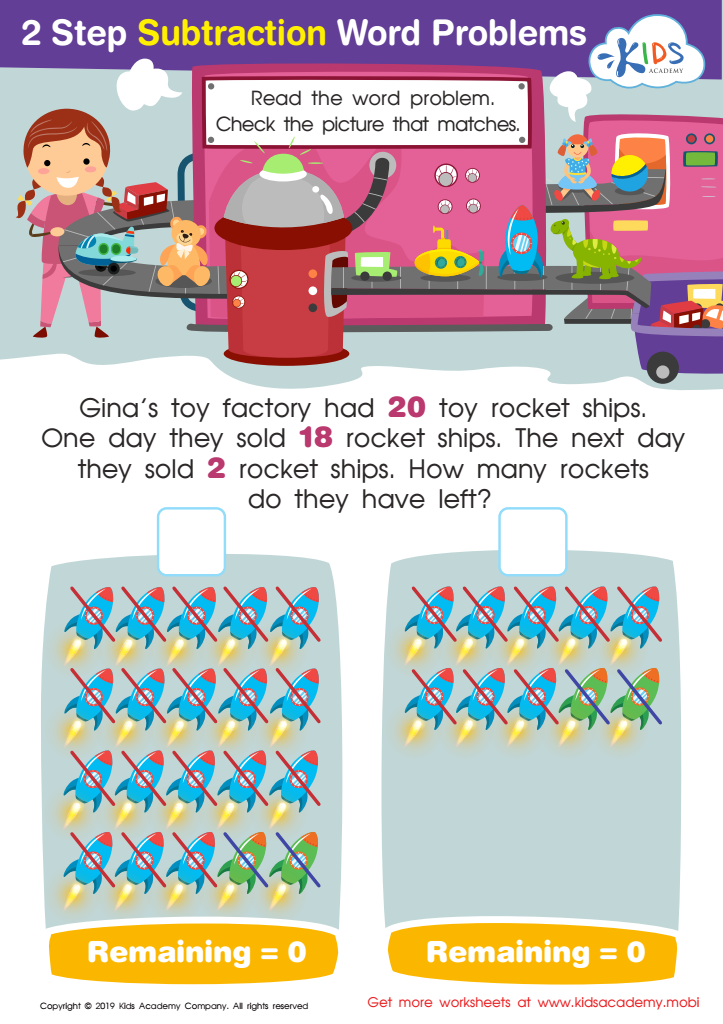
Step Subtraction Word Problems Worksheet
With this worksheet, kids can solve a multi-step subtraction problem with one-to-one number representation, helping Gina figure out her rocket count. Visualizing word problems is key, and this PDF will give your child a concrete image to work with. They'll be successful problem solvers in no time!
 Assign to My Students
Step Subtraction Word Problems Worksheet
Worksheet
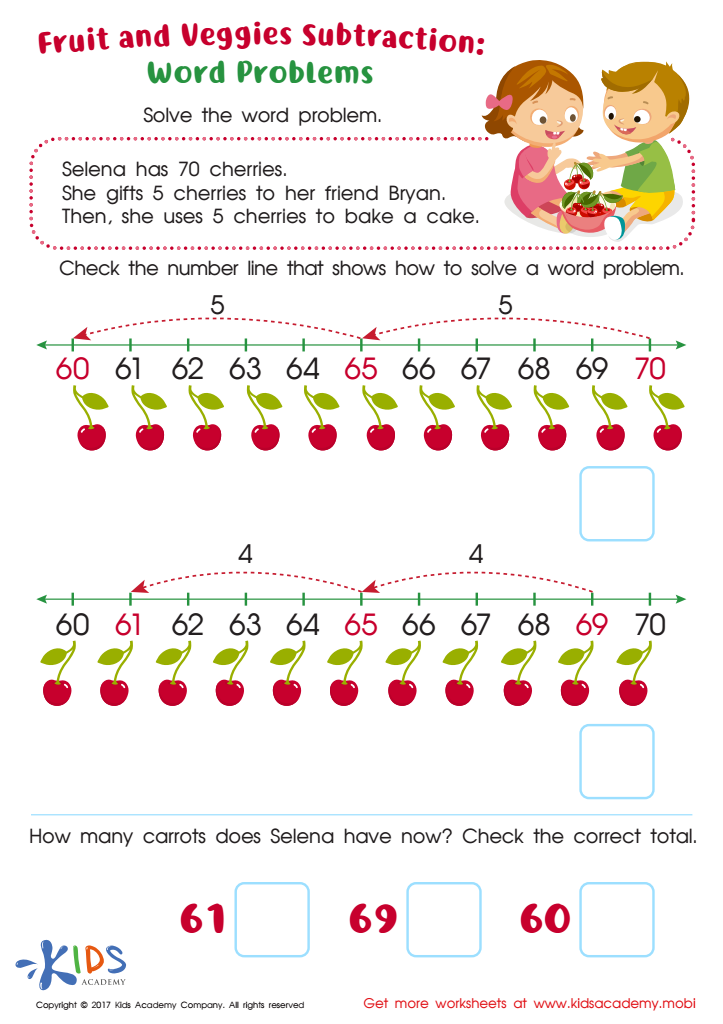
Subtraction Word Problems Free Printable
Try out this free printable subtraction worksheet! Your child can use number lines to solve challenging word problems – it's a great way to boost their problem-solving skills.
Subtraction Word Problems Free Printable
Worksheet
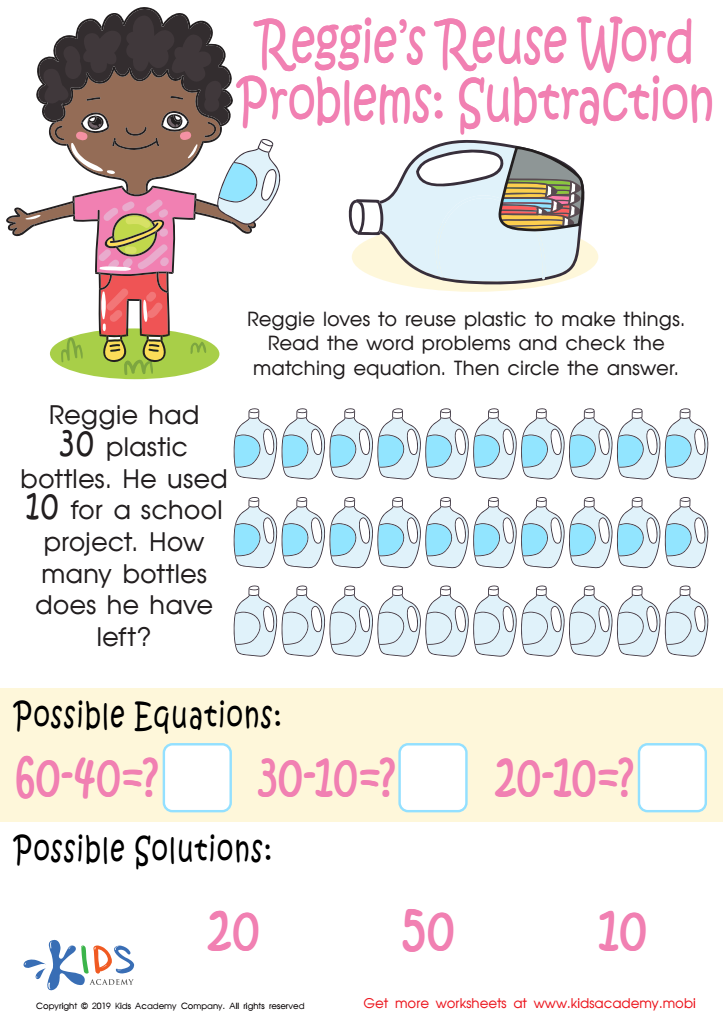
Reggie's Reuse Word Problems: Subtraction Worksheet
Kids can help pal Reggie become an eco-friendly friend! This PDF teaches kids subtraction and one-to-one number representation. They'll use pictures to solve word problems and find out how many plastic bottles Reggie can reuse. They'll also match number equations and solutions to get the right answer.
Reggie's Reuse Word Problems: Subtraction Worksheet
Worksheet
Join Kids Academy for Free
Who is primarily going to use this learning content?








Parents and teachers should prioritize subtraction practice through normal word problems for children aged 4-6 as it lays a vital foundation for mathematical understanding. At this formative stage, kids are not just learning numbers and operations; they are developing critical thinking and problem-solving skills. Word problems introduce real-life contexts for mathematical concepts, making subtraction relevant and engaging.
Practicing subtraction through relatable scenarios aids in building number sense, as children learn how to identify and manipulate quantities. This fosters their ability to visualize and conceptualize subtraction, moving beyond rote memorization to deeper understanding. Moreover, word problems enhance language skills and comprehension; kids must interpret the problem, identifying key information and translating it into mathematical actions.
Furthermore, regular practice with these problems cultivates perseverance and resilience in facing challenges, strengthening their belief in their capabilities. As they learn to solve various word problems, they also become adept at communicating their thought process, laying the groundwork for future collaborative work in math.
Ultimately, incorporating subtraction practice through normal word problems creates a holistic learning experience that nurtures cognitive skills, emotional resilience, and a positive attitude towards mathematics—a crucial asset in today's increasingly math-dependent world.








