
Lowercase letter writing Normal Worksheets for Ages 4-7
3 filtered results
Difficulty Level
Grade
Age
-
From - To
Subject
Activity
Standards
Discover our engaging Lowercase Letter Writing Normal Worksheets designed specifically for children ages 4-7! These worksheets provide a fun and interactive way for young learners to practice writing lowercase letters. With a variety of activities, including tracing, coloring, and matching exercises, students can build their fine motor skills while reinforcing letter recognition and writing proficiency. Ideal for home or classroom use, our worksheets cater to different learning styles, ensuring every child can master lowercase letters at their own pace. Encourage your child's literacy development and boost their confidence in writing with our carefully crafted worksheets tailored for early learners!
Favorites
With answer key
Interactive
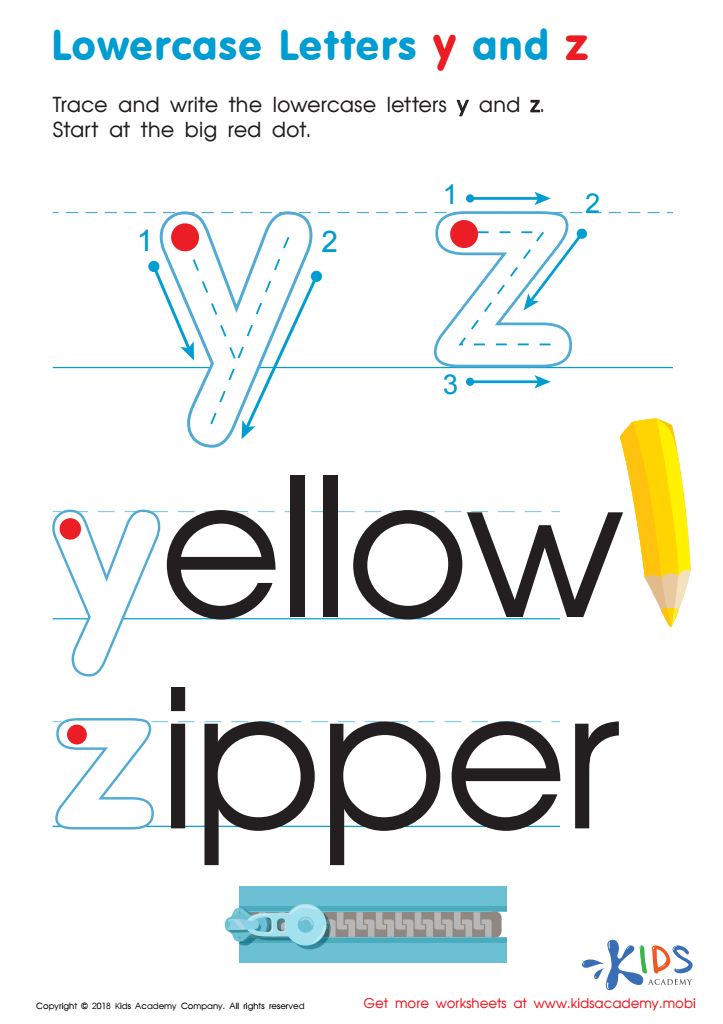
Lowercase Letters y z Worksheet
Help your child get a good start in writing and reading by tracing and writing the lowercase letters y and z. With this activity, they will learn the alphabet, which is essential for literacy success. Guide them through the worksheet and make sure they form the letters correctly. This will help them learn the basics needed to write and read fluently.
 Assign to My Students
Lowercase Letters y z Worksheet
Worksheet
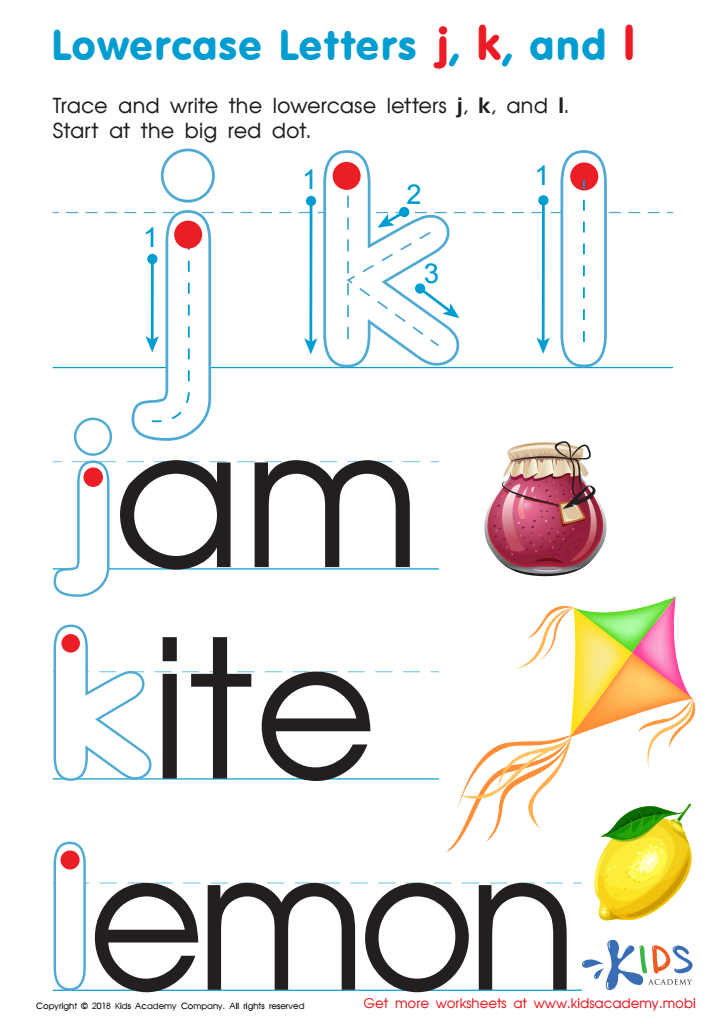
Lowercase Letters j k l Worksheet
Teach your child the difference between uppercase and lowercase letters. Have them trace and write the lowercase letters j, k, and l, starting at the red dot. Guide your child's hand to form the letters correctly.
Lowercase Letters j k l Worksheet
Worksheet
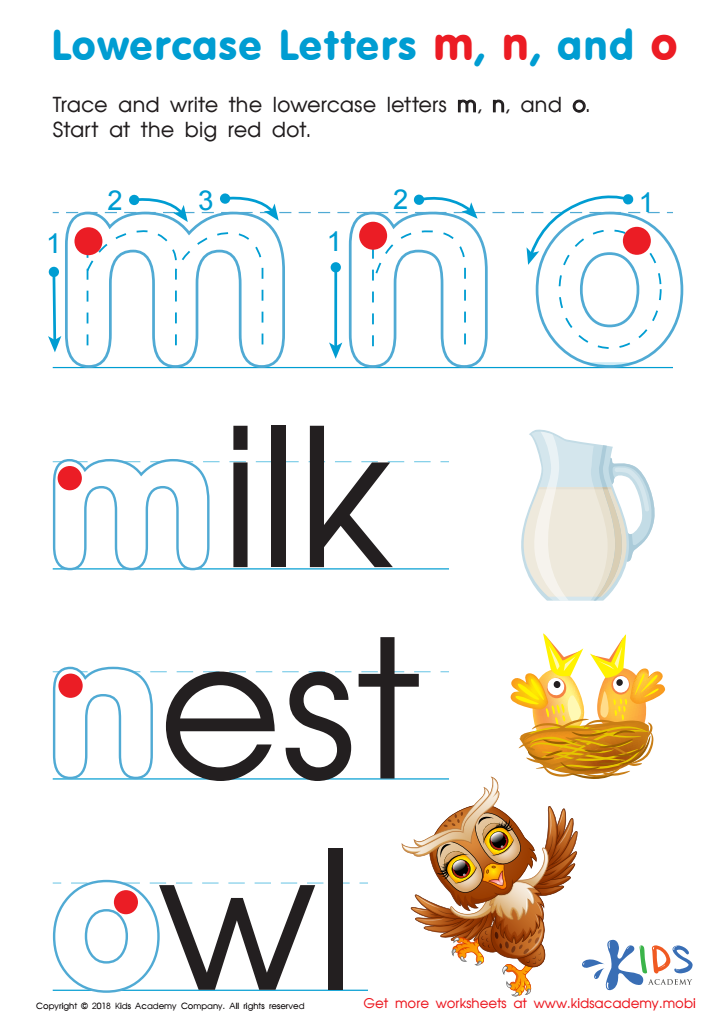
Lowercase Letters m n o Worksheet
Help your child learn the alphabet with letter tracing. Show them the difference between uppercase and lowercase letters by working through this free worksheet, tracing and writing lowercase m, n and o.
Lowercase Letters m n o Worksheet
Worksheet
Join Kids Academy for Free
Who is primarily going to use this learning content?







Teaching lowercase letter writing to children aged 4-7 is crucial for their developmental progress and literacy skills. At this age, children are in a formative stage where fine motor skills are rapidly developing. Learning to write lowercase letters exercises these skills, promoting better hand-eye coordination and dexterity. Mastery of lowercase writing is foundational since most text is written in lowercase, which aids in reading comprehension.
Furthermore, lowercase letters are essential for effective communication. As children begin to express themselves through writing, they need to understand the structure of words and sentences. Familiarity with lowercase helps them to grasp phonetic sounds and spelling, as well as differentiate between letters when writing.
Engaging in lowercase letter writing also fosters a sense of accomplishment and boosts self-esteem. When children successfully write their letters, it encourages them to explore further literary skills. Additionally, regular practice can lead to improved handwriting, which is an important aspect of their academic journey.
Ultimately, by prioritizing lowercase letter writing, parents and teachers can lay the groundwork for effective literacy development, ensuring children are well-prepared for future academic challenges. This foundational skill supports lifelong learning and communication, making it an essential focus for early education.








