Vowel Recognition Normal Short Vowels Worksheets for Ages 5-6
5 filtered results
Difficulty Level
Grade
Age
-
From - To
Subject
Activity
Standards
Unlock your child's reading potential with our Vowel Recognition Normal Short Vowels Worksheets for ages 5-6. Through engaging and colorful activities, these worksheets help young learners identify and pronounce short vowel sounds, an essential skill for early literacy. Perfect for use at home or in the classroom, each worksheet is designed to reinforce phonemic awareness. Boost your child's confidence and set them on the path to successful reading with these fun and educational resources from Kids Academy. Download now to make learning vowels a delightful experience!
Favorites
With answer key
Interactive
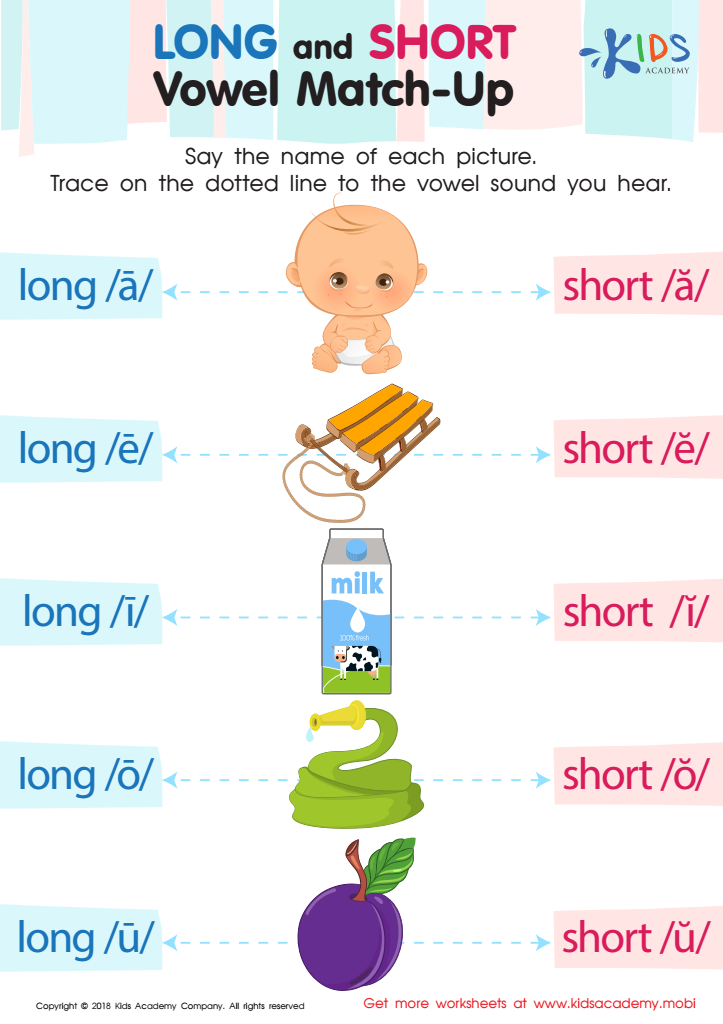
Long and Short Vowel Match up Reading Worksheet
Help your reader build confidence and refine their decoding skills! This worksheet combines long and short vowel recognition with a traceable component to improve fine motor skills. Your learner will name each picture and trace the dotted lines to get to the correct vowel sounds.
 Assign to My Students
Long and Short Vowel Match up Reading Worksheet
Worksheet
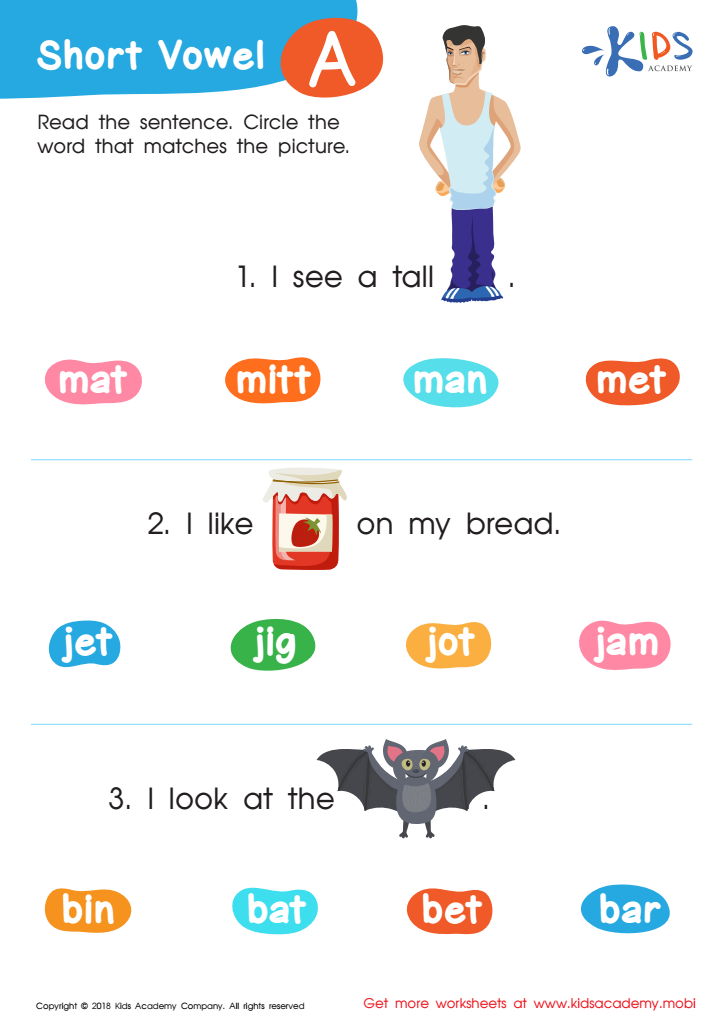
Short Vowel /a/ Worksheet
This free PDF helps new readers use sight words and pictures to read basic sentences. Then, they use accompanying word choices to find the correct word with the short a vowel sound. A key early reading skill, discriminating between short vowel sounds can be tricky in monosyllabic words, so use this PDF to help your reader reinforce it.
Short Vowel /a/ Worksheet
Worksheet
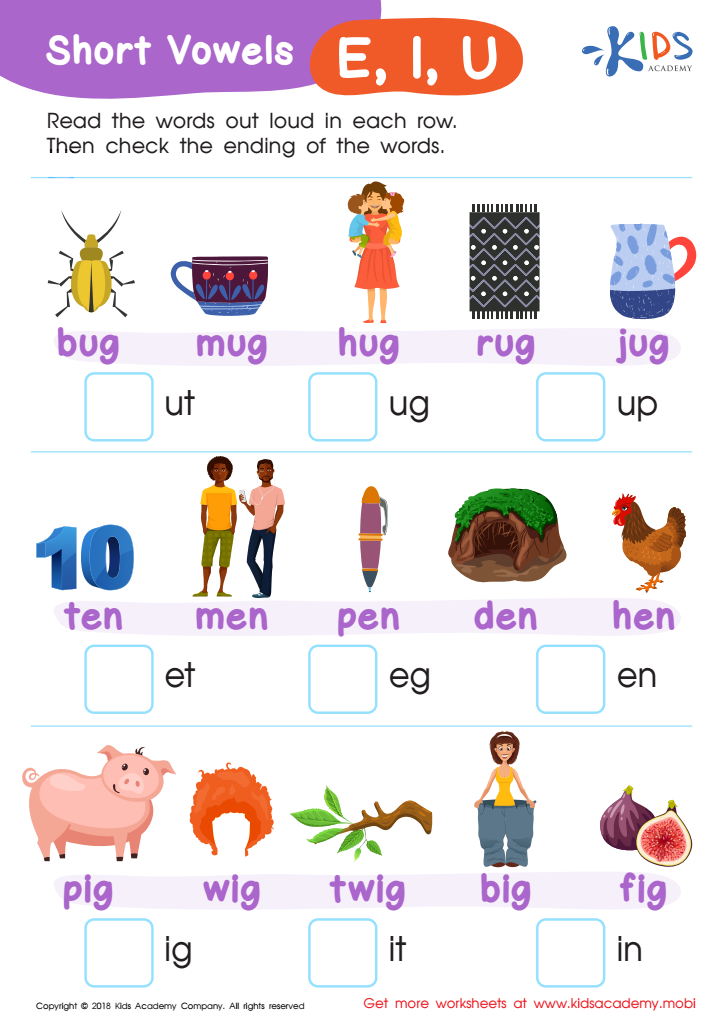
Short Vowels /e/, /i/, and /u/ Worksheet
Your emergent reader can have fun while practicing their short vowel sounds with this free, brightly colored worksheet. They'll identify one-syllable words by their pictures, then match the correct ending for each. They'll gain an understanding of how short vowel sounds vary in closed syllables with different endings, without even realizing it!
Short Vowels /e/, /i/, and /u/ Worksheet
Worksheet
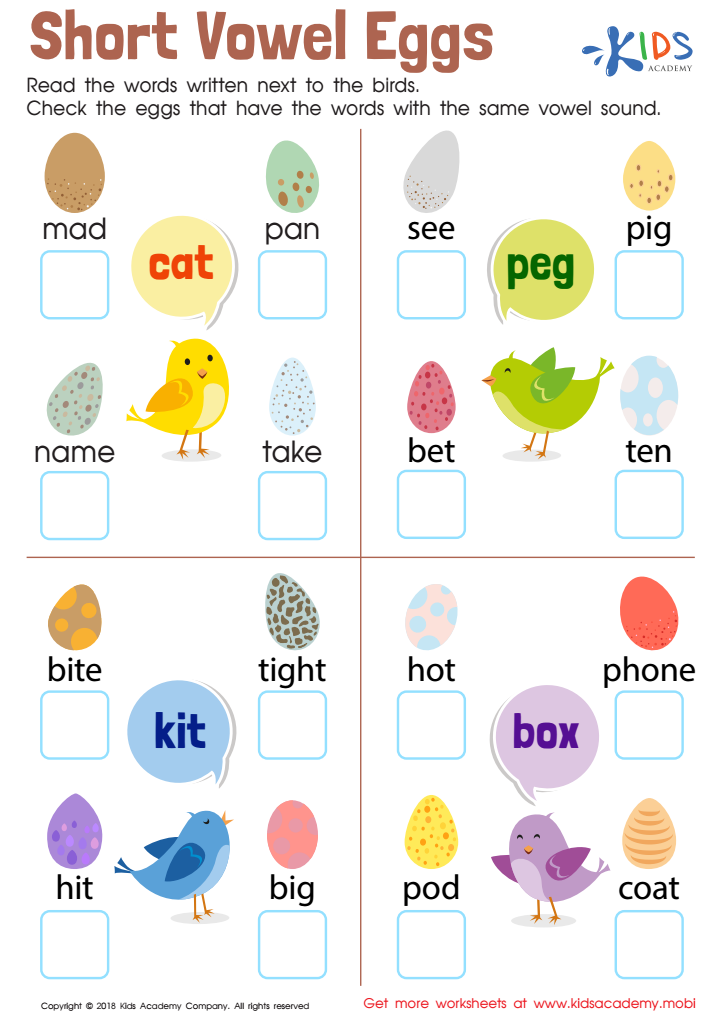
Short Vowel Eggs Worksheet
Your students will love helping these birdies pick the short vowel eggs! Have them read the words in the thought bubbles, then check off the boxes with the same short vowel sounds. The bright colors of this free Worksheet will draw them in and get them practicing their vowels!
Short Vowel Eggs Worksheet
Worksheet
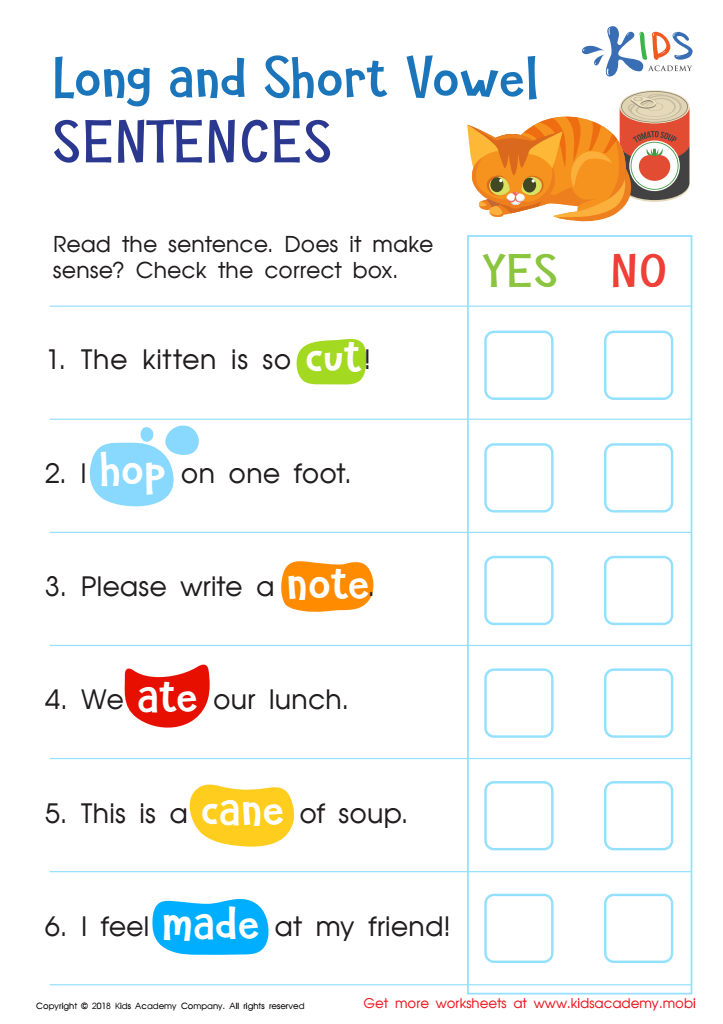
Long and Short Vowel Sentences: Assessment Worksheet
This printable worksheet helps kids practice differentiating between short and long vowel sounds. They'll use context clues to figure out which words make sense in simple sentences. A great way to build reading and writing skills!
Long and Short Vowel Sentences: Assessment Worksheet
Worksheet
Join Kids Academy for Free
Who is primarily going to use this learning content?



Vowel recognition, especially identifying normal short vowels, is crucial for young children ages 5-6 as it forms the cornerstone of their early reading and writing skills. At this developmental stage, children's brains are highly receptive to learning language patterns, making phonemic awareness a vital component of literacy education. Accurate recognition of short vowels helps children decode simple words, which is an essential skill for fluent reading.
When children master short vowel sounds (a, e, i, o, u), they gain the ability to break down and understand words phonetically. This foundational skill not only supports word recognition and pronunciation but also promotes vocabulary expansion and aids in spelling accuracy. For instance, differentiating the short ‘a’ in "cat" from the short ‘e’ in "bed" enables children to read these words correctly and build confidence in their reading abilities.
Moreover, early mastery of vowel sounds prevents future reading difficulties. Children who struggle with vowel recognition are more likely to face challenges in higher grades where reading comprehension and fluency are critical for academic success. Thus, parents and teachers should emphasize and support vowel recognition activities to foster a strong, lifelong foundation in literacy, promoting positive educational outcomes.