
Spatial reasoning Normal Math Worksheets for Ages 5-6
3 filtered results
Difficulty Level
Grade
Age
-
From - To
Subject
Activity
Standards
Enhance your child's mathematical foundation with our Spatial Reasoning Normal Math Worksheets for Ages 5-6. These thoughtfully designed worksheets develop critical spatial reasoning skills through fun and engaging activities. Young learners will enjoy building their understanding of shapes, patterns, and spatial relationships while boosting their problem-solving abilities. Perfect for use at home or in the classroom, our printable worksheets support early cognitive growth, making math both exciting and accessible for young minds. Start your child's educational journey today with exercises that make learning geometry and math logic fun and interactive!
Favorites
With answer key
Interactive
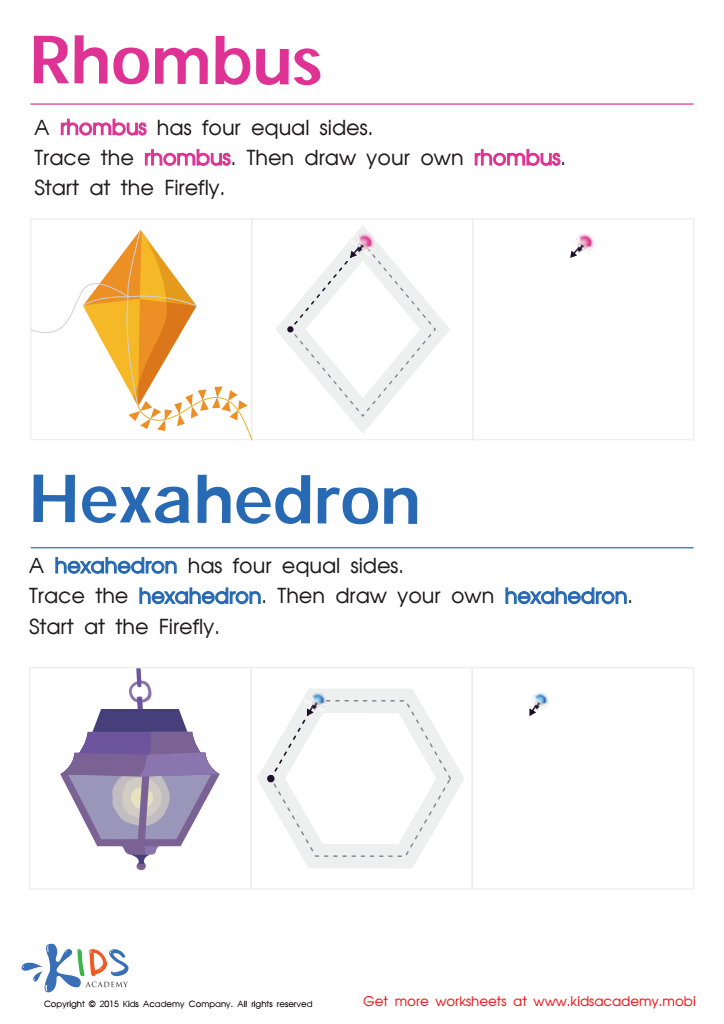
Draw a Rhombus And a Hexahedron Printable
Trace, draw and recognize shapes like rhombus, hexahedron and more! Start with the firefly to trace a rhombus, then use the yellow kite to remember the shape. Use the light to trace and draw a hexahedron. Learn with the best!
 Assign to My Students
Draw a Rhombus And a Hexahedron Printable
Worksheet
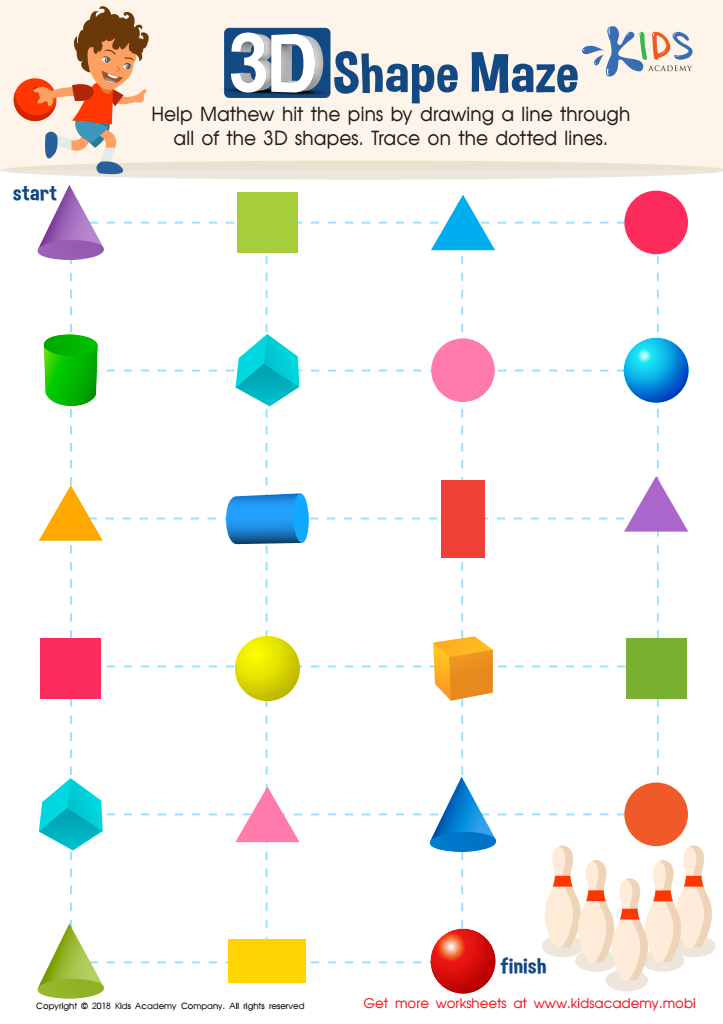
Shapes Maze Geometry Worksheet
Boost your child's geometry skills with this shapes maze worksheet! Help Matthew bowl a strike by guiding him through the maze to draw a line through every 3D shape. It's a fun and challenging way to practice foundational math skills!
Shapes Maze Geometry Worksheet
Worksheet
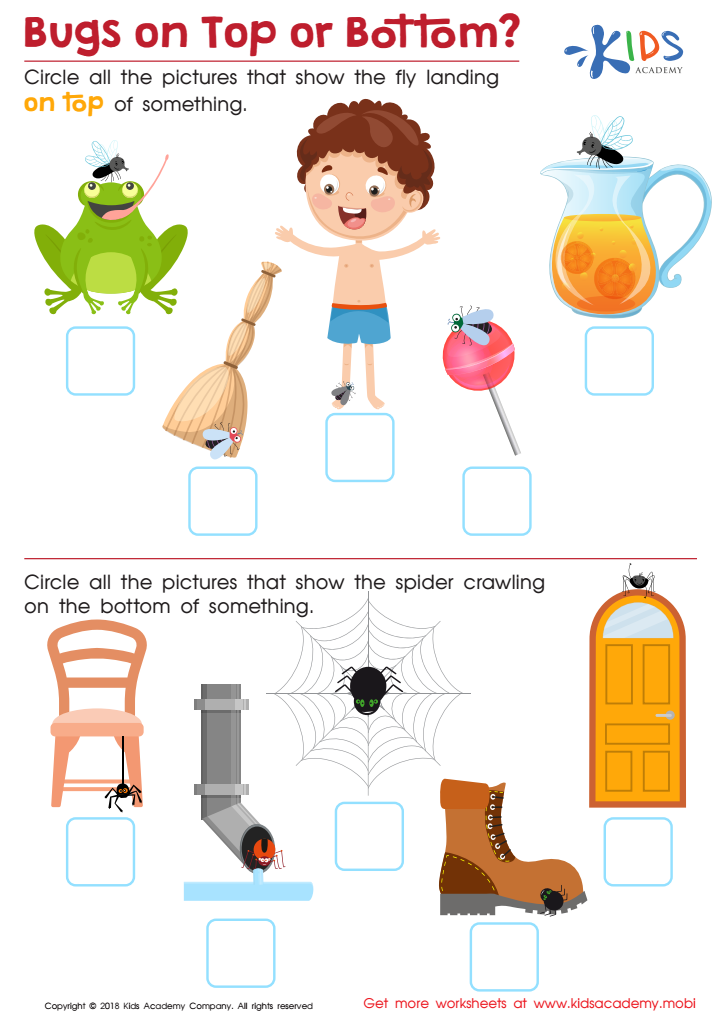
Bugs on Top or Bottom? Worksheet
Preschoolers need to learn directional skills such as top and bottom. This PDF worksheet helps them recognize bugs on the top or bottom using fun visuals. It builds their spatial reasoning while teaching prepositional words in an engaging way.
Bugs on Top or Bottom? Worksheet
Worksheet
Join Kids Academy for Free
Who is primarily going to use this learning content?






Spatial reasoning is fundamentally important for children aged 5-6 as it serves as a foundation for future success in various academic subjects and everyday problem-solving skills. This cognitive skill allows children to understand and manipulate various shapes and forms in their minds, and is closely related to their abilities in mathematics, science, engineering, and even reading and writing.
Firstly, spatial reasoning is integral to understanding and applying mathematical concepts. Basic arithmetic, geometry, and measurement all require a level of spatial awareness. For instance, recognizing patterns, understanding symmetry, and comprehending shapes are foundational skills fostered early through spatial reasoning activities. These skills directly contribute to a child's ability to grasp more advanced mathematical concepts like fractions, geometric properties, and spatial relationships.
Moreover, fostering spatial reasoning develops a child's problem-solving abilities and critical thinking. Engaging in puzzles, drawing, or building with blocks encourages children to visualize solutions, experiment, and learn from trial and error. These activities can also enhance fine motor skills, hand-eye coordination, and creativity.
Furthermore, strong spatial reasoning skills are predictors of STEM (Science, Technology, Engineering, and Mathematics) success later in life. Encouraging these skills early can ignite a child's interest in these fields, boosting their confidence and academic outcomes.
In essence, prioritizing spatial reasoning in early education equips children with essential skills that bolster their academic pursuits and everyday life, setting a solid foundation for lifelong learning and success.








