
Understanding fact families Normal Addition & Subtraction Worksheets for Ages 5-7
3 filtered results
Difficulty Level
Grade
Age
-
From - To
Subject
Activity
Standards
Unlock the world of mathematics for your child with our "Understanding Fact Families Normal Addition & Subtraction Worksheets" designed for ages 5-7. These engaging, printable resources introduce young learners to the concepts of addition and subtraction through the exploration of fact families. By mastering fact families, kids will develop a strong foundational understanding of numbers and their relationships. Our worksheets are carefully crafted to support early math skills, promote critical thinking, and build confidence. With appealing visuals and interactive exercises, children will enjoy practicing their math skills while gaining the essentials needed for future success. Dive in today and watch your child thrive!
Favorites
With answer key
Interactive
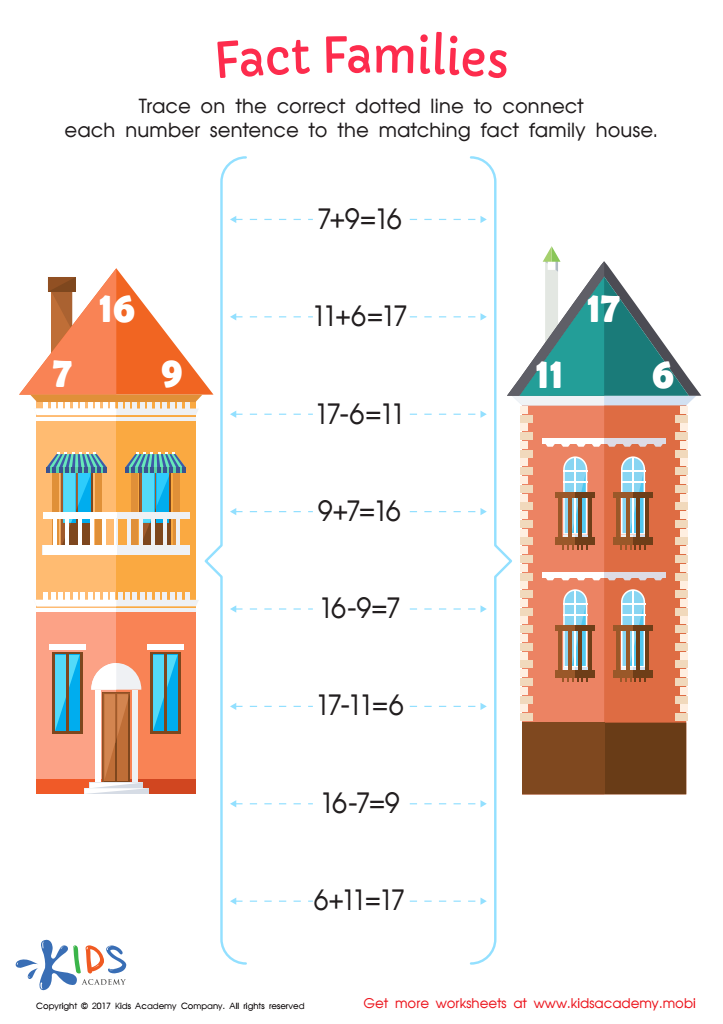
Fact Families — Add and Subtract Worksheet
Kids will love seeing how families of numbers "live" in their own houses!
 Assign to My Students
Fact Families — Add and Subtract Worksheet
Worksheet
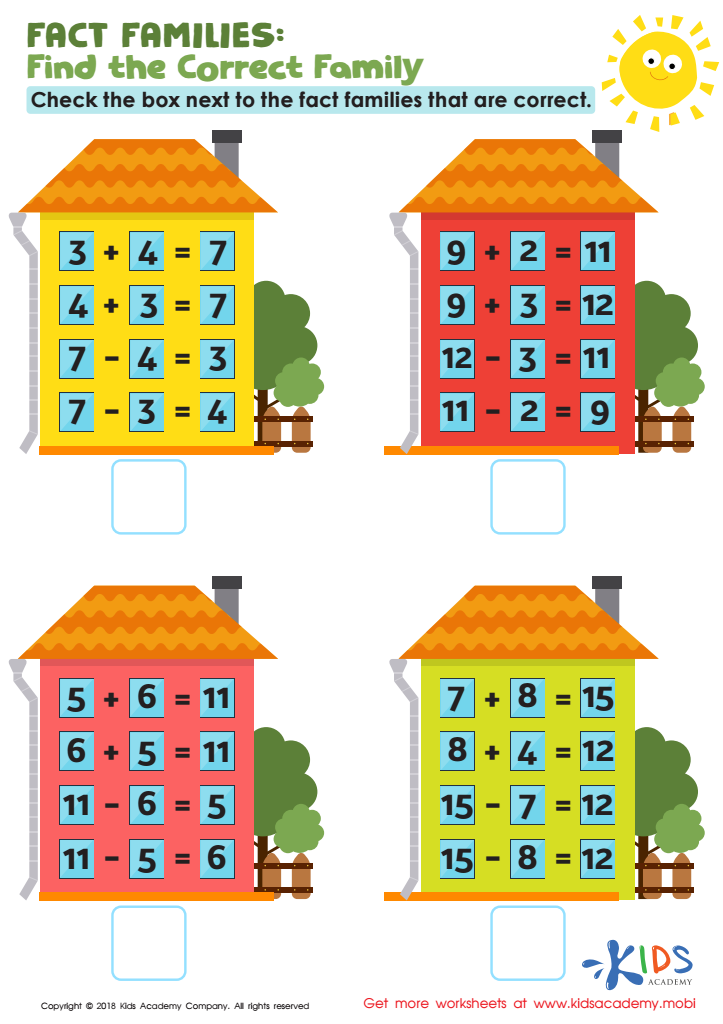
Fact Families: Find Correct Family Worksheet
Test your students' math and reasoning skills with this worksheet. It features 4 houses, each with a group of fact families on it. Some are correct, some are wrong - help students identify which are correct and circle the box next to them. This will help them progress in school.
Fact Families: Find Correct Family Worksheet
Worksheet
Join Kids Academy for Free
Who is primarily going to use this learning content?








Understanding fact families for addition and subtraction is essential for young learners aged 5-7, as it forms the foundation for their mathematical skills. Fact families demonstrate the relationship between numbers, helping children grasp the concept that addition and subtraction are interconnected operations. For instance, the numbers 2, 3, and 5 can be arranged to show that 2 + 3 = 5 and 5 - 3 = 2. This insight builds number sense, allowing students to understand how numbers relate to one another.
As parents and teachers emphasize fact families, children begin to internalize the concepts of fact families, enhancing their ability to solve problems efficiently and flexibly. This skill becomes invaluable as they encounter more complex math problems in later grades. Furthermore, learning about fact families promotes critical thinking and reasoning abilities, essential skills in both mathematics and everyday life.
By nurturing this understanding early on, parents and teachers provide children with the tools they need to develop confidence in math. This foundational knowledge not only supports academic success but also encourages a positive attitude towards learning. Ultimately, understanding fact families equips young learners with the skills necessary for future mathematical challenges, fostering lifelong learning and curiosity.








