Developing critical thinking Normal Science Worksheets for Ages 5-9
3 filtered results
-
From - To
Unlock your child's potential with our Normal Science Worksheets for Ages 5-9, meticulously designed to develop critical thinking. These worksheets offer engaging activities that inspire young minds to question, explore, and understand the world around them. Each worksheet builds foundational skills in scientific inquiry, encouraging observational, analytical, and logical reasoning. Ideal for the classroom or at-home learning, our worksheets make complex concepts accessible and fun. Foster a love for science and boost your child's problem-solving abilities today with these enriching, age-appropriate resources. Equip your little learners with the tools they need for lifelong curiosity and success.

Seeds on the Move Worksheet
 Assign to My Students
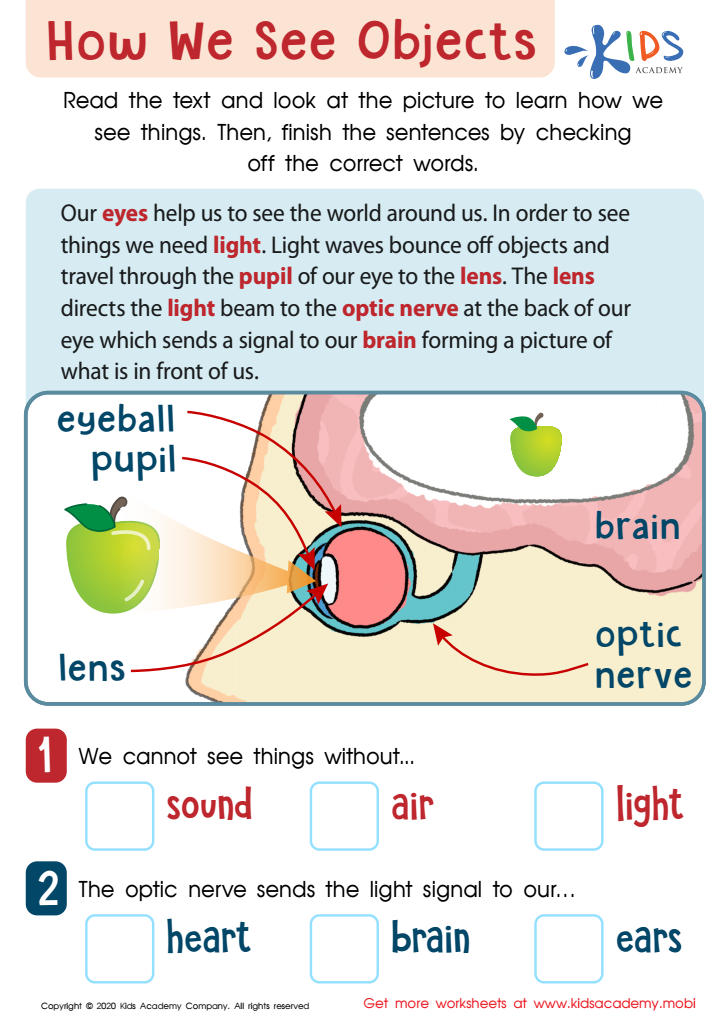
How We See Objects Worksheet

Man-Made or Natural? Worksheet








Critical thinking is a fundamental skill that lays the foundation for children's intellectual and emotional development, making it essential for parents and teachers to prioritize this cognitive ability in early education, particularly for ages 5-9. At this age, children's brains are highly malleable and receptive to learning, making it an optimal period for developing critical thinking skills.
Firstly, critical thinking encourages curiosity and fosters a love for learning. When children are taught to question, analyze, and evaluate information, they become more engaged and enthusiastic learners. This kind of active engagement helps build a strong educational foundation that will benefit them in more complex subjects later.
Secondly, developing critical thinking skills at an early age helps children solve problems effectively. Rather than relying on rote memorization or simplistic answers, they learn to apply logic and reasoning, which are invaluable in navigating everyday challenges and making informed decisions throughout their lives.
Lastly, fostering critical thinking helps children become independent thinkers. In an age where information is abundant and not always accurate, providing children with the tools to critically evaluate sources and form their own opinions is crucial. This supports their capacity to resist peer pressure, make ethical choices, and contribute thoughtfully to societal discourse.
In summary, nurturing critical thinking from an early age equips children with essential skills for academic success, social interaction, and personal growth, making it a vital aspect of education for parents and teachers to prioritize.







