Understanding base ten Normal Worksheets for Ages 6-8
3 filtered results
-
From - To
Understanding Base Ten Normal Worksheets for Ages 6-8 are designed to help young learners grasp the fundamentals of our number system. These engaging, interactive worksheets emphasize the importance of base ten concepts, teaching kids to efficiently count, group, and decompose numbers. Ideal for students aged 6-8, they foster essential math skills, such as place value, addition, and subtraction. Our resources are meticulously curated by educational experts to cater to various learning styles, encouraging independent thinking and problem-solving. Nurture your child's mathematical journey with our fun and stimulating activities that build a solid foundation for future math success.
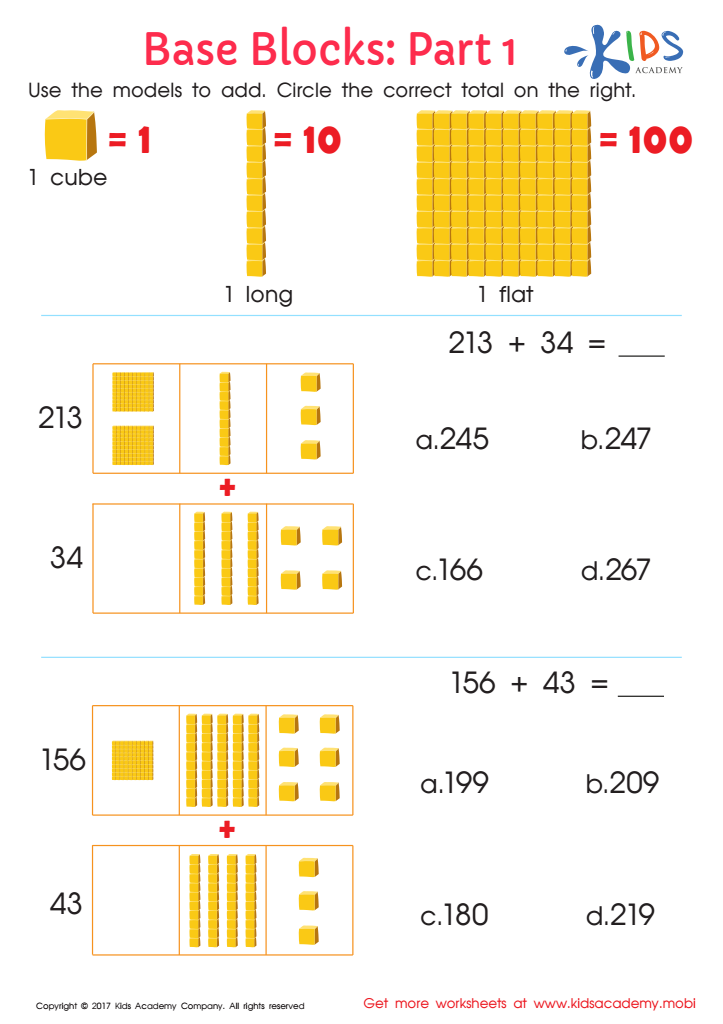
Base Ten Blocks Worksheet: Part 1
 Assign to My Students
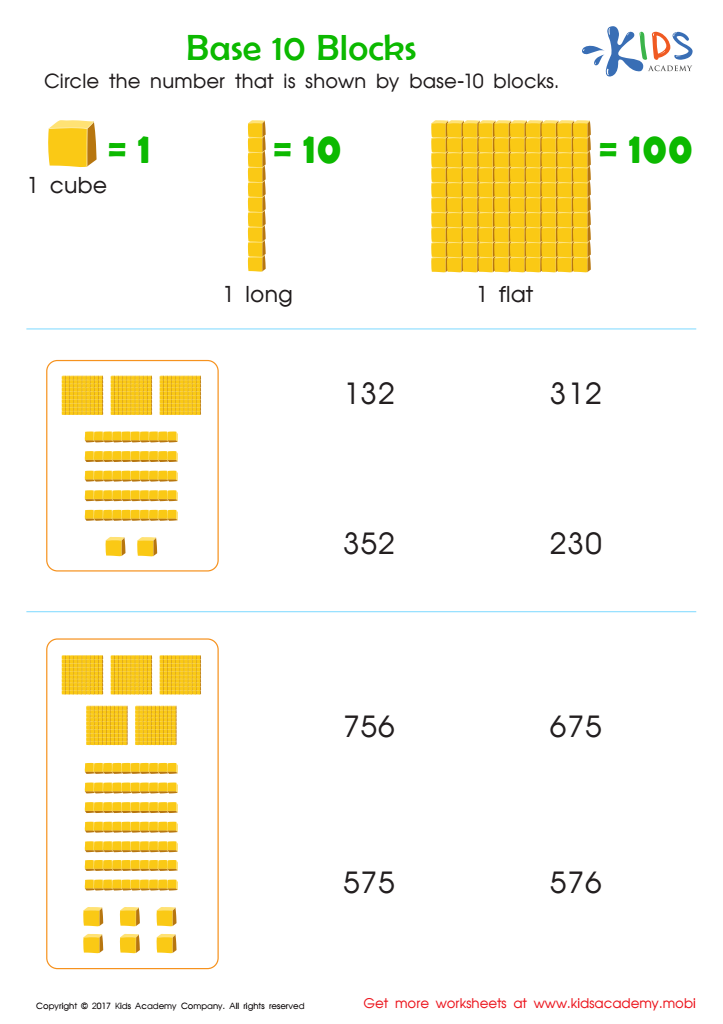
Base Ten Blocks Worksheet
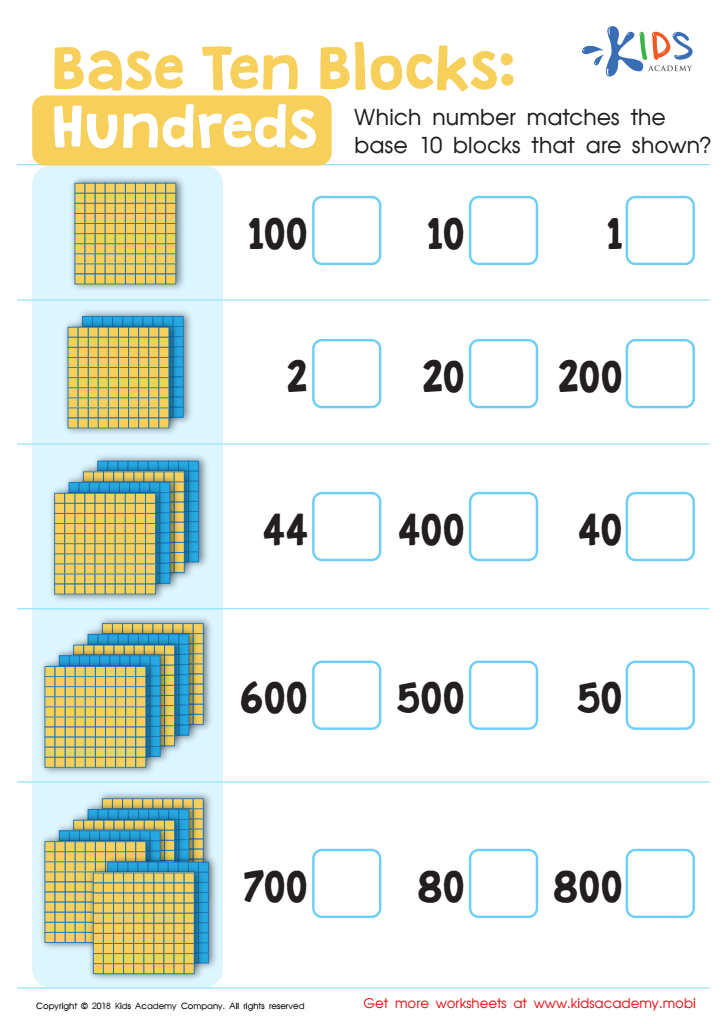
Base Ten Blocks: Hundreds Worksheet



.jpg)
Understanding base ten is fundamental for children aged 6-8 as it serves as the building block for mathematical learning. Base ten, also known as the decimal system, is the numerical system most widely used in daily life, so grasping this concept early prepares children for real-world applications.
For parents and teachers, investing time and effort into ensuring children understand base ten pays off significantly in numerous ways. Firstly, it strengthens their ability to perform basic arithmetic operations like addition, subtraction, multiplication, and division. Knowing that numbers are built around groups of ten helps in organizing and simplifying calculations, setting a foundation for more complex mathematical concepts in later years.
In cognitive development, understanding base ten enhances children’s number sense—the ability to recognize relationships between numbers, which is critical for problem-solving and logical thinking. It also fosters a deeper comprehension of place value, ensuring that students appreciate the relative worth of numbers based on their position (e.g., units, tens, hundreds).
Moreover, this understanding links directly to real-life skills such as handling money, telling time, and measuring dimensions. For parents, it means being able to support their child's homework more effectively. For teachers, it paves the way for a smoother transition to more sophisticated mathematics, thereby setting students up for long-term academic success. Hence, a solid grasp of base ten forms an essential cornerstone in early education.








