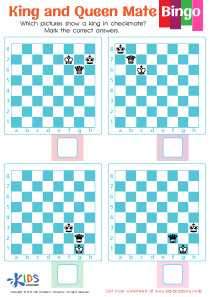
Problem-solving practice Normal Chess Worksheets for 6-Year-Olds
3 filtered results
Difficulty Level
Grade
Age
-
From - To
Subject
Activity
Standards
Our Problem-solving Practice Normal Chess Worksheets for 6-Year-Olds are designed to ignite young minds and enhance critical thinking. Tailored for early learners, these engaging worksheets simplify the strategic game of chess, breaking it down into fun, educational tasks that hone problem-solving skills. Perfect for budding chess enthusiasts, these resources encourage children to analyze moves, employ foresight, and develop patience, all while enjoying the timeless game of chess. Our printable puzzles and scenarios provide an excellent foundation for early cognitive development, setting up kids for long-term success both in chess and broader academic pursuits. Start their chess journey today!
Favorites
With answer key
Interactive
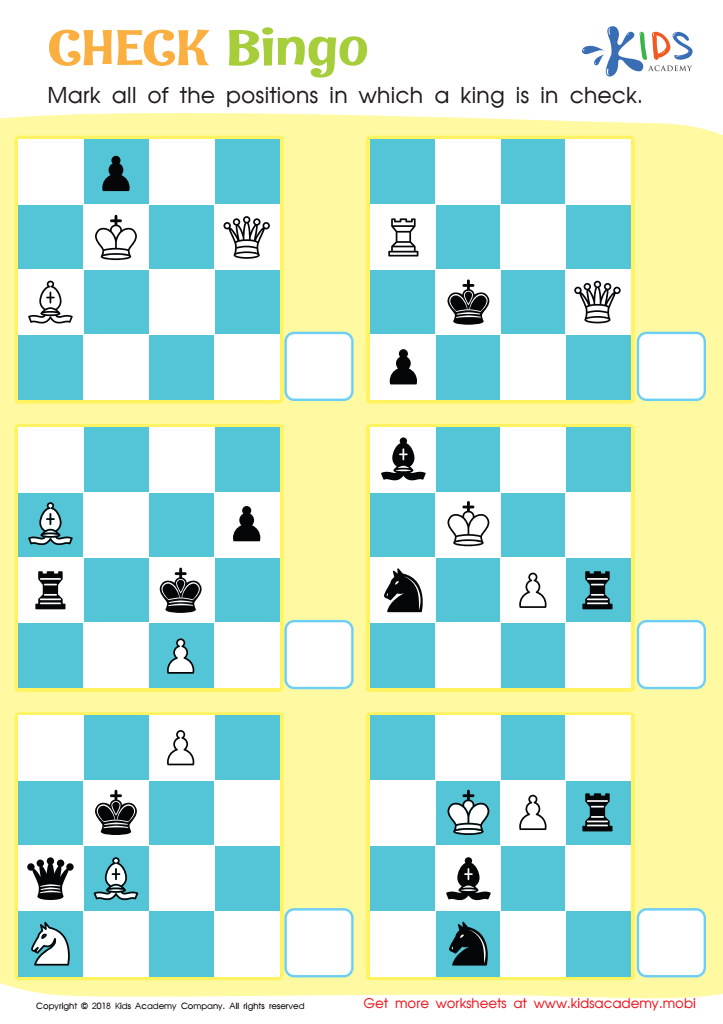
Check Bingo Worksheet
Chess helps young minds build critical thinking, problem-solving and logical reasoning skills. This free PDF worksheet is a fun way to teach these skills. It explains the concept of check and includes gameboards with kings in various positions. Students mark off the boards where a king isn't in check, and they're ready to move onto checkmate!
 Assign to My Students
Check Bingo Worksheet
Worksheet
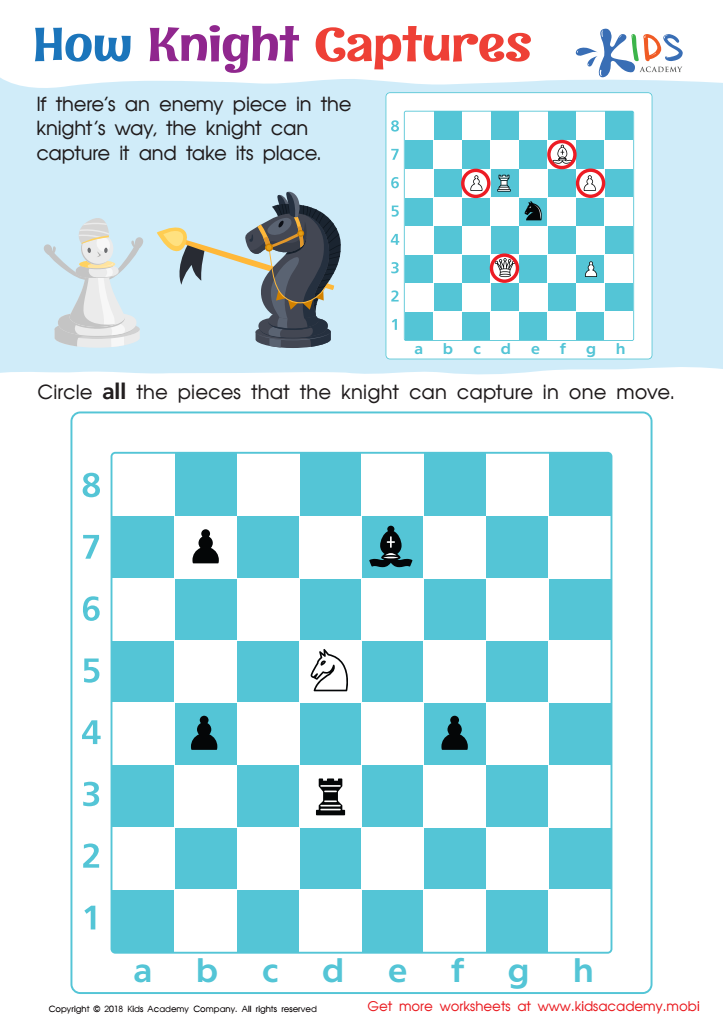
How Knight Captures Worksheet
Test your child's knowledge of chess pieces by asking them to identify the knight. It is shaped like a horse and its goal is to capture the enemy king in order to win the game. The knight has the advantage of being able to jump over other pieces, taking them out and taking their place. See how many pieces the knight can capture in one move with this worksheet.
How Knight Captures Worksheet
Worksheet
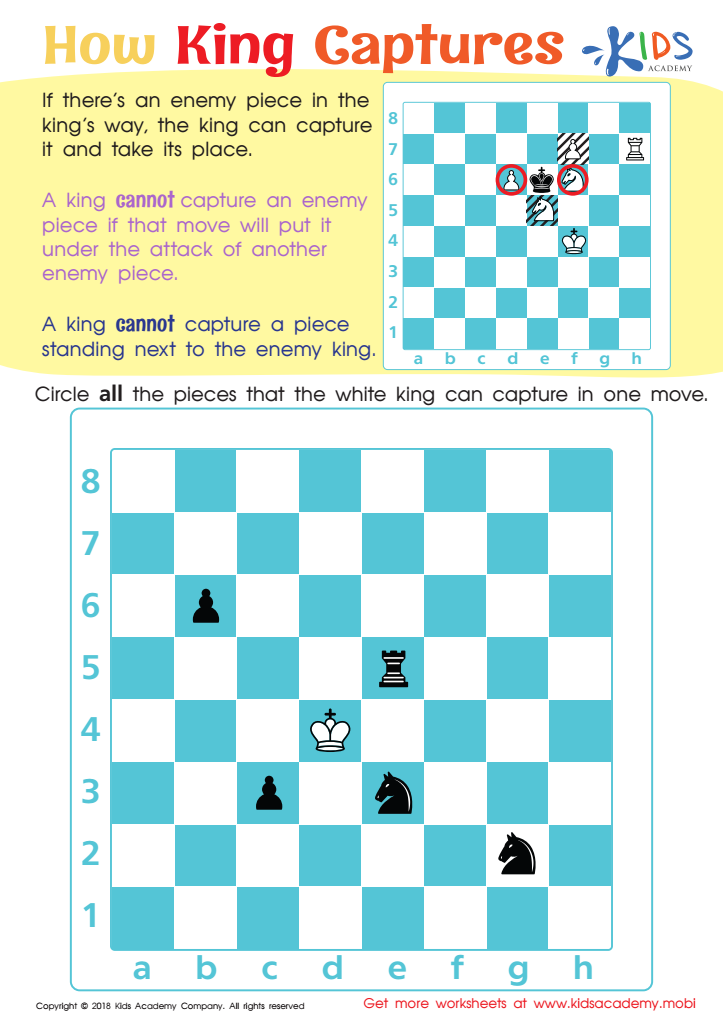
How King Captures Worksheet
The king can capture an enemy piece by taking its place. But it cannot move if the action will put it at risk of attack, or if it's next to the enemy king. On this worksheet, circle the places the white king can capture in one move. (80 words)
How King Captures Worksheet
Worksheet
Join Kids Academy for Free
Who is primarily going to use this learning content?





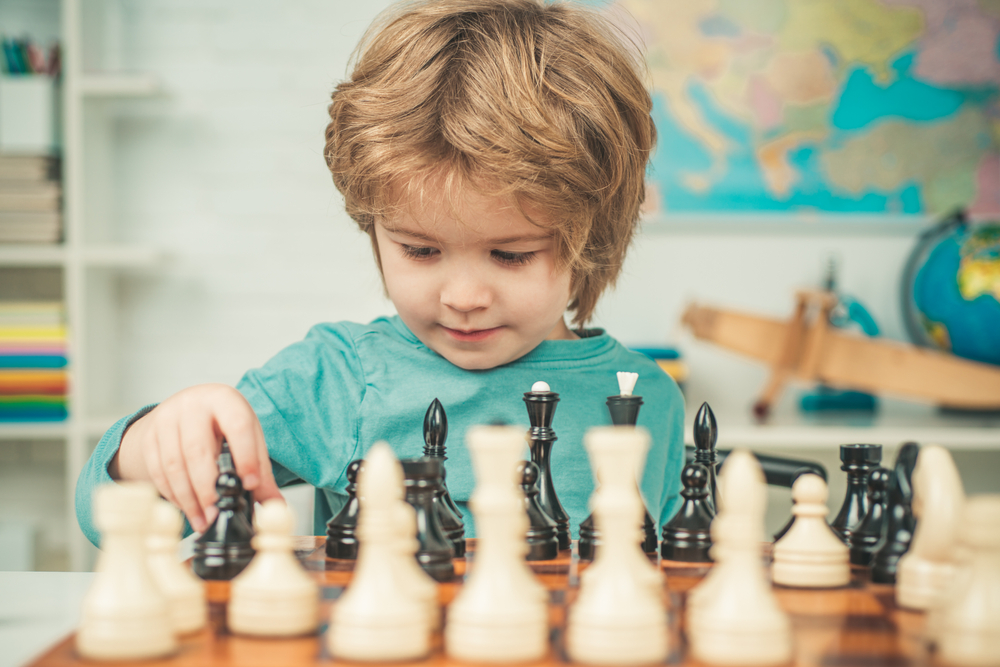

Parents and teachers should care about introducing 6-year-olds to problem-solving practice in normal chess for several insightful reasons. Chess is a timeless and strategic game that cultivates essential cognitive skills from an early age. Engaging in chess encourages young children to think critically and develop problem-solving strategies, which are foundational components of their overall intellectual growth.
Playing chess enhances memory, patience, and concentration, as children must remember different pieces' movements and think several steps ahead. It also fosters creativity and imagination, as young players learn to envision various outcomes from their decisions on the board. Problem-solving in chess requires systematic thinking, helping kids learn to approach challenges methodically rather than impulsively.
Additionally, chess serves as an excellent tool to improve mathematical abilities and logical thinking, as it involves recognizing patterns and understanding spatial relationships. These skills are transferable to academic subjects and everyday life situations. Socially, chess provides an opportunity for children to interact positively with peers, share experiences, and develop good sportsmanship qualities, such as winning graciously and losing patiently.
By incorporating problem-solving practice through chess, parents and teachers can support holistic childhood development—balancing intellectual, emotional, and social growth while equipping children with lifelong skills.