Counting practice Normal Worksheets for 6-Year-Olds - Page 2
25 filtered results
-
From - To
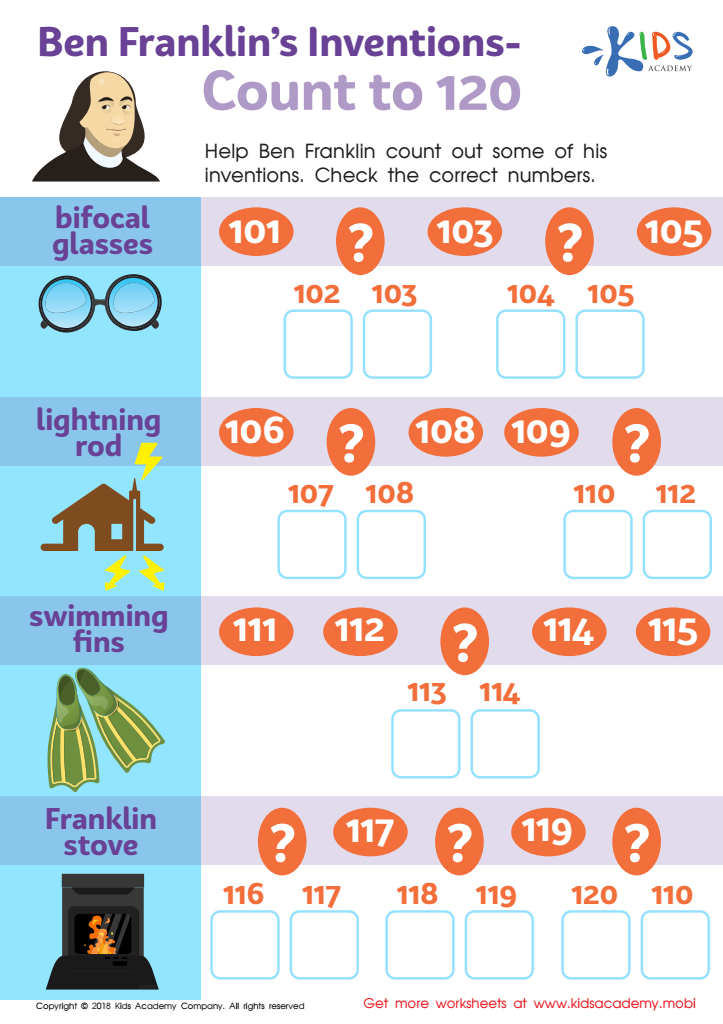
Ben Franklin’s Inventions – Count to 120 Worksheet
 Assign to My Students








Counting practice is vitally important for 6-year-olds for several reasons, and parents and teachers should be deeply invested in this aspect of early education. At this age, children's brains are highly receptive to learning foundational math skills that will support their academic success. Counting helps to nurture a child's number sense, which is the understanding of what numbers mean and how they relate to one another. This basic competency is essential for more complex mathematical operations like addition, subtraction, and eventually multiplication and division.
Beyond boosting math skills, counting practice also fortifies other critical cognitive abilities such as memory, pattern recognition, and logical reasoning. Counting requires a child to follow a sequence and understand each number's place in order, which enhances their problem-solving abilities and attention to detail.
Moreover, counting activities can be easily integrated into playful, everyday contexts, making learning enjoyable and relatable. For example, counting toys, steps, or objects in nature allows children to see the practical application of their skills in the world around them.
Taking time to engage in regular counting practice instills confidence in young learners, cultivates a positive attitude toward math, and sets a strong foundation for future academic growth. Consequently, both parents and teachers play a crucial role in supporting this vital aspect of early childhood education.








