
Map reading skills Normal Our Planet and Environment Worksheets for Ages 7-8
1 filtered results
Difficulty Level
Grade
Age
-
From - To
Subject
Activity
Standards
Enhance your child's map reading skills with our engaging worksheets, specifically designed for ages 7-8. These activities focus on understanding maps in the context of our planet and environment, making learning both fun and educational. Kids will explore essential concepts such as directions, landmarks, and distance estimation, all while promoting critical thinking and spatial awareness. Perfect for teachers and parents alike, these printable resources encourage interactive learning experiences. Help your child navigate the world around them, and develop important map reading skills necessary for understanding geography and environmental studies. Discover the adventure of learning through maps today!
Favorites
With answer key
Interactive
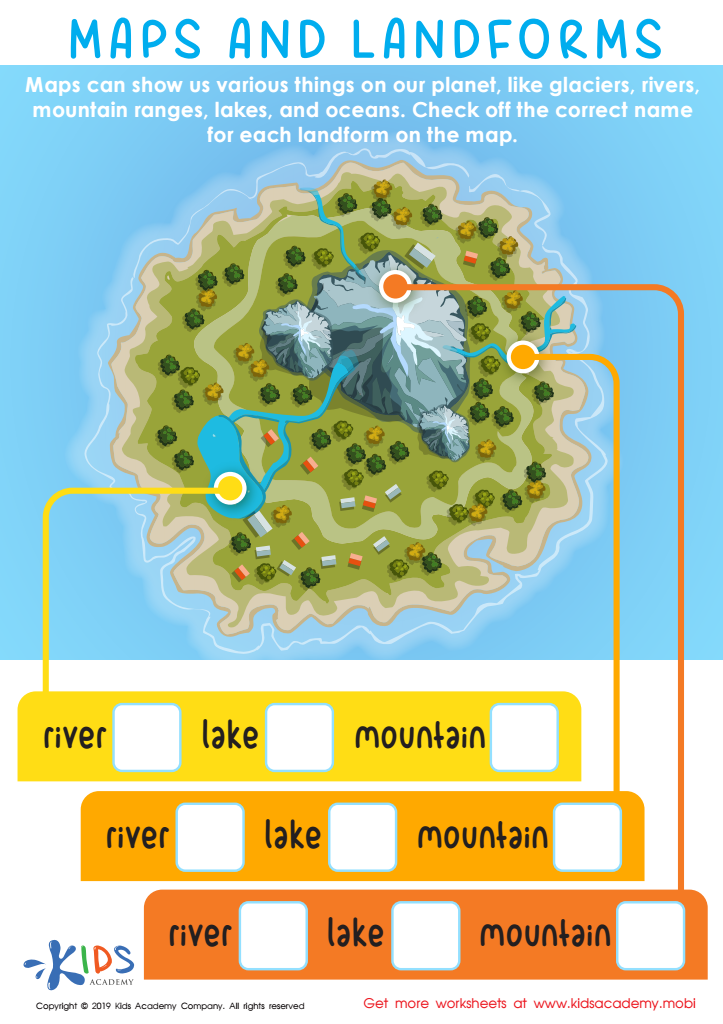
Maps and Landforms Worksheet
We can educate our kids on the world and its landforms by showing them a map. Point out mountains, rivers, and oceans, and help them identify each correctly. With this knowledge, they will better understand our planet.
 Assign to My Students
Maps and Landforms Worksheet
Worksheet
Join Kids Academy for Free
Who is primarily going to use this learning content?





Map reading skills are essential for children aged 7-8, especially in the context of understanding our planet and environment. Developing these skills at an early age fosters spatial awareness and critical thinking, enabling children to comprehend geographical concepts and their significance. By learning to read maps, students gain insight into their surroundings, which enhances their connection to local communities and global awareness.
Moreover, map reading promotes problem-solving abilities, as children learn to navigate different terrains, identify landmarks, and determine distances. This practical application of geography also encourages curiosity about natural resources, ecosystems, and environmental challenges. Understanding maps cultivates a sense of responsibility towards our planet, prompting discussions about conservation, climate change, and sustainability.
Furthermore, map skills improve interdisciplinary learning—merging subjects like math (scales and coordinates) and science (ecosystems and habitats) into engaging and visually appealing lessons. For parents and teachers, fostering these skills not only equips children for future learning but also inspires a lifelong interest in exploration and environmental stewardship. By prioritizing map reading, adults can help cultivate informed, responsible citizens who appreciate the complexities of our world, ready to make a positive impact.







