Counting practice Normal Worksheets for Ages 7-9 - Page 2
25 filtered results
-
From - To
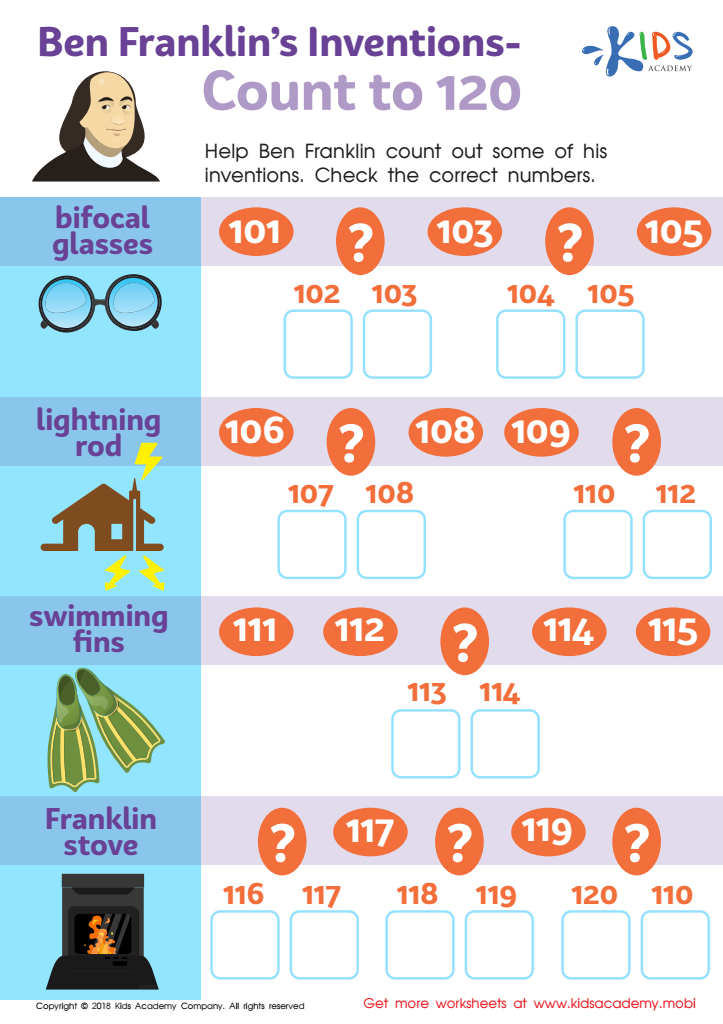
Ben Franklin’s Inventions – Count to 120 Worksheet
 Assign to My Students







Counting practice is critical for children aged 7-9 as it lays the foundation for their mathematical understanding and problem-solving skills. During these formative years, kids transition from basic counting to more complex operations like addition, subtraction, and even multiplication. A strong grasp of counting helps children understand numerical position, develop number sense, and establish a foundation for more advanced math concepts such as fractions, decimals, and geometry.
Parents and teachers play pivotal roles in fostering counting skills. Engaging children in counting activities—both structured and playful—encourages learning through exploration. For instance, using everyday objects like fruits, toys, or even steps while walking not only reinforces counting but also makes it fun. This hands-on approach enhances children's engagement and retention.
Additionally, counting practice sharpens critical thinking and enhances cognitive research skills. As children encounter various counting scenarios, they learn to recognize patterns, improve their focus and attention span, and gain confidence in their math abilities. Ultimately, by prioritizing counting practice, parents and teachers equip children with essential skills that will serve them throughout their academic journey and lay the groundwork for success in future mathematical endeavors.








