
Map reading skills Normal Our Planet and Environment Worksheets for Ages 7-9
1 filtered results
Difficulty Level
Grade
Age
-
From - To
Subject
Activity
Standards
Enhance your child's map reading skills with our engaging "Our Planet and Environment" worksheets, designed specifically for ages 7–9. These interactive resources foster critical thinking and help young learners navigate the world, understand geography, and connect with their surroundings. Featuring colorful maps and fun activities, children will develop essential skills while exploring natural landscapes, climates, and ecological concepts. Each worksheet not only promotes reading comprehension but also encourages teamwork and communication as kids collaborate on answers. Perfect for classroom use or at-home learning, our worksheets provide an enjoyable and educational experience, setting the groundwork for lifelong geographical understanding. Download now!
Favorites
With answer key
Interactive
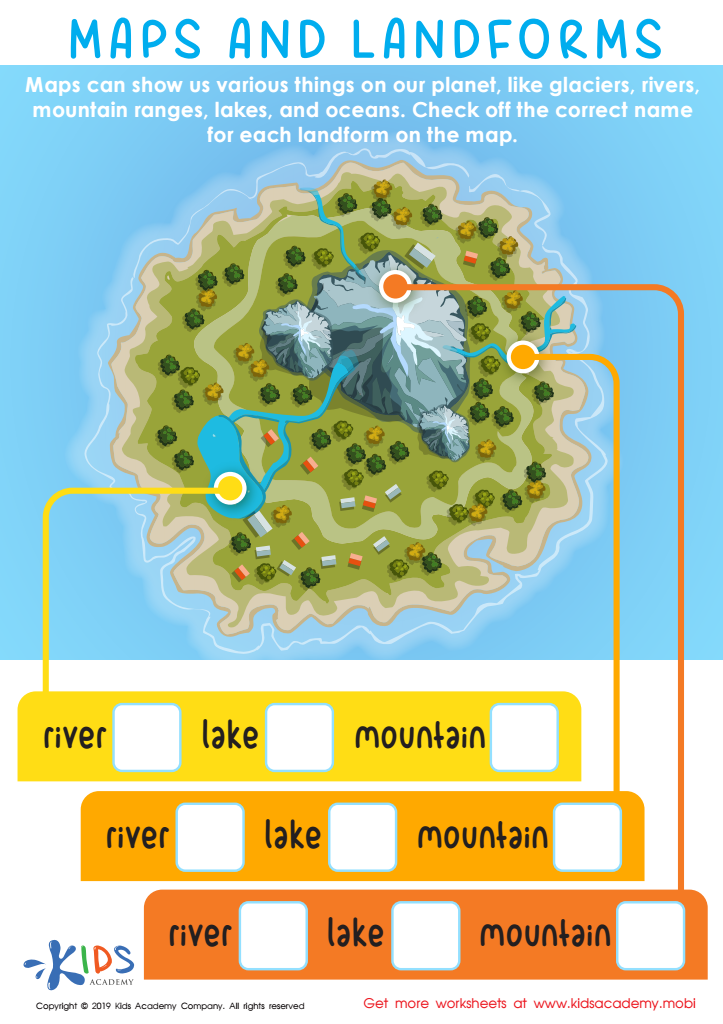
Maps and Landforms Worksheet
We can educate our kids on the world and its landforms by showing them a map. Point out mountains, rivers, and oceans, and help them identify each correctly. With this knowledge, they will better understand our planet.
 Assign to My Students
Maps and Landforms Worksheet
Worksheet
Join Kids Academy for Free
Who is primarily going to use this learning content?



Developing map reading skills in children ages 7-9 is crucial for their understanding of the world around them. During this stage, children are naturally curious and eager to explore. Teaching them how to read maps not only enhances their spatial awareness but also promotes critical thinking and problem-solving abilities. By engaging with maps, children learn to interpret symbols, understand directions, and grasp geographical concepts, which are fundamental for their educational journey.
Moreover, awareness of our planet and environment is vital as children develop a sense of responsibility towards sustainability. Understanding maps related to natural features, climate, and ecosystems can spark interest in environmental stewardship. It connects classroom learning with real-world applications, illustrating the impact of human activities on the earth.
Additionally, map reading encourages independence and confidence. As children learn to navigate their surroundings, whether it's finding a location on a local map or understanding a treasure map in a game, they build essential life skills. Parents and teachers should prioritize map reading as an engaging way to educate children about geography, ecosystems, and the importance of caring for our planet, fostering informed citizens of the future ready to tackle ecological challenges.







