
Sound recognition Normal Vowels Worksheets for 7-Year-Olds
5 filtered results
Difficulty Level
Grade
Age
-
From - To
Subject
Activity
Standards
Help your 7-year-old master sound recognition with our engaging Normal Vowels Worksheets. Designed by educational experts, these fun activities focus on identifying and differentiating vowel sounds, a crucial skill for budding readers. Each worksheet provides interactive exercises that enhance listening, pronunciation, and phonics. Suitable for home or classroom use, our worksheets are crafted to make learning enjoyable and effective. Boost your child's confidence in reading with tailored resources aimed at developing core literacy skills. Explore our collection today to give your young learner a strong foundation in vowel sound recognition. Perfect for parents and teachers alike!
Favorites
With answer key
Interactive
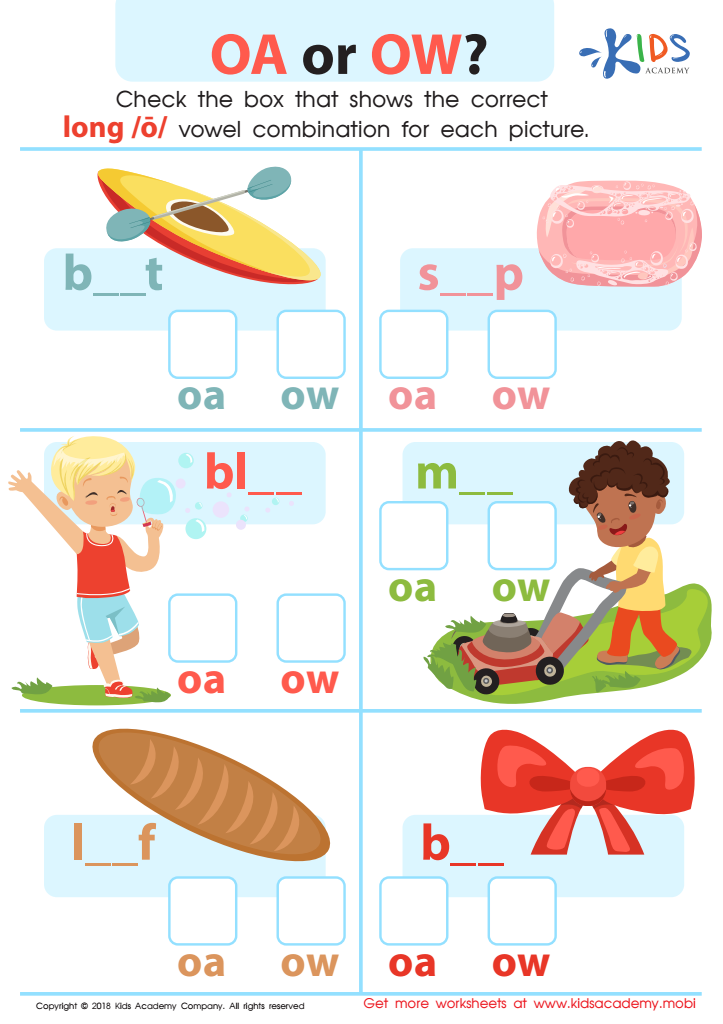
Reading: OA or OW Worksheet
This printable worksheet helps young and emergent readers with decoding words and understanding digraphs (two letters with one sound). It requires students to complete the spelling for each word based on the picture, focusing on /oa/ and /ow/ spellings. It's ideal for a reading classroom and for spelling practice.
Reading: OA or OW Worksheet
Worksheet
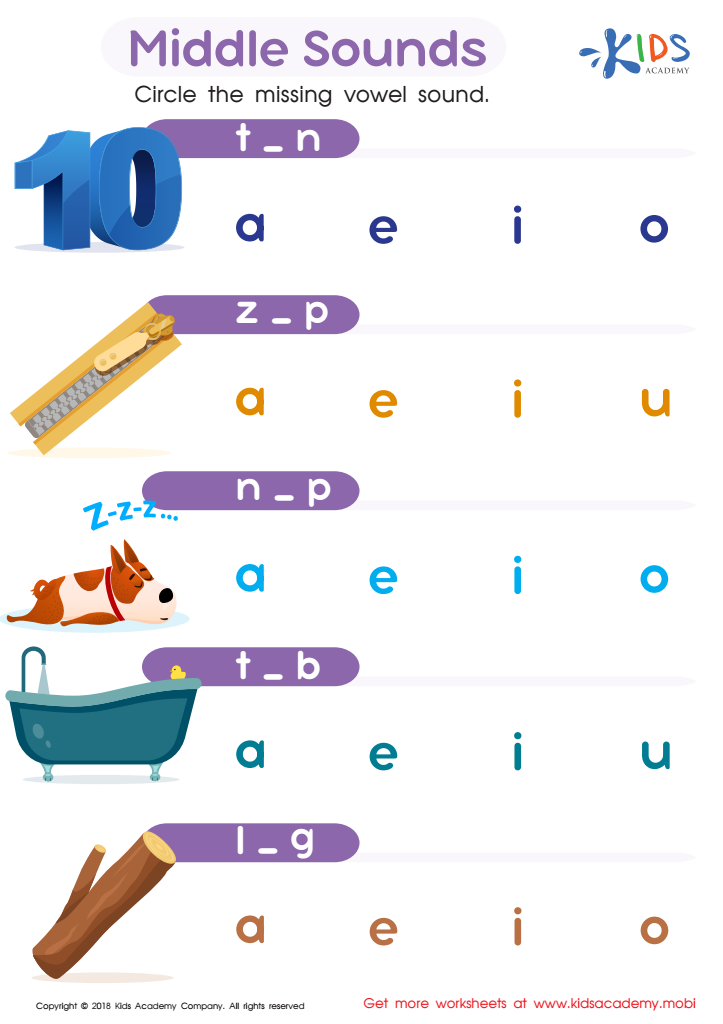
Middle Sounds Worksheet
Download this free worksheet and help your reader identify middle sounds in words. Pictures provide clues to the word, while tracing circles around the middle vowel sound strengthens fine motor and visual discrimination skills. It's a great way to teach sound discrimination between similar-sounding short vowels - a key component for proficient reading.
Middle Sounds Worksheet
Worksheet

Long and Short U Worksheet
Revised: Spice up your lesson on long and short vowels with this fun printout! Kids read the words "tube" and "tub," then reinforce the sound by coloring in the words and pictures. It's a great way to make phonics class enjoyable!
Download (PDF)
 Assign to My Students
Assign to My Students
Long and Short U Worksheet
Worksheet
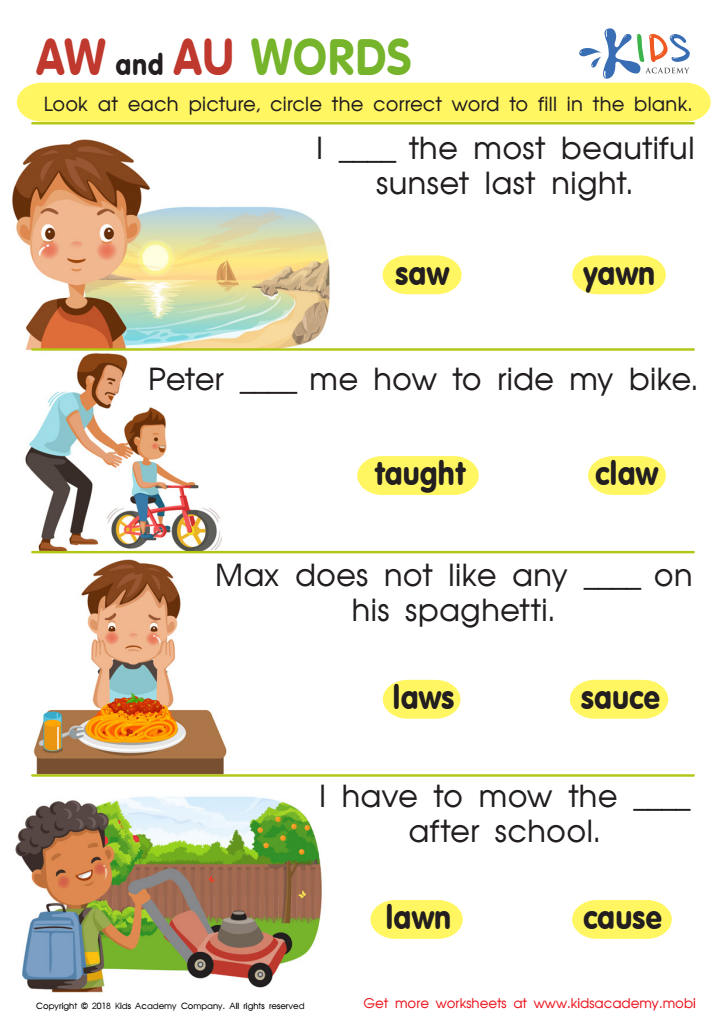
Reading: AW and AU Words Worksheet
This worksheet helps kids recognize that /au/ and /aw/ can make the same sound. Students read sentences and pick the correct word with one of the digraphs. Understanding digraphs improves decoding and reading fluency. Perfect for reading and phonics classes.
Reading: AW and AU Words Worksheet
Worksheet
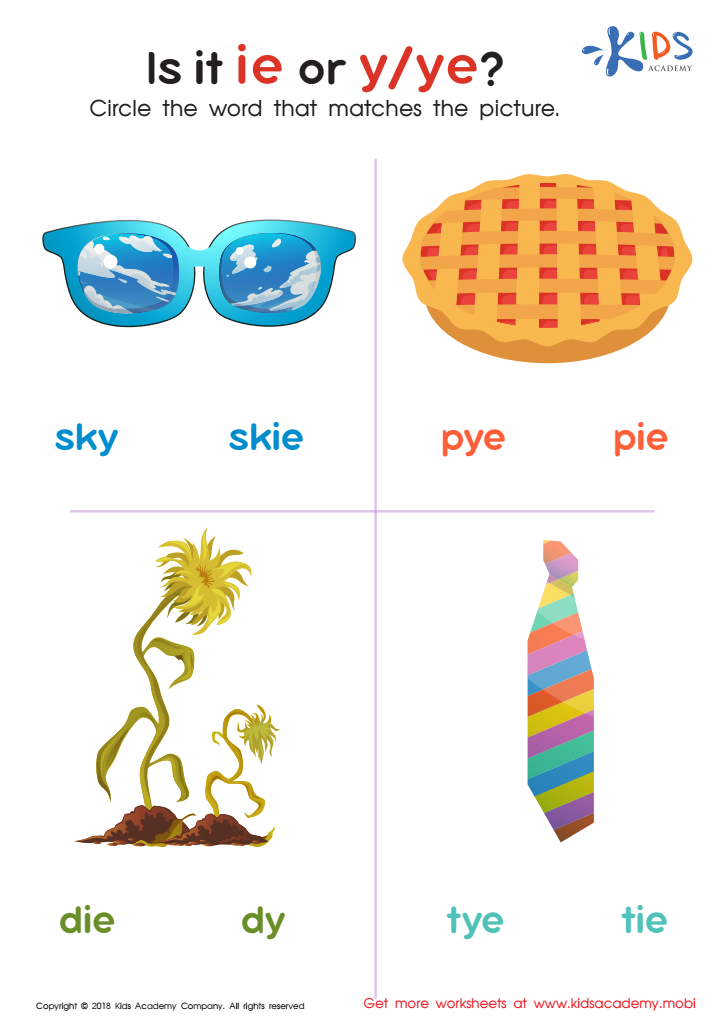
Is It IE or Y/Ye? Worksheet
Test your child's picture identification skills by pointing at common items in your house and asking them to name them. Then, look at the objects in this worksheet with your little one. Point at each one, ask for the name, then ask which spelling is correct. Help them circle the correct word.
Is It IE or Y/Ye? Worksheet
Worksheet
Join Kids Academy for Free
Who is primarily going to use this learning content?





Sound recognition is a critical aspect of early childhood education, as it lays the foundation for reading and writing proficiency. For 7-year-olds, who are typically in the first or second grade, mastering normal vowel sounds is particularly important. Vowels form the core of spoken and written language; every word contains at least one vowel, making their correct pronunciation and recognition essential for effective communication.
When children can accurately identify and produce normal vowel sounds, they enhance their phonemic awareness — the ability to hear, identify, and manipulate individual sounds in spoken words. This skill directly contributes to the development of decoding skills, allowing children to read new words by sounding them out. Consequently, strong phonemic awareness leads to improved reading fluency and comprehension, which are vital for academic success across all subjects.
From a social perspective, sound recognition also aids in developing clear speech, reducing the frustration associated with being misunderstood and building confidence in verbal interactions. Effective communication skills foster strong relationships with peers and adults, which is essential for emotional and social development.
Thus, parents and teachers should prioritize sound recognition of normal vowels, as this skill is integral to a child's overall academic growth, communication abilities, and social development. By supporting this foundational aspect of language learning, they set children on a path to becoming proficient, confident readers and effective communicators.






