Map reading skills Normal Science Worksheets for 7-Year-Olds
1 filtered results
-
From - To
Unlock your child's potential with our "Map Reading Skills Normal Science Worksheets for 7-Year-Olds." These engaging worksheets, designed specifically for young learners, will make map reading fun and educational. Your child will learn essential skills such as understanding symbols, cardinal directions, and reading simple maps through interactive activities. Perfect for enhancing spatial thinking and geography knowledge, our worksheets offer hands-on practice to build confidence. With visually appealing designs and age-appropriate tasks, Kids Academy ensures learning is both enjoyable and effective. Start exploring the world of maps today and see your child's skills grow effortlessly. Give your child the tools to navigate with ease!
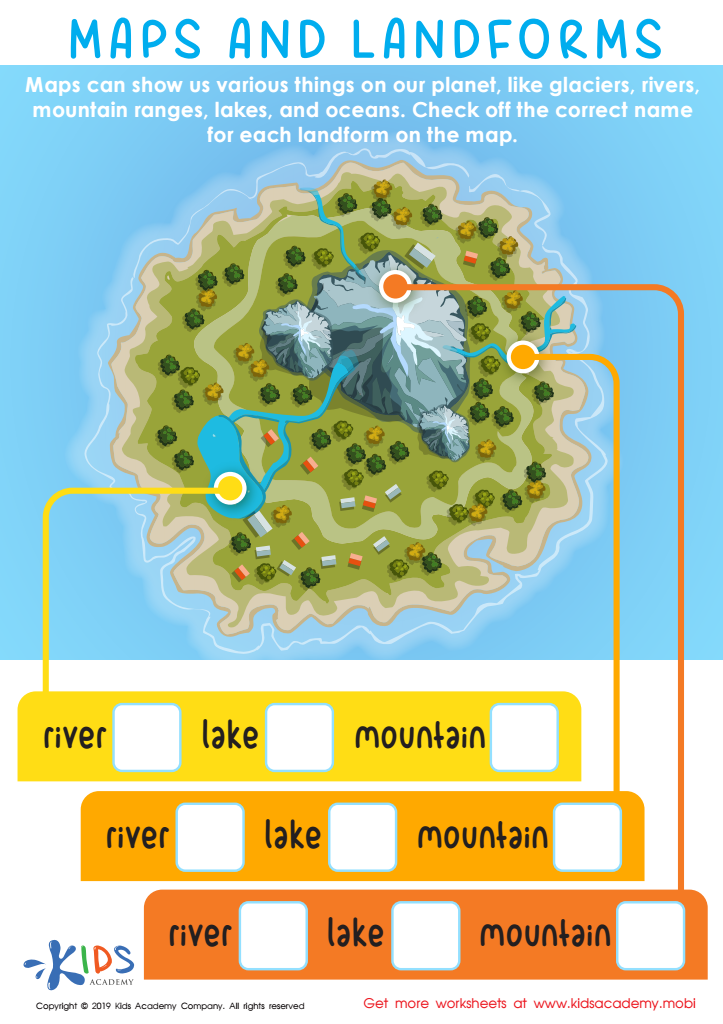
Maps and Landforms Worksheet
 Assign to My Students





Map reading skills are crucial for the cognitive development of 7-year-olds and play an essential role in their holistic education. Firstly, teaching map reading helps children understand spatial relationships and geographical concepts, fostering strong problem-solving abilities. It encourages them to visualize and interpret patterns, which is central to subjects like math and science.
Additionally, map reading enhances a child's ability to follow directions, crucial for everyday navigation and later academic success. This skill can be especially beneficial during family vacations or local explorations, where following maps can turn into a fun and educational activity. It inculcates an appreciation for the environment, promoting curiosity and awareness about different regions and cultures.
Moreover, map reading improves critical thinking and decision-making skills. When children learn to interpret maps, they identify landmarks, measure distances, and assess routes, sharpening their analytical abilities. These competencies are foundational for more advanced studies in STEM fields.
In the classroom, integrating map reading with storytelling and history lessons can make learning more engaging and meaningful. For parents and teachers, the overall aim is to broaden the child's world, laying a foundation of practical skills that can foster independence and confidence in problem-solving. Therefore, developing map-reading skills benefits children's academic growth and equips them with essential life skills for their future.







