
Understanding pollination Normal Math Worksheets for Ages 8-9
3 filtered results
Difficulty Level
Grade
Age
-
From - To
Subject
Activity
Standards
Our "Understanding Pollination Normal Math Worksheets for Ages 8-9" seamlessly blends fundamental math skills with the fascinating world of pollination. Designed to captivate young minds, these worksheets help children grasp essential mathematics concepts while exploring how plants reproduce and thrive. Each printable worksheet engages students with compelling problems and real-life scenarios related to the pollination process, reinforcing learning through cross-curricular connections. Fun illustrations and interactive questions make math practice enjoyable, ensuring that your child not only improves their numeracy skills but also gains a deeper understanding of the natural world around them. Perfect for online learning or classroom use!
Favorites
With answer key
Interactive
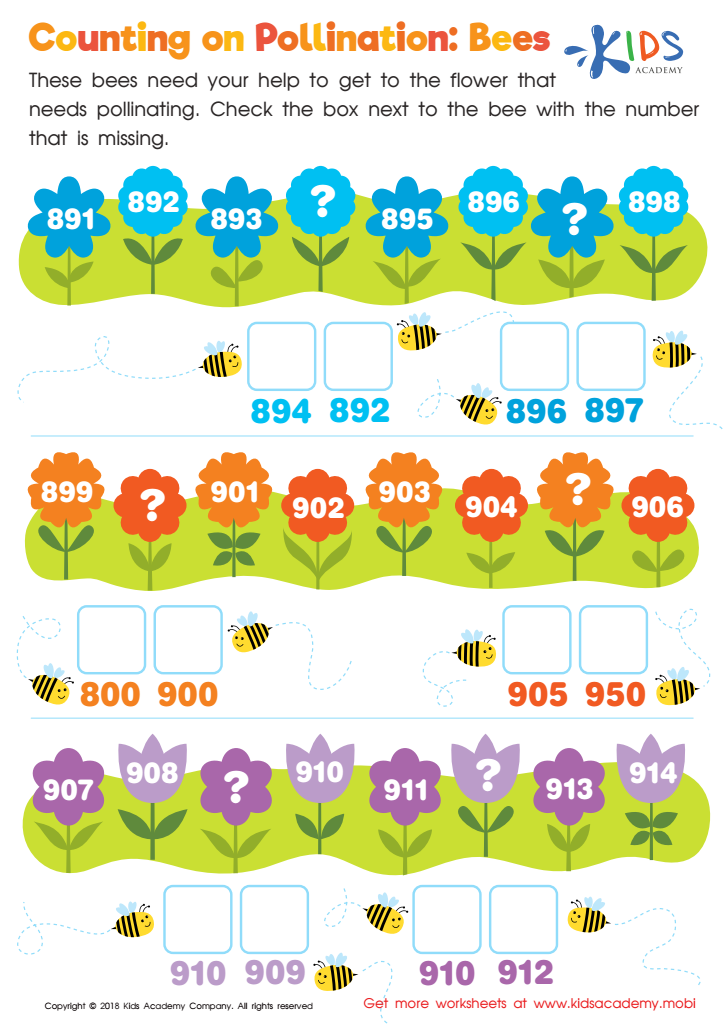
Counting on Pollination: Bees Worksheet
This downloadable worksheet helps kids improve their math skills while having fun - they'll help the bees pollinate the flowers by finding the missing number. It's an entertaining way to practice number patterns, sequences and number line skills, aiding in fast and efficient math computations.
 Assign to My Students
Counting on Pollination: Bees Worksheet
Worksheet
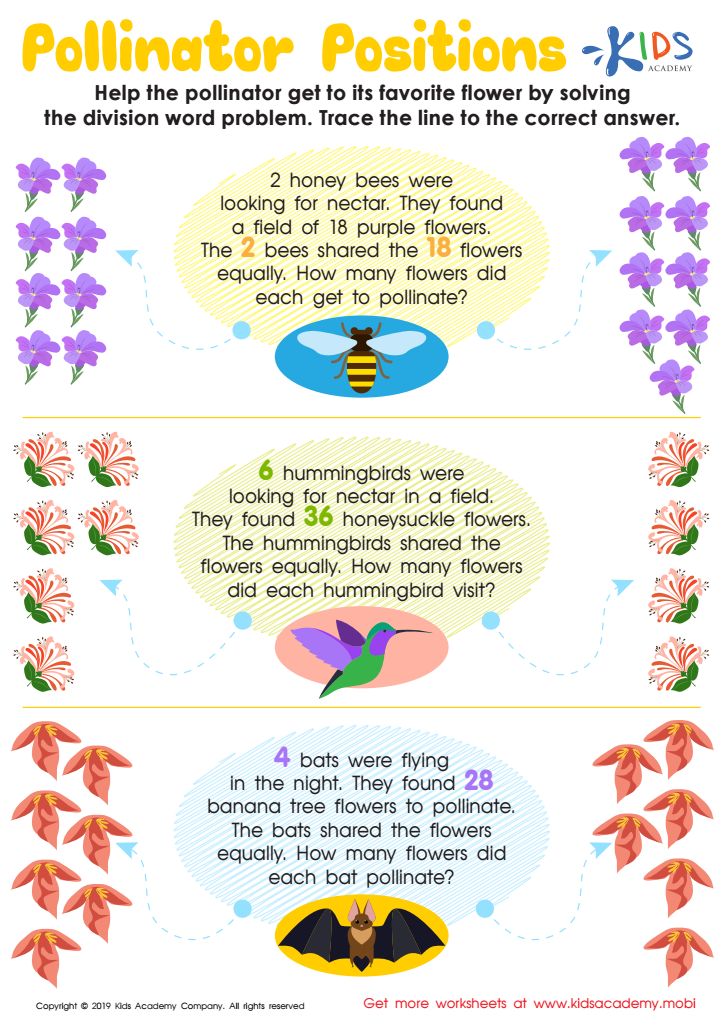
Pollinator Positions Worksheet
Kids will love learning about pollinators and how vital they are. Help their favorite friends get to the right flowers with this fun PDF. Children can solve the problems without even knowing they're doing division; just read the word problems and use the highlighted numbers. Finish by tracing the lines to the correct quotient!
Pollinator Positions Worksheet
Worksheet
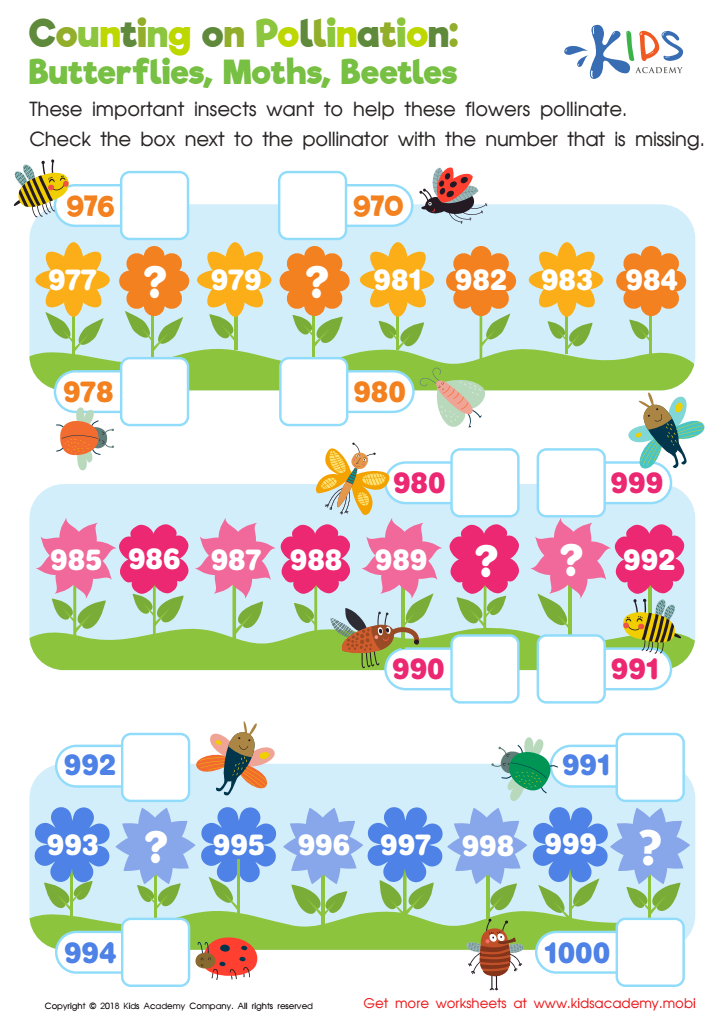
Counting on Pollination: Butterflies, Moths, Beetles Worksheet
A number line can help boost computation accuracy and efficiency. It can also be used with more advanced numbers. Help your child practice by having them identify missing numbers in sequences. This fun worksheet lets them help the pollinators in the process, as they strengthen their number sense.
Counting on Pollination: Butterflies, Moths, Beetles Worksheet
Worksheet
Join Kids Academy for Free
Who is primarily going to use this learning content?







Understanding pollination is crucial for children aged 8-9 because it integrates vital concepts of biology, ecology, and the interdependence of living organisms, fostering environmental awareness from a young age. It illustrates the life cycle of plants, emphasizing the role that bees, butterflies, birds, and other pollinators play in the production of food. This knowledge lays the foundation for understanding how ecosystems function and the importance of biodiversity.
Pollination also provides a tangible context for practical math skills. Students can engage in counting, graphing, and measuring activities, such as tracking the number of flowers pollinated by different insects or calculating distances between plants. This blending of science and math helps students see the relevance of mathematical concepts in real-world situations.
Parents and teachers play a significant role in nurturing curiosity and responsibility toward the natural world. Teaching pollination encourages children to appreciate nature's interconnectedness and their part in protecting it. This awareness can inspire sustainable practices, like supporting habitats for pollinators or planting their own gardens. By understanding pollination, young learners build a strong foundation for future scientific thinking, environmental stewardship, and practical mathematical application.








