
Observation skills Normal Science Worksheets for Ages 8-9
3 filtered results
Difficulty Level
Grade
Age
-
From - To
Subject
Activity
Standards
Unlock the wonders of science with our Observation Skills Normal Science Worksheets for Ages 8-9! Designed to enhance critical thinking, these engaging worksheets teach young learners how to observe, analyze, and interpret their environment. Featuring fun activities that encourage curiosity and exploration, children will learn to recognize patterns, make predictions, and draw conclusions based on their findings. Perfect for both classroom and home learning, our worksheets foster a love for science and promote essential observational skills. Dive into hands-on experiences that excite and inspire, setting a strong foundation for future scientific endeavors. Start nurturing your child's inner scientist today!
Favorites
With answer key
Interactive
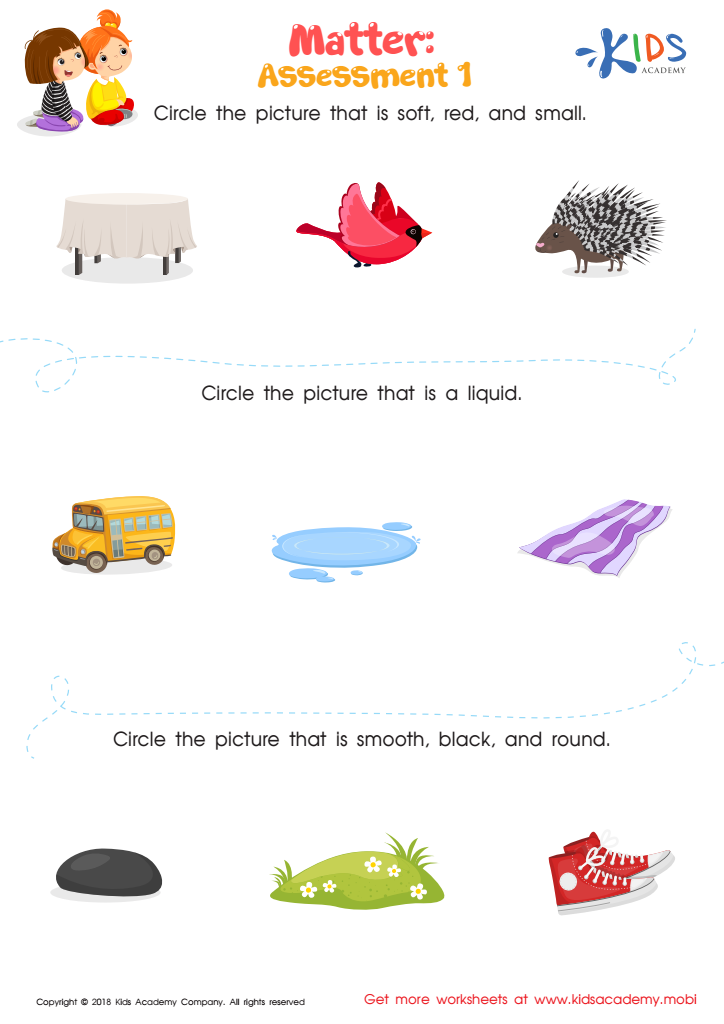
Matter: Assessment 1 Worksheet
Have your children learn that anything that has weight and takes up space is matter. Examples include buses, tables, people, animals, and more. Use this worksheet to help them identify the objects and circle the soft, red, and small one; the liquid; and the smooth, black, and round one.
 Assign to My Students
Matter: Assessment 1 Worksheet
Worksheet
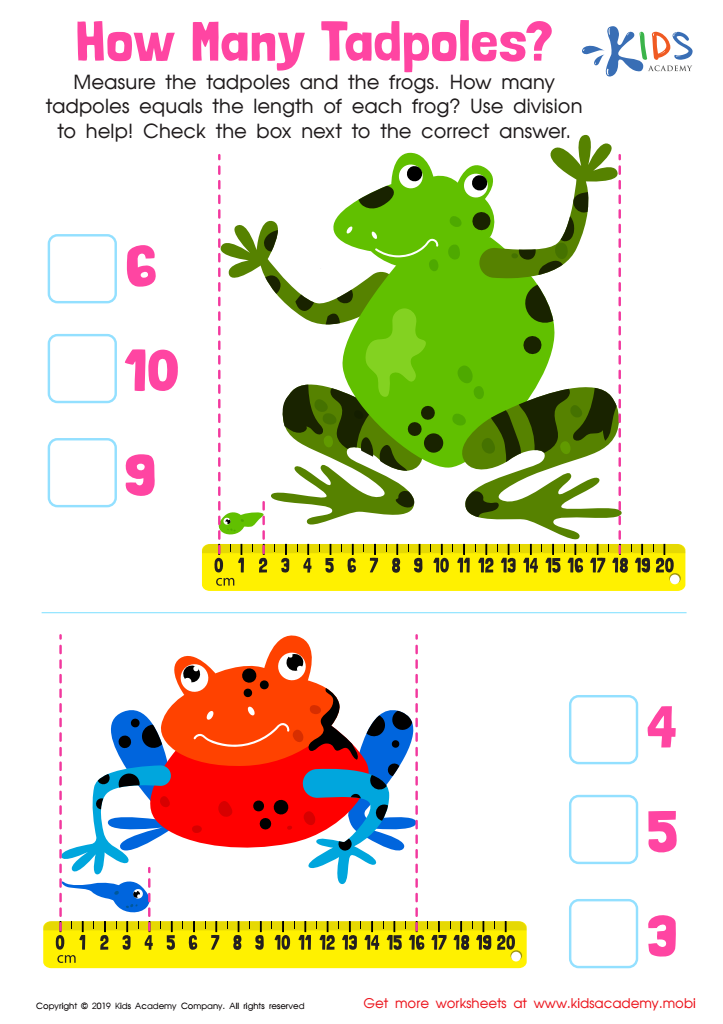
How Many Tadpoles Worksheet
Kids love tadpoles! They'll have fun using them to work out the measurements of their frog friends. By dividing the length of the frogs by the length of the tadpoles, children can deduce how many tadpoles it takes to equal a frog. With the use of 'how many' and 'each' they'll solve math problems without realizing it!
How Many Tadpoles Worksheet
Worksheet
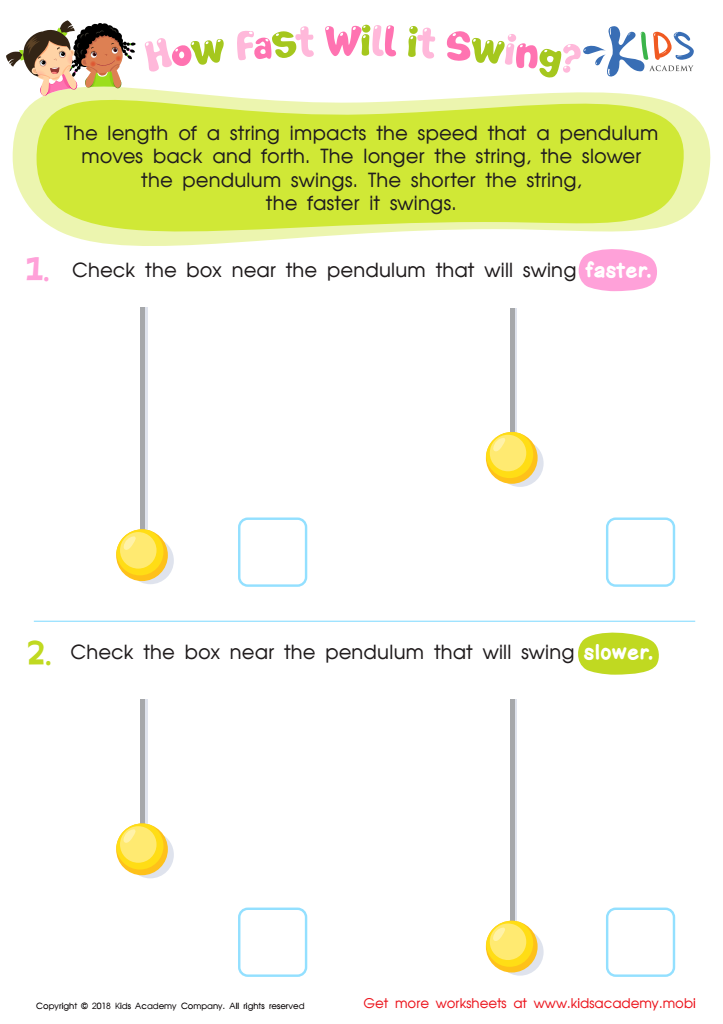
Pendulum Experiment Worksheet For 3rd Grade
Time to flex those science muscles! A pendulum's speed depends on its string length. Complete this 3rd grade pendulum experiment worksheet and experiment with a yo-yo at home! Read the description to answer the questions correctly.
Pendulum Experiment Worksheet For 3rd Grade
Worksheet
Join Kids Academy for Free
Who is primarily going to use this learning content?




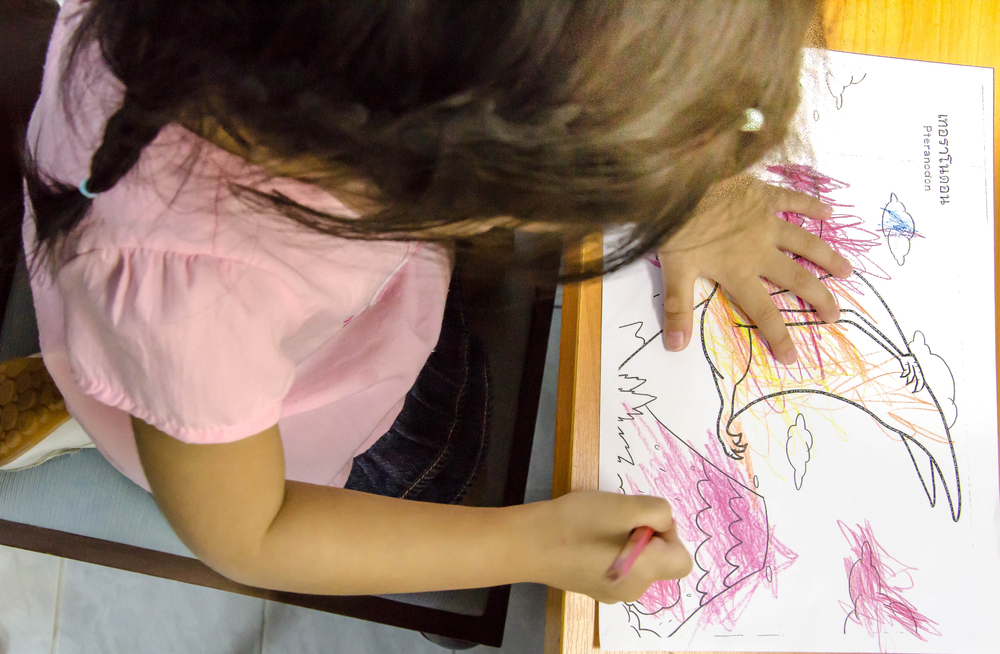


Observation skills in the context of Normal Science for 8-9-year-olds are crucial for fostering a child's cognitive development and scientific inquiry abilities. At this age, children are naturally curious, and honing their observation skills helps them learn to notice details in their environment, ask questions, and seek answers. By engaging in activities that emphasize observation, children develop critical thinking and analytical skills, which are foundational for scientific reasoning.
Parents and teachers should care about these skills as they empower children to explore the world around them. Observation serves as the first step in the scientific method: making detailed observations can lead to hypotheses, experiments, and conclusions. Moreover, improving observation skills encourages children to engage with scientific concepts in meaningful ways, enhancing their understanding of subjects such as biology, chemistry, and physics.
Additionally, observational skills are not limited to formal science; they apply broadly to literacy and social skills, allowing children to interpret emotions, body language, and other non-verbal cues. This holistic approach helps create well-rounded learners equipped to tackle complex problems. Therefore, fostering strong observation abilities in young learners is essential for preparing them for future academic and life challenges.







