Mental math skills Normal Kindergarten Math Worksheets
3 filtered results
-
From - To
Boost your child's confidence in mathematics with our engaging Mental Math Skills Kindergarten Worksheets! Specifically designed for young learners, these worksheets promote quick thinking and problem-solving abilities. Featuring a variety of fun exercises, such as addition, subtraction, and number patterns, they are perfect for one-on-one learning or classroom activities. Children will improve their mental calculation skills while enjoying colorful illustrations and interactive challenges. Our worksheets encourage a smooth transition from basic number concepts to more complex mental math, laying a strong foundation for future success in mathematics. Explore this essential resource and help your kindergartener thrive in math today!
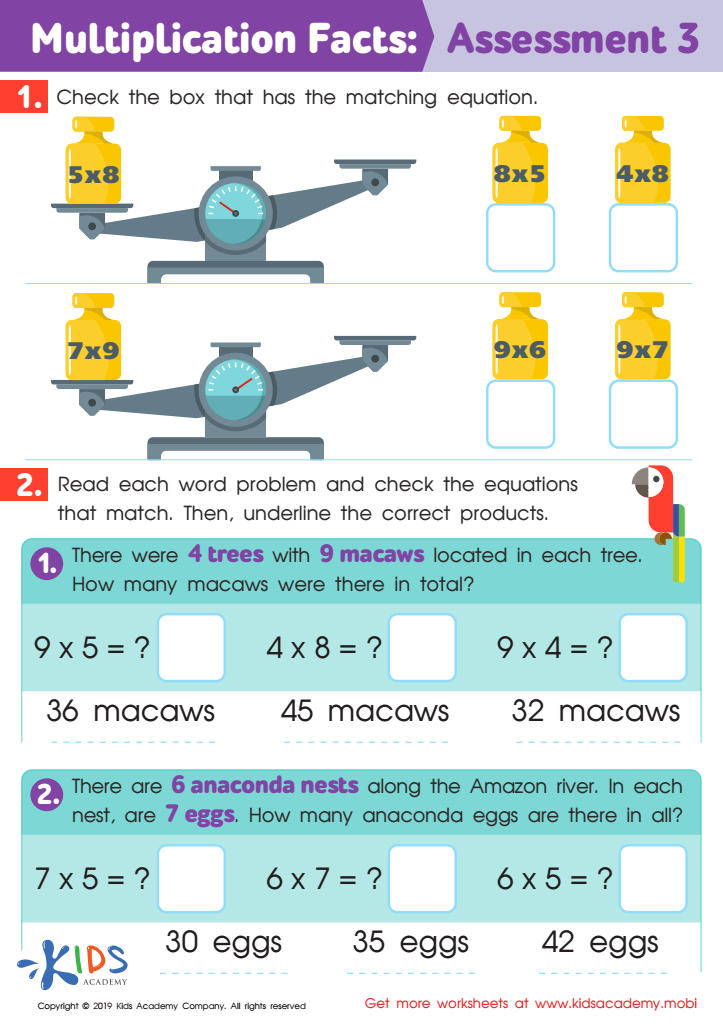
Multiplication Facts: Assessment 3 Worksheet
 Assign to My Students
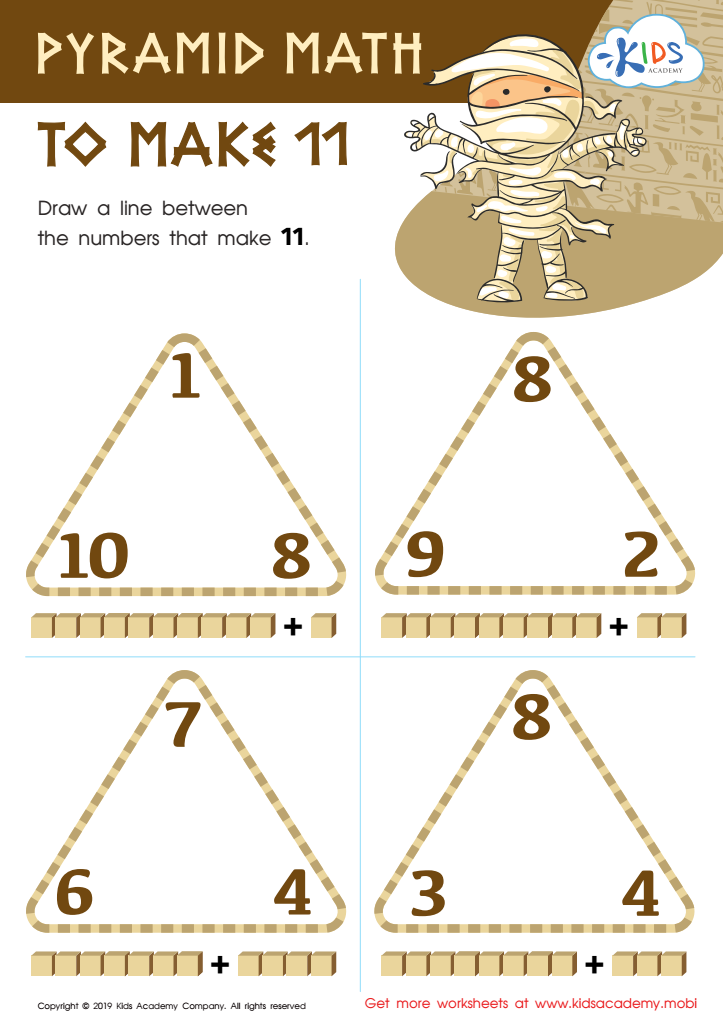
Pyramid Math to Make 11 Worksheet








Mental math skills are crucial for young learners in kindergarten as they lay the foundation for future mathematical understanding and problem-solving abilities. Teachers and parents should prioritize these skills for several compelling reasons.
Firstly, mental math enhances number sense, which is essential for grasping more complex mathematical concepts later on. When children practice mental math, they develop a better understanding of numbers, patterns, and mathematical relationships.
Secondly, mental math fosters independence and confidence in children. When they can solve problems without relying on calculators or paper, they learn to trust their own abilities. This self-sufficiency encourages a growth mindset and a positive attitude toward math, making students more willing to tackle challenges.
Moreover, strengthening mental math skills promotes cognitive development, enhancing memory, attention, and reasoning abilities. Children who are adept at mental calculations often excel in various academic areas beyond mathematics.
Finally, incorporating mental math in a fun, engaging manner encourages cooperation and social interaction in the classroom and at home, creating a supportive learning environment. Thus, prioritizing mental math in kindergarten is not just about numbers; it’s about nurturing confident, independent thinkers equipped for lifelong learning.








