Hand-eye Coordination Normal Grade 2 ABC Letters Worksheets
4 filtered results
Difficulty Level
Grade
Age
-
From - To
Subject
Activity
Standards
Enhance your child's hand-eye coordination with our meticulously designed Grade 2 ABC Letters Worksheets. These engaging and educational printables offer a fun way for children to practice fine motor skills while mastering the alphabet. Each worksheet is crafted to promote steady hand movement and precise placement, essential for improved writing skills. Tailored for second graders, our vibrant and comprehensive sheets encourage young learners to trace, draw, and connect letters, fostering both coordination and confidence. Ideal for both classroom and home use, these exercises support developmental milestones in a playful and effective manner. Explore our collection and watch your child's skills grow!
Favorites
With answer key
Interactive
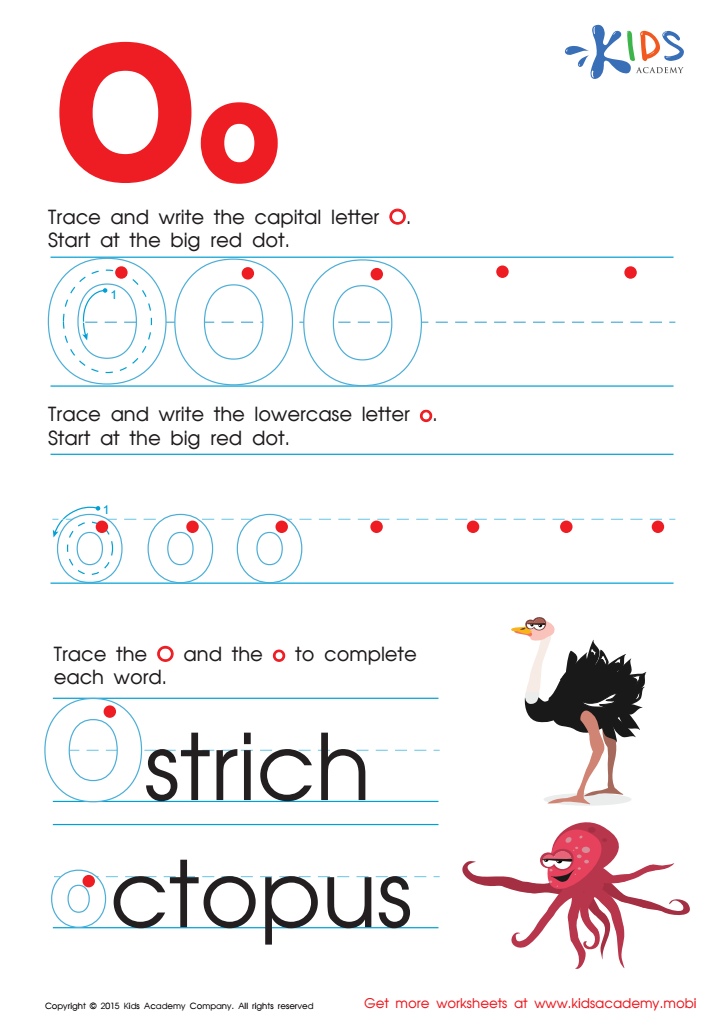
Letter O Tracing Page
Practice writing the letter "O" with our new worksheet. Trace and write the letter several times, starting at the red dot. First do the uppercase letter, then the lowercase. Use the pictures to complete the words "Ostrich" and "octopus". Kids Academy offers more fun alphabet worksheets.
 Assign to My Students
Letter O Tracing Page
Worksheet

Letter P Tracing Page
Trace the lines from the red dot to learn to write "P"! Then practice this letter with the fun activities: complete the word "Pig" and "Pumpkin". Check out Kids Academy to get more free ABC worksheets.
Letter P Tracing Page
Worksheet

Letter H Tracing Page
Trace the letter "H", then practice writing its lowercase form. Finally, choose your favorite form of transport and ride away! Get our worksheets to make learning fun and easy.
Letter H Tracing Page
Worksheet
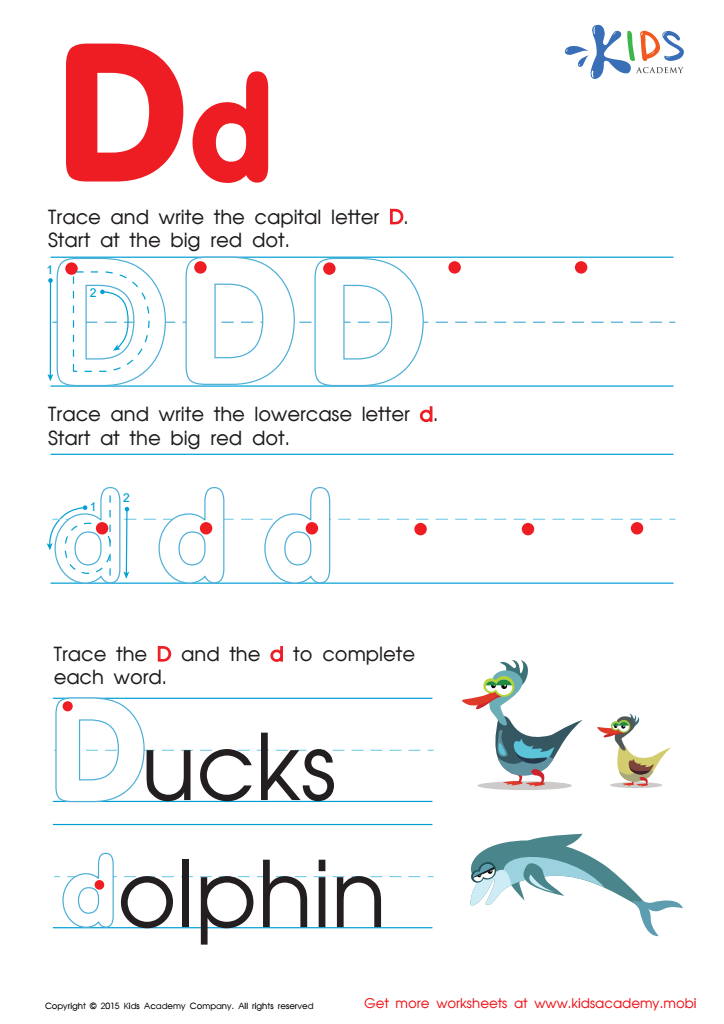
Letter D Tracing Page
Trace and write capital and lowercase letter "D" with our free printable alphabet worksheet! Be careful not to mix up "b" and "d" - just look at the ducks and write their first letter. The dolphin wants to join the fun too - do you like dolphins? Get more fun worksheets and activities at Kids Academy!
Letter D Tracing Page
Worksheet
Join Kids Academy for Free
Who is primarily going to use this learning content?



Hand-eye coordination is a crucial developmental skill for children and plays a fundamental role in various aspects of their growth, particularly in educational settings. For Grade 2 students, who are learning to master ABC letters, strong hand-eye coordination significantly enhances their ability to read and write effectively.
When children develop good hand-eye coordination, they are able to align their visual input with the movements of their hands. This alignment is essential for activities such as tracing letters, cutting shapes with scissors, and turning the pages of a book. In the context of learning the alphabet, children must visually identify each letter and accurately reproduce its shape through writing. Without adequate hand-eye coordination, this task becomes challenging and can delay literacy development.
Moreover, hand-eye coordination is tied to overall cognitive progression. Fine motor skills acquired through activities like drawing and writing contribute to brain development, aiding in better problem-solving and planning abilities. Socially, children with good hand-eye coordination are more likely to participate confidently in classroom activities, fostering a positive learning environment.
Parents and teachers should prioritize activities that strengthen hand-eye coordination, such as puzzles, building blocks, and threading beads. By doing so, they are setting a foundation not just for academic success, but for a broad range of life skills that will benefit children well beyond the classroom.