
Rhyming worksheets activities for Ages 4-5
1 filtered results
Difficulty Level
Grade
Age
-
From - To
Subject
Activity
Standards
Unlock the world of words with our enchanting Rhyming Worksheets Activities! Designed to captivate young minds, these worksheets are an ideal blend of fun and learning, tailored to enhance phonemic awareness and literacy skills. Our collection offers a variety of engaging activities, from matching games to fill-in-the-blanks, all centered around the joy of rhyming. Perfect for preschoolers and early learners, these activities not only bolster language development but also spark creativity and imagination. Dive into our Rhyming Worksheets Activities today and watch as your child discovers the rhythm and magic of words!
Favorites
With answer key
Interactive
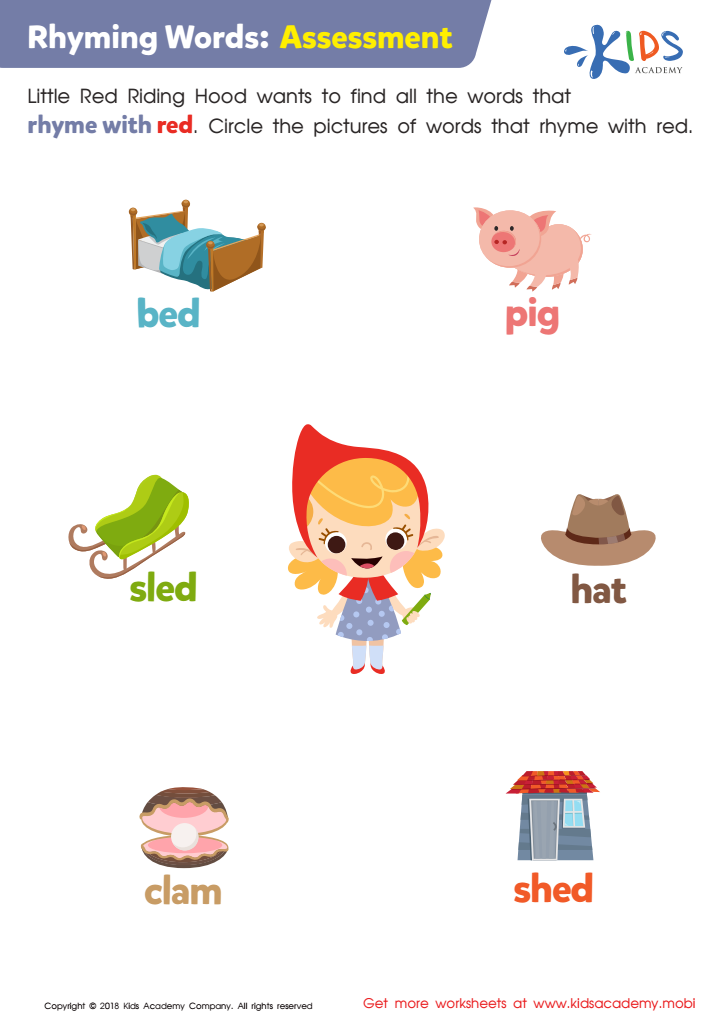
Rhyming Words: Assessment Worksheet
Help Little Red Riding Hood find rhyming words with "red". Download and print this worksheet. Have your child circle the rhyming words and pictures. Get them to say each word out loud and compare it to the word "red". When they're done, review the answers and talk about any words that don't rhyme.
 Assign to My Students
Rhyming Words: Assessment Worksheet
Worksheet
Learning Skills
Join Kids Academy for Free
Who is primarily going to use this learning content?



.jpg)




Rhyming worksheets activities stand as an essential tool in the educational journey of young learners, offering a spectrum of benefits that extend far beyond the borders of language and literacy. These activities are designed not just to entertain but to educate, providing a foundation that supports cognitive development, phonemic awareness, and a love for language that can last a lifetime.
Firstly, rhyming worksheets activities serve as an excellent resource for enhancing phonemic awareness. Phonemic awareness is the ability to hear, identify, and manipulate the individual sounds in words. By engaging in rhyming exercises, children learn to recognize patterns in sounds, which is a critical stepping stone in learning to read and write. These activities make the abstract concept of phonemes more concrete, allowing children to understand that words are made up of smaller sound units.
Moreover, rhyming worksheets activities foster language skills in a fun and engaging manner. Through the playful aspect of rhyming, children expand their vocabulary and learn about word structures, all while being immersed in an enjoyable learning experience. This playful learning ensures that children remain engaged and interested, laying down a positive foundation for lifelong learning.
Additionally, these activities promote cognitive development. As children attempt to find rhyming pairs or complete rhyming sentences, they engage in critical thinking and problem-solving. They learn to make connections between different words and sounds, enhancing their memory and recall abilities. This type of cognitive exercise is vital for young learners as it paves the way for more complex problem-solving skills in the future.
Lastly, rhyming worksheets activities are adaptable and can cater to a wide range of learning styles and levels. Whether a child is a visual, auditory, or kinesthetic learner, rhyming activities can be tailored to meet their individual needs, ensuring that every child has the opportunity to succeed and flourish.
In conclusion, the benefits of rhyming worksheets activities are manifold. They not only lay the groundwork for literacy and phonemic awareness but also support cognitive development and make learning an enjoyable experience. As such, incorporating rhyming exercises into early education is invaluable in fostering a well-rounded and engaging learning environment.








